
Most performance marketers treat creative learning as a simple swap: a new image here, a different headline there, maybe a fresh color palette when CPAs start rising. That instinct is understandable, but it's costing you. The teams consistently winning on Meta and TikTok aren't just refreshing visuals on a hunch. They're running disciplined, evidence-based pipelines that treat every asset as a data point in a broader system. This guide breaks down exactly how to build that system, from structuring hypotheses to scaling winners before fatigue eats your budget.
Table of Contents
- What is creative learning and why does it matter for ad performance?
- Building a creative learning pipeline: From hypothesis to scale
- Creative fatigue and refresh cadence: Platform-specific lessons
- Creative is the new targeting: Structural diversity and AI-driven delivery
- AI and creative learning: Training the next generation of marketing teams
- Expert nuances and pitfalls most marketers miss
- Next steps: Enhance your creative learning with Creaboost
- Frequently asked questions
Key Takeaways
| Point | Details |
|---|---|
| Continuous creative learning | Treat creative learning as an ongoing pipeline, not a series of one-off swaps. |
| Platform-specific refresh | TikTok requires frequent creative refreshes; Meta allows more stability but still benefits from regular updates. |
| Structural creative diversity | Focus on creating structurally different concepts instead of numerous micro-variants to maximize algorithmic reach. |
| Minimum testing standards | Follow minimum duration and data requirements for split tests to ensure reliable results and learning. |
| AI-powered creative training | Modern creative learning programs leverage AI workflows and apprenticeships to build marketing skills. |
What is creative learning and why does it matter for ad performance?
Creative learning is not the same as creative testing. Testing is a single experiment. Learning is the ongoing, structured process of drawing insight from those experiments and feeding that insight back into your next cycle of creative production. The distinction matters because one-off tests produce isolated data points. A real learning pipeline produces compounding knowledge, which means each new brief starts smarter than the last.
For e-commerce brands running paid social at any meaningful scale, this difference shows up directly in business outcomes. Higher ROAS, better customer engagement, and sustainable ad performance are not accidents. They are the output of teams that have built creative learning into their operating rhythm, not just their creative calendar.
The ad creative best practices that separate top performers from average ones tend to share one characteristic: they are grounded in accumulated learning, not gut feel.
Here is what a continuous creative learning pipeline delivers that one-off testing cannot:
- Faster scaling of winners. When you know why something works, you can replicate the underlying structure across new products, new offers, and new formats.
- Reduced wasted spend. You stop running concepts that your own historical data would have flagged as unlikely to convert.
- Platform-aligned performance. Meta and TikTok both reward advertisers who feed their algorithms high-quality signals. Disciplined creative learning is how you generate those signals.
- Predictive clarity. Instead of being surprised by rising CPAs, you see the pattern coming and have new assets ready to deploy.
As TikTok's own guidance notes, creative testing and learning should be operationalized as a continuous pipeline, not a series of one-off experiments, with disciplined success criteria and systematic scaling of winners. The platforms themselves are telling you the answer. Most teams just haven't built the infrastructure to act on it.
"The gap between brands that scale efficiently on paid social and those that plateau is almost always a creative learning gap, not a budget gap or a targeting gap."
Building a creative learning pipeline: From hypothesis to scale
A real pipeline has a clear structure. It starts with a hypothesis, moves through controlled testing, and ends with a documented scaling decision. Here is how to operationalize that process:
- Define your creative levers. The most influential ones are format (video vs. static, long vs. short), hook (the first two to three seconds or opening line), and offer framing (discount, benefit, urgency, social proof). Structure every test around one of these.
- Isolate variables. Test one change at a time. If you change the hook and the visual in the same test, you will not know which drove the result. A creative testing framework for e-commerce built around isolating variables gives you actionable data. Isolating variables and changing only one element is the single most common discipline that separates teams with clean learnings from teams with confusing data.
- Set success criteria before you launch. Decide in advance what ROAS, CPA, or CTR threshold constitutes a winner. Teams that define success after the fact tend to rationalize mediocre results.
- Run tests long enough to be meaningful. Budget dilution and statistical noise are real problems on both platforms.
- Document and scale. When a winner emerges, log the insight (not just the asset) and build your next round of creative from that learning.
Pro Tip: TikTok split testing best practices recommend running tests for at least 7 days and targeting 80% statistical power before drawing conclusions. Cutting tests short is one of the most common ways teams end up with false confidence in their creative choices.
When you are scaling ads on Meta and TikTok, the operational challenge shifts from "what do we test" to "how fast can we act on what we learn." That is where tooling and process discipline compound.
| Creative lever | Test type | Success metric | Minimum duration |
|---|---|---|---|
| Hook (video) | A/B split | Through-play rate | 7 days |
| Format (static vs. video) | A/B split | CPA | 7 days |
| Offer framing | A/B split | ROAS | 10 days |
| Visual concept | Multi-cell | CTR + ROAS | 14 days |
TikTok Smart Creative tips are also worth incorporating when you are building your TikTok-specific testing cadence, since the platform's native optimization tools interact directly with your creative learning loop.
Creative fatigue and refresh cadence: Platform-specific lessons
Creative fatigue is the quiet budget leak that most teams notice too late. By the time your CPA graph shows a visible spike, your assets have often been decaying for a week or more. The key is building refresh cadence into your system before fatigue forces your hand.
TikTok and Meta have meaningfully different decay rates. TikTok creative fatigue tends to set in faster than on Meta, which means your TikTok refresh cadence needs to be more aggressive. TikTok's feed is built on novelty. Audiences signal boredom quickly, and the algorithm picks up on that engagement decline and pulls back delivery before your dashboard metrics catch up.
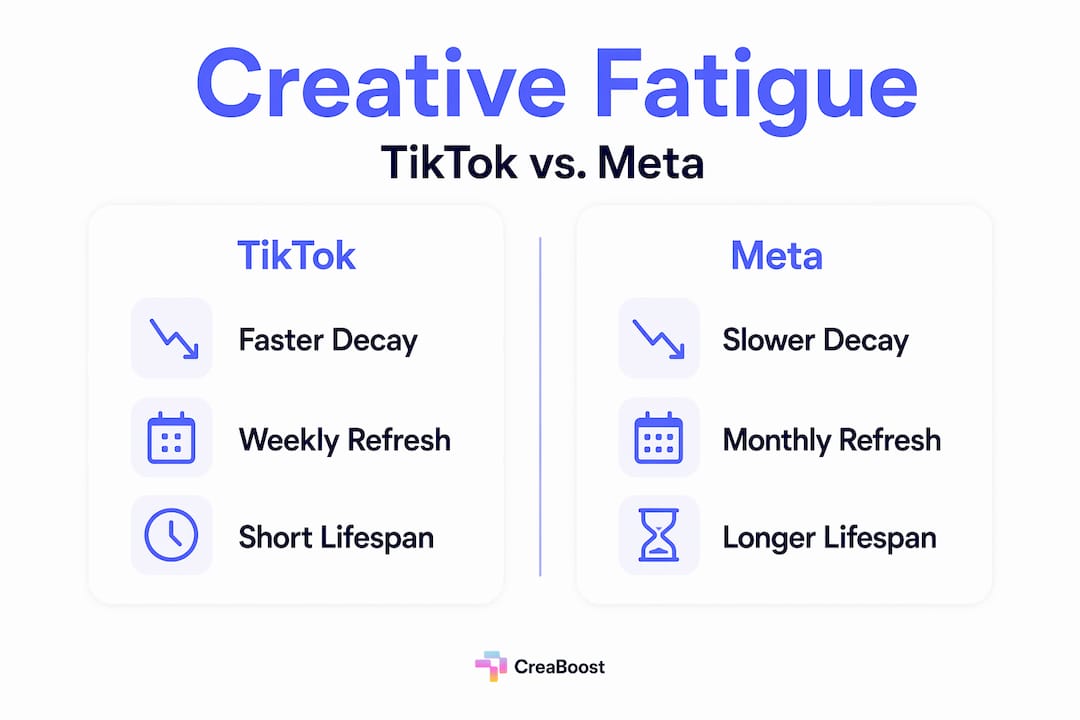
Meta allows for a longer creative shelf life, but algorithmic decay still applies. A static ad that performs well in week one will not necessarily maintain that performance through week six, even without a significant change in your targeting or bid strategy.
| Platform | Typical fatigue window | Recommended refresh frequency | Warning signal |
|---|---|---|---|
| TikTok | 5 to 10 days for top ads | Weekly | Drop in through-play rate |
| Meta (video) | 2 to 4 weeks | Every 2 to 3 weeks | Rising frequency with falling CTR |
| Meta (static) | 3 to 6 weeks | Monthly | CPA creep above target |
Practical actions that reduce fatigue risk:
- Monitor creative performance at the individual asset level daily, not weekly.
- Set automated rules that flag assets when frequency crosses thresholds tied to your target CPA.
- Use qualitative signals (comment sentiment, share rate) as early indicators before the numbers move.
- Build your creative best practices for ROAS around a refresh calendar, not just a production calendar.
Pro Tip: Keep three to five fresh creatives per ad group ready to deploy at any point. When fatigue signals appear, you want to swap immediately. Waiting for production to catch up is how you lose two weeks of efficient spend.
The high-converting ad CTAs you rotate in during a refresh also matter. A new visual with a tired CTA will not recover performance the way a genuinely fresh concept will.
Creative is the new targeting: Structural diversity and AI-driven delivery
If you have been solving creative fatigue by generating dozens of micro-variants, you may be doing more work for less return than you realize. Changing a button color, swapping a background shade, or adjusting a headline by one word does not produce a meaningfully different creative in the eyes of the delivery algorithm.
Modern ad delivery systems are increasingly sophisticated at detecting conceptual similarity. According to Triple Whale's analysis of AI-driven delivery, the "creative is the new targeting" framing is now tied to algorithmic concept clustering. Micro-variants of the same underlying idea may not be treated as truly distinct by delivery systems, which means they compete against each other for the same audiences and reduce your total learning surface.
The practical implication: five structurally different ads can outperform thirty micro-variants because the algorithm treats them as five distinct learning inputs rather than one large redundant cluster.
What counts as a structural difference versus a cosmetic tweak:
- Structural: Different hook format (UGC vs. product demo vs. talking head), different narrative structure (problem/solution vs. testimonial vs. listicle), different offer framing (percentage off vs. free shipping vs. bundle value)
- Cosmetic: Different background color, font variation, small headline rewording, logo placement change
"Advertisers who feed AI delivery systems with genuine creative diversity get broader audience signals, better learning, and more efficient spend allocation. Those who feed micro-variants get algorithmic sameness at scale."
For teams focused on building ad creatives in 2026, this reframe changes how you brief designers and set production priorities. Fewer concepts, but more genuinely distinct from each other, produces better results than a high volume of near-identical assets.
AI and creative learning: Training the next generation of marketing teams
Creative learning is not just an operational discipline anymore. It is becoming a core capability that marketing teams need to develop deliberately, especially as AI tools reshape the production and analysis side of the workflow.
Industry programs are already responding to this shift. Adobe Digital Academy's partnership with the Effie LIONS Foundation is a direct example: the program is moving toward AI-assisted workflows and content creation to prepare marketers for real-world ambiguity and end-to-end campaign management. The goal is not to replace creative judgment with AI. It is to build marketers who can work fluently alongside AI tools to move faster and learn better.
For your team, this translates into a specific set of skills to develop:
- Data fluency. Reading creative performance data at the cohort level, not just the individual asset level, so you can identify patterns across campaigns.
- Rapid content iteration. Using AI-assisted production tools to compress the time between insight and deployment.
- Adaptability. Designing learning systems that can absorb new platform mechanics quickly, because both Meta and TikTok change their delivery logic regularly.
- Qualitative analysis. Interpreting creative signals (hook performance, comment sentiment, view duration curves) alongside quantitative KPIs.
Teams that invest in these skills, and in the tools that support them, are the ones closing the creative agencies and AI capability gap faster than their competitors. The operational advantage compounds quickly when your team can run more experiments, learn faster from each one, and deploy winning concepts before fatigue sets in.
Expert nuances and pitfalls most marketers miss
Here is the perspective that most creative learning guides skip: CTR is not your creative performance signal. It is a proxy. And on Meta and TikTok especially, it is often a misleading one.
A creative with a strong hook will generate clicks. But if the landing page does not match the energy or promise of the ad, conversions collapse. The CTR looks fine on the dashboard. The ROAS does not. Teams that optimize only for surface engagement metrics end up chasing the wrong signals, scaling assets that click well but convert poorly, and missing the actual performance levers.
TikTok creative strategy for Shopify highlights this directly: Meta and TikTok creative performance is often better diagnosed by signals like hook strength, through-play rate, native content feel, and offer clarity rather than CTR alone, because mismatched landing and funnel performance can decouple engagement from conversions entirely.
Practical lessons from running hundreds of campaigns:
- Diagnose with creative signals first. Before you kill an asset based on CPA, check whether the hook is working (through-play rate) and whether the offer is clear (watch for high click, low add-to-cart patterns).
- Native feel is a real performance variable. An ad that looks like an ad gets skipped. An ad that feels like organic content stops the scroll and earns attention. This is not a design note. It is a conversion rate driver.
- Offer clarity beats creativity. A brilliant concept with a confusing offer will always lose to a simple concept with an obvious value proposition.
- Funnel fit matters as much as creative quality. The best ad in your account pointed at the wrong landing page will underperform every time.
The creative best practices for ROAS that actually move the needle are almost always grounded in funnel-aware thinking, not just asset-level optimization. Treat your creative not as a standalone asset but as the first step in a conversion sequence, and your diagnostic process becomes much sharper.
Next steps: Enhance your creative learning with Creaboost
The frameworks in this guide are proven. The harder part is executing them consistently without the operational drag eating your team alive.
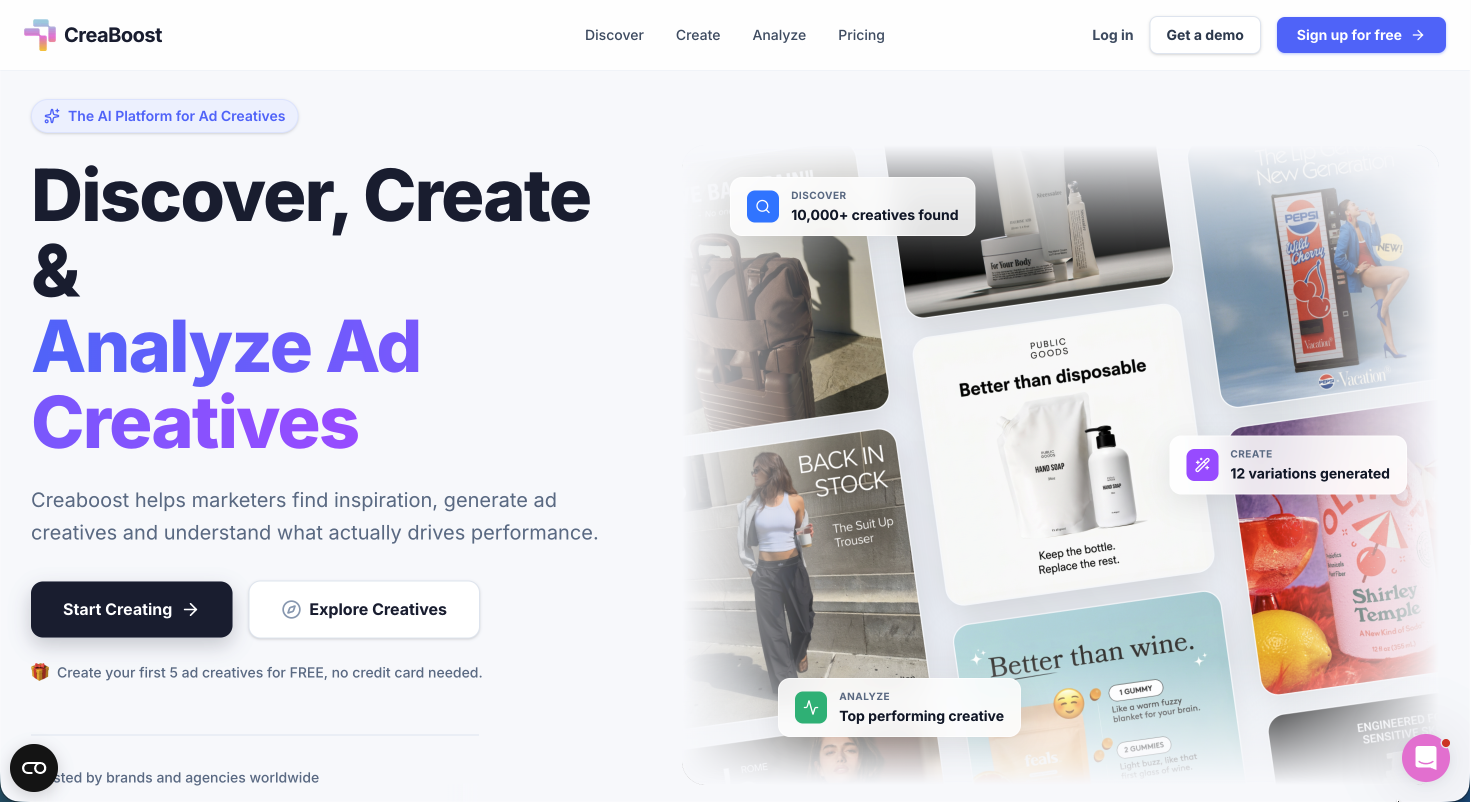
Creaboost is built for exactly this. Our platform covers the full creative loop: discover what concepts are driving performance in your vertical, generate AI creative generation at scale without designer bottlenecks, and connect to creative performance analytics that auto-tags every asset by hook, format, angle, and concept. You get the tagging discipline most teams abandon within a quarter, the fatigue signals most teams catch a week too late, and the operational layer that keeps your accounts coherent as you scale. If your team is ready to stop guessing and start systematically learning from every dollar you spend, Creaboost is where that system lives.
Frequently asked questions
How often should I refresh ad creatives on TikTok vs. Meta?
TikTok creatives should be refreshed more frequently, often weekly, due to faster audience fatigue, while Meta creatives typically last two to four weeks before showing meaningful decay signals.
What's the minimum test duration for creative split tests on TikTok?
TikTok recommends running split tests for at least 7 days to collect enough data for statistically meaningful learnings, with 80% statistical power as the target threshold.
Should I focus on creative variants or build structurally different concepts?
Structurally distinct concepts outperform high volumes of micro-variants because AI delivery systems cluster similar ads together, reducing their combined learning surface and reach diversity.
Are creative learning programs using AI becoming an industry standard?
Yes. Programs like Adobe Digital Academy now train marketers using AI-powered workflows and content creation tools to build real-world campaign capabilities.
What are the most important signals for creative ad performance?
Hook effectiveness, offer clarity, and native content feel are stronger performance predictors than CTR alone, especially when engagement and conversions are showing a disconnect.