

Ad fatigue is real, and it hits harder than most marketers want to admit. You launch a campaign, performance spikes, and then two weeks later your CTR tanks and your cost per acquisition climbs. It's not bad luck. It's a structural problem with how most teams approach creative production. The platforms have changed. Meta Andromeda, Google Performance Max, and TikTok Smart Creative all reward volume, diversity, and speed of iteration. If your creative pipeline can't keep up, your results won't either. This guide gives you a repeatable, research-backed system for producing, testing, and scaling ad creatives that actually hold their performance over time.
Table of Contents
- Understanding high-performing ad principles
- Prepping for success: Research, audience, and platform strategies
- Crafting creatives: Production steps for stand-out ads
- Testing and optimizing your ad creatives
- Why most marketers fail to sustain ad creative performance
- Take your ad creative workflow further with CreaBoost
- Frequently asked questions
Key Takeaways
| Point | Details |
|---|---|
| Benchmark to win | High-performing ads use platform benchmarks for CTR, CR, and CPM as their north star for optimization. |
| Native is essential | Ads styled like organic content blend in and outperform on platforms like TikTok. |
| Continuous iteration | Ongoing testing and data-driven tweaks are critical for keeping ad performance high over time. |
| Advanced preparation | Deep research and audience understanding are key to crafting creatives that actually convert. |
Understanding high-performing ad principles
Before you can build a system for great creatives, you need to agree on what "great" actually means. In 2026, high-performing ad creatives are defined by three core metrics: click-through rate (CTR), conversion rate (CR), and cost per thousand impressions (CPM). Each of these tells a different part of the story, and no single number gives you the full picture.
CTR tells you whether your creative is stopping the scroll. A low CTR almost always points to a weak hook, a mismatched audience, or a format that doesn't fit the platform. CR tells you whether the creative is doing its job beyond the click. You can have a beautiful ad with a 3% CTR that converts at 0.2% because the landing page experience doesn't match the promise. CPM tells you how competitive your placement is and how much you're paying to reach your audience.
Platform benchmarks matter here because what counts as "good" varies significantly. Consider this comparison across the major paid platforms:
| Platform | Average CTR | Average CR | Average CPM |
|---|---|---|---|
| TikTok | 0.84% to 1.5% | 0.46% to 2.5% | From $3.50 |
| Meta (Facebook) | 0.9% to 1.5% | 1% to 3% | $7 to $14 |
| Google Display | 0.35% to 0.5% | 0.5% to 1.5% | $2 to $10 |
| 0.4% to 0.6% | 0.5% to 1% | $25 to $50 |
TikTok stands out because its CPM is the lowest among major platforms, meaning you can reach more people for less money. But the catch is that TikTok's algorithm is brutally efficient at filtering out ads that don't feel native to the feed.
Here's what separates high-performing creatives on social platforms from average ones:
- Hook within the first 2 seconds. Attention is gone before your brand even registers.
- Platform-native format. Vertical video on TikTok, square or 4:5 on Meta feed, horizontal for YouTube.
- Clear, single-minded message. One problem, one solution, one call to action.
- Visual authenticity. Polished studio ads underperform against raw, real-feeling content on social.
- Consistent brand identity. Even native-style content needs recognizable colors, fonts, and CTA styles.
"The brands winning on TikTok in 2026 aren't the ones with the biggest production budgets. They're the ones who understand that the feed is a conversation, not a billboard."
Using creative analytics tools to track these metrics across your live campaigns gives you the feedback loop you need to stop guessing and start iterating with purpose. Without that data layer, you're flying blind.

Prepping for success: Research, audience, and platform strategies
Most creative failures happen before a single pixel is designed. The prep work, specifically your research, audience segmentation, and platform mapping, determines whether your production effort pays off or gets wasted.
Start with a creative audit of your existing assets. Pull your last 90 days of ad performance and look for patterns. Which formats consistently beat your CTR baseline? Which audience segments respond to emotional hooks versus rational ones? Which platforms are delivering the lowest CPM with acceptable conversion rates? This audit isn't just about finding winners. It's about identifying the structural reasons why certain creatives work and others don't.
Here's a structured research process you can run before any new campaign:
- Pull competitor intelligence. Identify your top three competitors and catalog every ad they're running across Meta, TikTok, and Google. Note format, hook style, offer type, and visual approach.
- Segment your audience by platform behavior. A 28-year-old woman who follows fitness accounts on TikTok behaves very differently from the same person scrolling Facebook on a Sunday morning. Build distinct personas for each platform.
- Map your creative concepts to platform expectations. TikTok demands content that mimics native user content, meaning raw footage, trending audio, and direct-to-camera delivery. Meta rewards a wider variety of formats but still penalizes anything that screams "advertisement."
- Identify your highest-potential products for Dynamic Product Ads (DPA). Not every product in your catalog deserves equal creative investment. Use performance data to prioritize.
- Define your creative brief template. Every asset should have a documented purpose, target audience, platform, format, and success metric before production starts.
| Research element | TikTok focus | Meta focus |
|---|---|---|
| Content style | UGC, raw, trending audio | Mix of UGC and polished |
| Hook type | Visual action, text overlay | Emotional or curiosity-driven |
| Format | 9:16 vertical video | 1:1, 4:5, Stories |
| Audience signal | Interest and behavior clusters | Lookalike and custom audiences |
Pro Tip: Use AI creative discovery to pull inspiration from brands already winning in your category. Seeing what's actually running at scale across platforms saves weeks of manual research and gives you a real-world benchmark for what your creative needs to compete against.
The goal of this prep phase is to enter production with zero ambiguity. Every creative decision should be backed by data from your ad creative analytics, competitor research, and platform-specific audience behavior. When your team knows exactly who they're talking to, what platform they're on, and what success looks like, production gets faster and results get better.
Crafting creatives: Production steps for stand-out ads
With your research complete and your strategy locked, production is where everything comes together. But production without a clear framework is where most teams lose time and money. Here's a step-by-step process for building creatives that are built to perform from day one.
-
Concept development. Start with your single most important insight from the research phase. What is the one thing your target audience cares about most? Build your concept around solving that specific problem or fulfilling that specific desire. Avoid the temptation to communicate multiple messages in one ad.
-
Copywriting and scripting. Write your hook first. For video, this is your first 2 to 3 seconds of dialogue or on-screen text. For static, it's your headline. Test multiple hook variations before committing to production. For TikTok specifically, your script should sound like something a real person would say, not a brand announcement.
-
Storyboarding and asset planning. Map every scene or visual element before you shoot or design. This is where you decide on format ratios (1:1, 4:5, 9:16, 16:9), visual style, color usage, and CTA placement. Planning for multiple ratios upfront saves significant time in post-production.
-
Production and editing. Keep TikTok content fast-paced with cuts every 2 to 4 seconds. Use captions, because native-style ads on TikTok consistently drive the highest performance metrics, and most TikTok users watch with sound off. For Meta static ads, lead with the visual before the copy.
-
Platform adaptation and batch resizing. A single creative concept should produce at least four to six variations across formats and platforms. This is non-negotiable for feeding modern algorithms that reward creative diversity.
Here's a quick checklist for platform-native asset readiness before you push anything live:
- 9:16 vertical video for TikTok and Instagram Reels (minimum 15 seconds, maximum 60 seconds for most placements)
- 4:5 ratio for Meta feed ads (outperforms 1:1 in most feed placements due to screen real estate)
- 1:1 square for flexible placements across Meta and Google Display
- 16:9 horizontal for YouTube pre-roll and Google Performance Max
- Captions burned into video for all social placements
- Brand colors, fonts, and CTA style consistent across all variations
Pro Tip: When generating ad creatives from a product URL, you can produce dozens of platform-ready variations in minutes rather than days. This kind of batch production capability is what allows you to feed Meta Andromeda and TikTok Smart Creative with the volume of diverse assets these algorithms need to find your best audience.
Advanced creative teams also build iteration into the production process from the start. Rather than producing one "final" version of a creative, they produce a core asset plus three to five variations that test different hooks, different CTAs, or different visual treatments. This approach means you enter the testing phase with real options rather than scrambling to create new assets after performance drops.
Testing and optimizing your ad creatives
Even the best creative will plateau. The question is whether you see it coming and have a plan, or whether you react after your ROAS has already fallen off a cliff.
A structured testing protocol starts with knowing what to test and in what order. Here's the priority sequence:
- Hook variations first. The first 2 to 3 seconds of a video or the headline of a static ad has the highest leverage on CTR. Test this before anything else.
- Offer and CTA second. Once you have a hook that stops the scroll, test whether "Shop now," "Get 20% off," or "See how it works" drives better conversion.
- Visual style third. UGC versus polished, lifestyle versus product close-up, human face versus no face. These tests inform your broader creative strategy.
- Format and ratio last. After you've found a winning concept, test whether it performs better in 4:5 versus 1:1 on Meta or 15 seconds versus 30 seconds on TikTok.
Run each test with enough budget to reach statistical significance before drawing conclusions. A common mistake is pausing tests after 48 hours because one variant looks like it's winning. Give your tests at least 7 days and a minimum of 1,000 impressions per variant before making decisions.
Monitoring performance benchmarks like CTR, CR, and CPM gives you the signals you need to catch creative fatigue before it becomes a crisis. Specifically, watch for:
- CTR dropping more than 20% from its peak over a 7-day rolling window
- CPM increasing while CTR holds steady (audience saturation)
- Frequency rising above 3 on Meta (your audience has seen this ad too many times)
- Conversion rate declining even as click volume holds (creative-to-landing-page mismatch)
"Creative fatigue doesn't announce itself. It shows up quietly in your data, and by the time most marketers notice it, they've already wasted two weeks of budget."
Pro Tip: Set up automated alerts in your ad manager for CTR drops and CPM spikes. Pairing those alerts with analyzing creative performance at the asset level means you can retire underperformers and promote new variations without losing momentum.
Scaling winners is as important as retiring losers. When a creative consistently beats your CTR and CR benchmarks over 14 days, increase its budget incrementally (20 to 30% every 48 to 72 hours) rather than dramatically. Sudden large budget increases can reset the learning phase on Meta and TikTok, hurting the performance you're trying to scale.
Why most marketers fail to sustain ad creative performance
Here's the uncomfortable truth most marketing content won't tell you. The reason most marketers can't sustain ad creative performance isn't a lack of talent or budget. It's a workflow problem disguised as a creative problem.
Teams produce a batch of creatives, launch them, watch the results, and then scramble to build new assets when performance drops. This reactive cycle means you're always behind. By the time you've identified a fatigue signal, briefed your designer, and gotten new assets into the ad manager, you've lost 10 to 14 days of performance.
The brands that consistently win are running an always-on creative pipeline. They're producing new assets every week, not every quarter. They're using sustaining creative performance data to inform the next round of production before the current round has even peaked. They treat creative production like a content calendar, not a project.
The mindset shift required is significant. Creative isn't a deliverable. It's a process. And that process needs to be fed by real-time data, competitor intelligence, and a production system that can move at platform speed. Teams that make this shift stop chasing performance and start building it systematically.
Take your ad creative workflow further with CreaBoost
If the framework in this guide resonates with you, the next challenge is execution at scale. Manually pulling competitor ads, briefing designers, resizing assets, and monitoring performance across six platforms is a full-time job for multiple people.
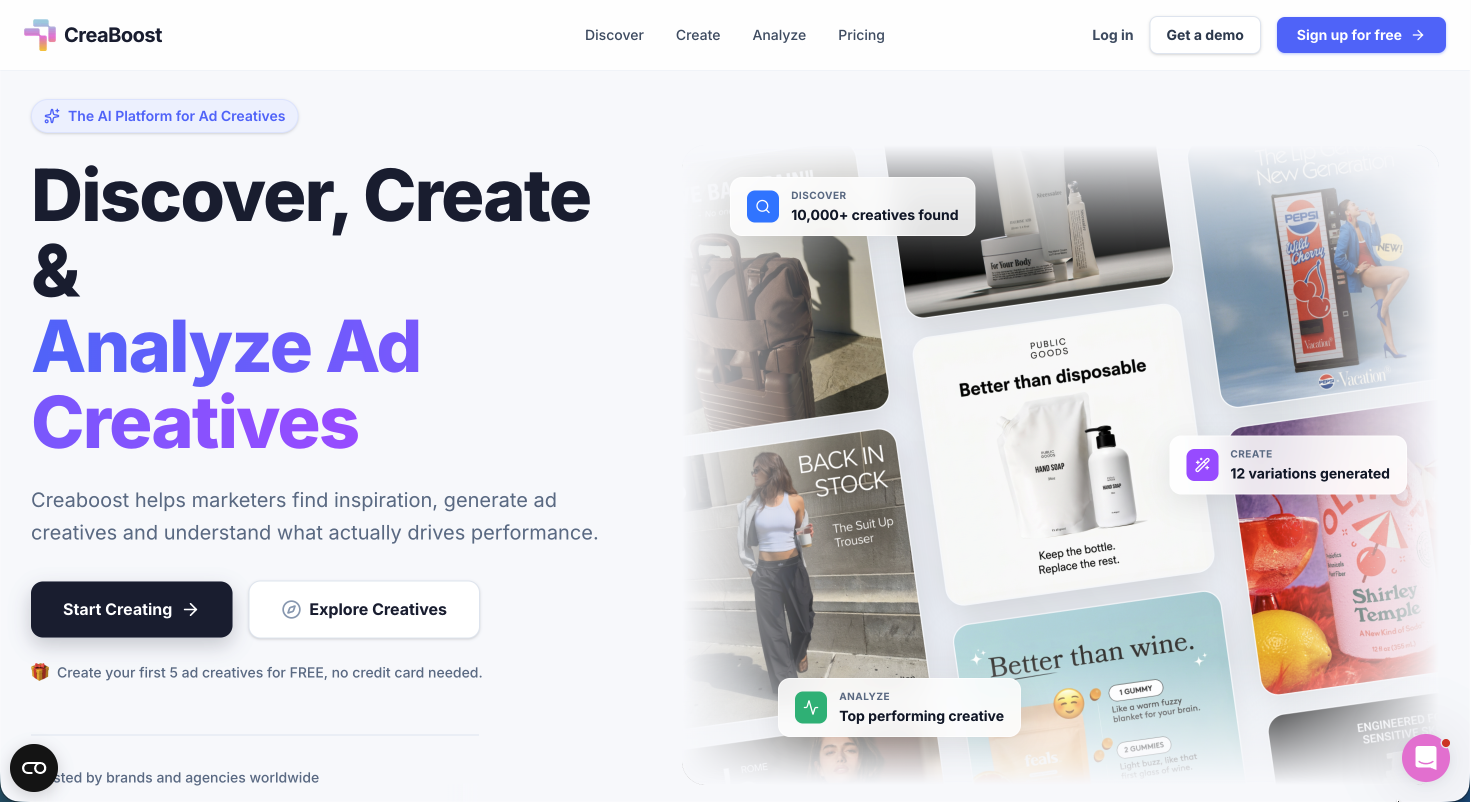
CreaBoost brings discover ad creative solutions, production, and measurement into a single platform built for teams that need to move fast. The Discover module pulls every ad running across Meta, TikTok, Google, LinkedIn, and more into shareable inspiration boards. The Create module turns a product URL into platform-ready concepts with batch resizing locked to your brand identity. And performance analytics surfaces fatigue signals, tags your visuals automatically, and shows you exactly which assets to scale and which to retire. If you're ready to stop reacting and start building a real creative engine, explore AI ad creative tools that make it possible.
Frequently asked questions
What is the most important metric to track for high-performing ads?
Click-through rate (CTR) and conversion rate (CR) are the most important metrics for measuring high-performing ad creatives, with TikTok benchmarks showing CTR of 0.84% to 1.5% and CR of 0.46% to 2.5% as strong targets in 2026.
How do I know if my ad creative is "native-style" for TikTok?
Native-style TikTok ads look and feel like typical user-generated content, blending seamlessly into the feed. If your ad could pass as something a regular creator posted, you're on the right track, since TikTok's top creatives consistently mimic organic user content.
What are the average benchmarks for TikTok ad performance in 2026?
In 2026, TikTok ad benchmarks show an average CTR of 0.84% to 1.5%, a conversion rate of 0.46% to 2.5%, and a CPM starting from $3.50, making it one of the most cost-efficient platforms for paid social.
How often should I refresh my ad creatives?
It's best to test or rotate new creatives every 2 to 4 weeks to stay ahead of ad fatigue and prevent the performance drop-off that comes from audience overexposure to the same assets.