
Your click-through rate isn't just a vanity metric. It's the first signal your creative is pulling its weight. And yet, most e-commerce teams burn the same two CTAs over and over until their audiences go completely numb. CTA buttons boost CTR by 22% and lead generation by 78% when selected and placed strategically. That gap between what your CTAs are doing right now and what they could do is almost entirely a creative decision. This guide gives you 31 proven options, real benchmark data, and a practical framework for rotating them before fatigue kills your results.
Table of Contents
- How to choose high-performing ad CTAs
- The ultimate list: 31 high-converting ad CTA ideas
- CTA performance benchmarks for Meta and TikTok ads
- When to use each CTA: Practical recommendations
- Our take: Why most brands underuse CTAs and how to win
- Unlock peak ad performance with CreaBoost
- Frequently asked questions
Key Takeaways
| Point | Details |
|---|---|
| Match CTA to campaign | Choose CTAs that align with your objective and funnel stage to maximize conversions. |
| Use data to choose | Rely on real performance benchmarks to guide your CTA selection for each platform. |
| Rotate to prevent fatigue | Refresh ad CTAs every month and test new ideas to maintain audience attention and results. |
| Urgency drives action | Adding urgency or scarcity elements to CTAs can increase clicks and conversions. |
How to choose high-performing ad CTAs
Before diving into the top-performing CTA options, it's critical to understand what makes an ad CTA effective for your campaign goals. A CTA that converts cold traffic on TikTok won't necessarily work for a warm retargeting audience on Meta. Context is everything.
The single most important variable is funnel stage alignment. Match your CTA to funnel stage, using softer prompts like "Learn More" for top-of-funnel awareness and harder action verbs like "Shop Now" or "Claim Yours" once someone already knows your brand. Misaligning these is one of the most common ways teams waste budget without realizing it.
Here are the core principles for selecting effective ad CTAs:
- Funnel alignment: Cold audiences need low-commitment CTAs. Warm audiences, especially retargeting segments, respond to urgency and direct purchase prompts.
- Urgency and scarcity: Phrases like "Limited Time" or "Only 3 Left" create psychological pressure that speeds up decision-making. These work especially well in retargeting campaigns where the prospect already knows the product.
- Action verbs that drive engagement: Words like "Unlock," "Claim," "Grab," and "Discover" feel more dynamic and personalized than passive options. They suggest the user is getting something, not just being sold to.
- Landing page alignment: Your CTA needs to match what the landing page delivers. If your CTA says "Claim Your Offer" but the page opens on a generic homepage, you lose the conversion before it starts.
- A/B testing cadence: Always test new CTA variations for at least 5 to 7 days before drawing conclusions. Shorter windows don't give the algorithm enough data to stabilize delivery.
Understanding how to boost ad performance through intentional CTA selection is a foundational skill, not an afterthought. It's one of the fastest levers you have without touching your budget, targeting, or creative visuals.
Pro Tip: Build a running document tracking which CTAs you've tested, the date range, and the key results. Most teams have no institutional memory around CTA performance, which means they keep retesting the same losers.
When you combine the right action verb with the right funnel stage and a landing page that delivers on the promise, you stop leaking clicks. Every dollar goes further.

The ultimate list: 31 high-converting ad CTA ideas
Armed with selection criteria, you're ready for inspiration. Here is your resource for CTA idea expansion and creative fatigue-proofing. These are organized by campaign objective so you can find the right fit fast.
Lead generation CTAs
- Download — One of the strongest performers for lead gen. A "Download" CTA generated 49 leads at a $5.10 CPA, outperforming both "Learn More" and "Sign Up" in head-to-head tests.
- Sign Up — Works well for webinars, newsletters, and community offers. Best when the offer is clearly articulated in the ad copy.
- Get Your Free Guide — Reduces friction by emphasizing the zero cost. Feels like a transaction where the user wins.
- Reserve Your Spot — Strong for events and limited-access launches. Combines lead capture with scarcity.
- Start Your Free Trial — Ideal for SaaS-adjacent or subscription e-commerce. Removes the payment barrier mentally.
- Get Early Access — Generates qualified leads and builds a waitlist. Works exceptionally well pre-launch.
- Join the Waitlist — Similar to above, but more explicit about exclusivity.
Direct purchase CTAs
- Shop Now — The workhorse. Effective when you're targeting warm audiences but overused on cold traffic.
- Buy Now — More direct and urgent than "Shop Now." Best for flash sales and limited-time offers.
- Grab Yours Today — Adds immediacy without feeling aggressive. Performs well in lifestyle and fashion e-commerce.
- Claim Your Offer — Positions the purchase as something the user is unlocking, not just completing.
- Order Now — Blunt and effective for high-intent retargeting audiences who already know the product.
- Get It Now — Short, fast, and action-oriented. Works well in mobile-first TikTok ad formats.
- Add to Cart — Great for retargeting dynamic product ads. Picks up where the user left off.
Engagement and discovery CTAs
- Learn More — Low-commitment and ideal for cold audiences. Best at top of funnel but overused everywhere else.
- See How It Works — Drives video views or landing page visits. Great for complex products that need explanation.
- Discover [Product Name] — Personalizes the CTA around your offer and sounds exploratory rather than pushy.
- Watch Now — Strong for video-first formats, especially TikTok. Aligns the CTA with the native behavior of the platform.
- Explore the Collection — Works well for fashion, home goods, and beauty brands with multiple SKUs.
- View the Look — Specific to apparel and lifestyle. Pulls the user into a curated product set.
Scarcity and urgency CTAs
- Limited Time Offer — Clear and direct. Works best when the ad creative reinforces the deadline visually.
- Only X Left — Dynamic and specific. Personalized urgency outperforms generic urgency almost every time.
- Ends Tonight — Best for day-of campaigns or final-hour pushes in a sale window.
- Last Chance — A high-urgency option for retargeting users who engaged but didn't convert.
- Don't Miss Out — FOMO-driven and works well when paired with a strong visual of the product.
Value and offer CTAs
- Get X% Off — Specificity converts. "Get 30% Off" outperforms "Save Big" consistently because it sets a clear expectation.
- Claim Your Discount — Makes the saving feel personal and earned.
- Try for Free — Removes the risk objection entirely. Ideal for trials, samples, or intro offers.
- Get Your Free Sample — Especially powerful in beauty and wellness where product experience drives purchase.
- Unlock Your Deal — Positions the offer as exclusive and user-triggered.
- See Today's Deal — Creates curiosity while implying daily freshness. Works well in retargeting.
When you use these CTAs to lift ROAS through ad creative, the goal is variety with purpose, not random rotation.
Pro Tip: Rotate CTAs every 5 to 7 days within an active ad set to extend the life of a winning creative. Swap "Shop Now" for "Claim Yours" or "Grab Yours Today" first. Often the offer stays the same but the new verb refreshes the click impulse.
CTA performance benchmarks for Meta and TikTok ads
Now that you have a rich set of CTA options, see how the best ones perform in the real world, backed by benchmark data you can use.
Understanding platform-specific benchmarks keeps your expectations calibrated and your testing priorities sharp.
On Meta, "Download" outperformed every other CTA tested in a controlled lead generation campaign, delivering 49 leads at $5.10 CPA. "Learn More" generated fewer leads at a higher cost, and "Sign Up" lagged further behind. The lesson here is not that "Download" always wins, but that it dramatically under-tested relative to its performance potential.
On TikTok, the numbers reflect a different environment. TikTok's average ad CTR is 0.84%, with e-commerce ads averaging between 0.65% and 1.2% and beauty ads reaching 0.85% to 1.8% at the top end. TikTok Shop campaigns can achieve conversion rates above 10%, which makes the right CTA even more valuable in that environment.
"The difference between a 0.7% and a 1.4% CTR on TikTok isn't just a number — it's the gap between a campaign that scales and one that stalls. CTA choice is a direct driver of that difference."
| CTA | Platform | Typical CTR range | Strength |
|---|---|---|---|
| Download | Meta | Above average | Lead gen, lowest CPA |
| Shop Now | Meta + TikTok | Baseline | Bottom-funnel purchase |
| Learn More | Meta | Below average | Top-funnel awareness |
| Claim Your Offer | Meta | Above average | Retargeting, warm audiences |
| Watch Now | TikTok | Strong | Video-first content |
| Get It Now | TikTok | Strong | Mobile impulse purchase |
| Try for Free | Meta + TikTok | Above average | Trial offers, subscriptions |
| Only X Left | Meta + TikTok | High | Urgency-driven retargeting |
When evaluating your own account data against these benchmarks, also factor in your ad placements for Meta and TikTok, since placement type heavily influences which CTAs feel native and which feel jarring to the user.
The biggest takeaway from benchmark data is this: no CTA wins in every context. "Shop Now" dominates bottom-funnel spend because it's the default, not because it's the best option. The teams pulling ahead are the ones systematically testing alternatives and measuring at the cohort level.
When to use each CTA: Practical recommendations
Understanding CTA performance data is essential, but putting them into action at the right moment in your campaign flow turns information into results.
Use this table to match your CTA to your campaign objective:
| Campaign type | Audience temperature | Recommended CTA |
|---|---|---|
| Cold awareness | New audience | Learn More, Discover, Watch Now |
| Consideration | Engaged but not converted | See How It Works, Try for Free, Get Early Access |
| Retargeting | Visited site or added to cart | Claim Your Offer, Last Chance, Only X Left |
| Offer push | Sale or flash event | Limited Time, Ends Tonight, Get X% Off |
| Loyalty reactivation | Past customers | Claim Your Discount, See Today's Deal, Grab Yours Today |
Here is a practical workflow for plugging CTAs into your creative rotation:
- Audit your current CTAs. Identify which CTAs are live right now and how long they've been running. Anything past four weeks without a variation test is a candidate for refresh.
- Map each ad set to a funnel stage. Cold, warm, and hot audiences all need different CTA language. Confirm your current mapping is accurate.
- Select two CTA variants per ad set. One familiar option and one fresh alternative. This keeps the test controlled while introducing variation.
- Run the test for 5 to 7 days. Don't judge early. Let spend accumulate before pulling conclusions.
- Log results in a shared tracker. Include CTA text, funnel stage, audience type, CTR, CPA, and CVR. This becomes your institutional knowledge.
- Rotate the winning CTA into your evergreen creative. Keep the losing variation for future retesting in a different context.
The best practice is matching CTA to funnel stage, with soft options for cold audiences and harder purchase prompts for warm ones. But just as important is the soft versus hard CTA distinction itself. Soft CTAs reduce commitment pressure and work for brand building. Hard CTAs maximize conversion intent for buyers who are ready to act. Confusing the two is one of the most common and costly mistakes in ad creative.
Landing page alignment deserves its own attention. If your CTA says "Claim Your Offer" but the destination is a product listing page with no visible offer, you've broken the user's expectation. That break is where conversions die. Every CTA should have a dedicated, congruent destination.
Teams that learn how to scale ads profitably build this CTA-to-landing-page matching into their brief process, not as an afterthought.
Our take: Why most brands underuse CTAs and how to win
While best practices get you started, here's a candid look at why most brands miss out on CTA gains and how you can take the lead.
The honest reason most brands default to "Shop Now" and "Learn More" isn't laziness. It's risk aversion. Creative teams get burned by something that underperforms and retreat to familiar ground. The problem is that familiar ground stops working the moment your audience has seen it dozens of times. Fatigue doesn't just reduce CTR. It actively repels attention because the brain learns to filter out patterns it has already categorized as irrelevant.
Here's what we see consistently across accounts: brands that test at least four distinct CTAs per month see meaningfully better results than brands running the same two CTAs all quarter. The gap isn't because any single CTA is magical. It's because variety resets the pattern-recognition fatigue in the algorithm's delivery and in the user's eye.
There's also an emerging opportunity on TikTok that most Meta-first teams are completely ignoring. Creator-native CTAs, phrases that sound like something a real person would say rather than a platform button, outperform standard options on TikTok. "Go grab yours before they're gone" embedded in a creator's voiceover converts better than a button that says "Shop Now" for the tenth time in a user's feed. The creative best practices for each platform genuinely diverge at the CTA level.
The experiment-first mindset is what separates high-performing teams from average ones. That means weekly CTA swaps on at least one ad set, granular A/B tests with clean tracking, and a genuine willingness to be surprised by the data. The teams that win are the ones that let performance data override internal opinions about what "sounds right."
Pro Tip: Track CTA-level click momentum in your analytics dashboard. When a CTA's CTR drops two weeks in a row without a corresponding drop in spend, that's fatigue starting. Catching it then saves you a week of wasted budget compared to waiting for CPA to spike.
Unlock peak ad performance with CreaBoost
Ready to level up your CTA strategy and convert insights into results? CTA optimization only pays off when you can actually measure what's working and act on it fast.
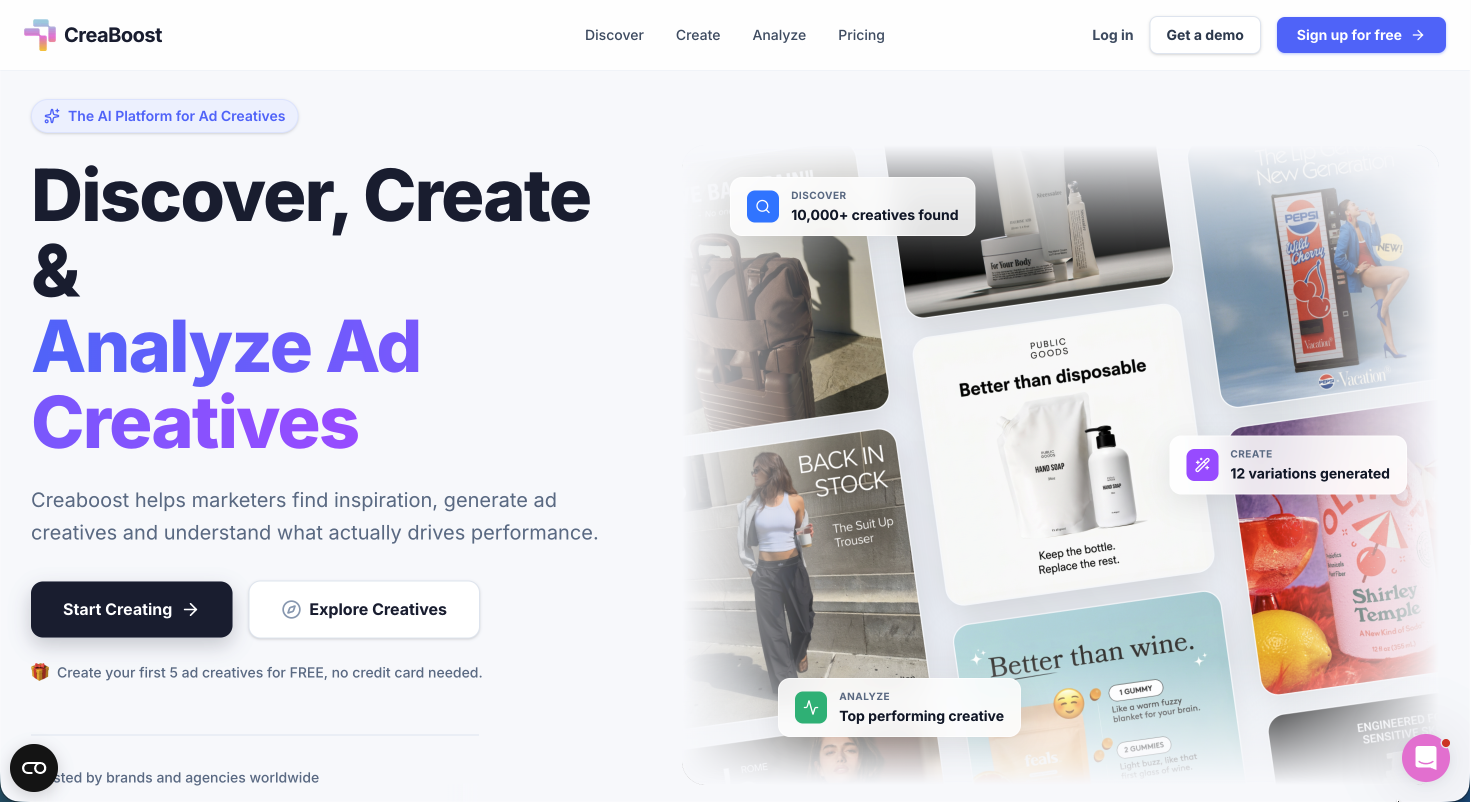
CreaBoost's Analyze ad CTA performance feature connects directly to your Meta and TikTok ad accounts, auto-tagging every creative by hook, angle, and CTA type so you can see exactly which options are driving ROAS and which ones are quietly dragging your CPA up. No manual spreadsheets. No guessing. You spot fatigue before it shows up in headline metrics. When it's time to test a fresh batch of CTAs from your new list, the AI ad creative tools in Create let you spin up dozens of on-brand variants in minutes. Paste in your product URL, select your formats, and launch new CTA tests the same day. The creative bottleneck disappears.
Frequently asked questions
Which CTA generates the lowest cost per lead on Meta ads?
In controlled tests, "Download" consistently delivered the most leads at the lowest cost per acquisition, with one campaign recording 49 leads at $5.10 CPA compared to all other CTA options tested.
What is a good CTR for TikTok e-commerce ads?
A strong CTR for TikTok e-commerce ads sits between 0.65% and 1.2%, with beauty campaigns and TikTok Shop formats often hitting the higher end of that range.
How often should I rotate ad CTAs to avoid creative fatigue?
Rotate your CTAs every 3 to 4 weeks at a minimum, or sooner if you notice two consecutive weeks of declining CTR without a corresponding drop in ad spend.
Do urgency-based CTAs really improve conversion rates?
Yes. CTAs built around urgency and scarcity consistently lift response rates by motivating faster decisions, especially in retargeting campaigns where the prospect already has product awareness.
Should I use the same CTA for Meta and TikTok ads?
Some CTAs perform on both platforms, but TikTok and Meta have different benchmarks for CTR and CVR, and native-feeling CTAs on TikTok often outperform the standard button options you'd default to on Meta.