

Most performance marketers treat scaling as a budget problem. If ROAS looks good, the instinct is to pour more money in and watch revenue climb. But that instinct is wrong more often than it's right. Raising spend without a structured approach can tank your ROAS within days, trigger algorithm resets that kill momentum, and burn through creative assets that took weeks to produce. Real ad platform scalability is a system, not a dial. And once you understand how the system works, you can grow revenue without the chaos that usually comes with it.
Table of Contents
- Defining ad platform scalability
- The key levers: creative, budget, and targeting
- Guardrails and pitfalls: How to scale without burning budget
- Applying scalability principles to Meta and TikTok
- A contrarian view: Why slow, creative-first scaling wins
- Unlock ad scalability with better creative tools
- Frequently asked questions
Key Takeaways
| Point | Details |
|---|---|
| Scalability is multi-lever | Effective ad platform scaling relies on creative, budget, and targeting in sequence for real growth. |
| Creative comes first | Upgrading creatives before budget changes delivers more sustainable results and protection against diminishing returns. |
| Guardrails prevent waste | Using clear KPIs like ROAS and frequency keeps scaling efforts profitable and under control. |
| Platform strategies differ | Meta and TikTok require adjusted settings and cadence for best scalability outcomes. |
| Slow, measured scaling wins | Stepwise, creative-led adjustments outperform fast budget changes that hurt long-term growth. |
Defining ad platform scalability
Scalability, in the context of paid social, means growing your ad results profitably. Not just growing them. The distinction matters because you can always spend more money on ads. The hard part is doing it without your cost per acquisition rising faster than your revenue.
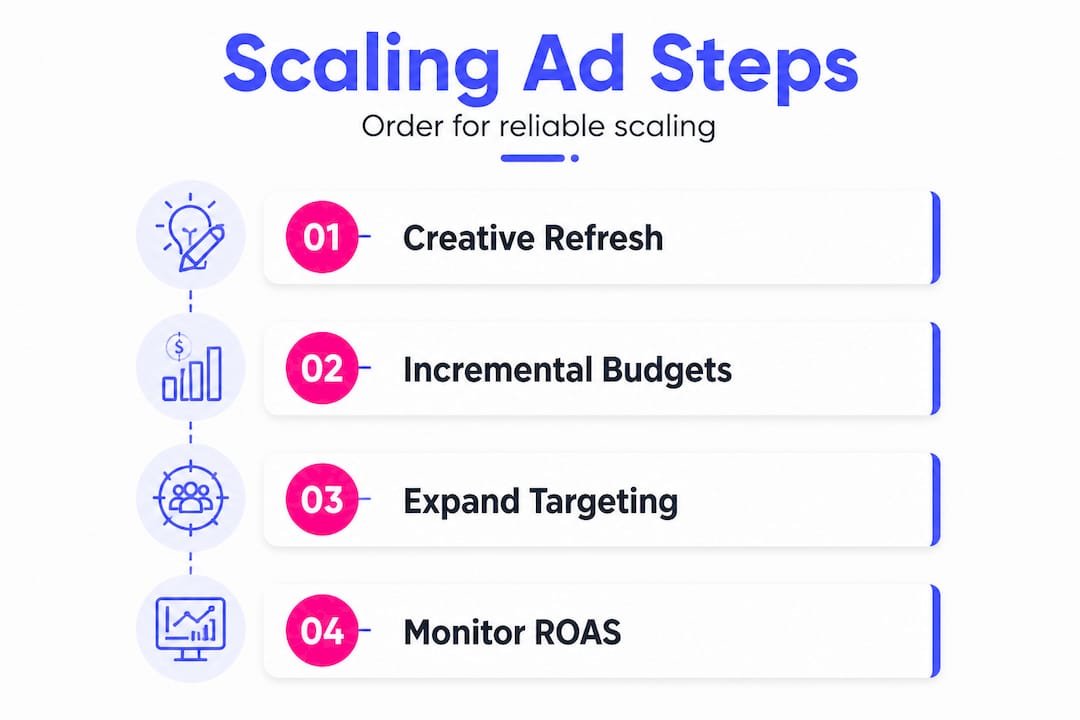
True scalability involves three things working together: the right creative assets, the right budget structure, and the right audience approach. Pull any one of those levers too hard without touching the others and your results get messy fast. That's why the most reliable playbook for scaling, backed by performance marketing frameworks, follows a clear sequence: creative first, then budget, then targeting.
Here's what scalable growth actually looks like in practice:
- Stable or improving ROAS as spend increases over time
- Creative volume that keeps pace with audience fatigue
- Audience expansion that happens gradually, not all at once
- Budget changes made incrementally, with results measured before the next adjustment
- Clear guardrails that trigger a pause before wasted spend compounds
"The most common scaling mistake isn't moving too slowly. It's moving too many things at once. When you change creative, budget, and targeting in the same week, you lose the ability to diagnose what actually moved the needle."
Understanding this gives your team an operational foundation. Instead of reacting to rising CPAs after the fact, you're running a controlled process. You have creative insights for performance teams shaping your hypothesis, clear rules for when to act, and a feedback loop that gets faster over time.
The key levers: creative, budget, and targeting
Now that we know what scalability is, it's critical to break down how to achieve it — one lever at a time for reliable, measurable growth.
The research is consistent on this: creative first, then budget, then targeting. Here's why the order matters, and how to execute each lever correctly.
1. Upgrade and diversify your creative assets
Creative is the variable that matters most at scale. A weak creative with a big budget is just a more expensive problem. Before you touch spend levels, ask whether your current creative set is genuinely strong — meaning multiple angles, formats, and hooks tested across your audience. If you're running three variations of the same concept, you're not creative-diverse, you're creative-concentrated.

Think about it this way: your audience sees your ads repeatedly. The algorithm needs fresh signals to keep optimizing. The moment engagement rates start dropping, delivery gets more expensive. Refreshing creative resets that decay cycle without requiring a single extra dollar of budget.
2. Raise budgets incrementally using ROAS guardrails
Once your creative set is solid, budget increases become safer. The standard rule: raise budgets in 15 to 20 percent increments and wait 48 to 72 hours before evaluating results. Aggressive budget jumps trigger algorithm learning phases on Meta that can destabilize performance for days. Slow increases let the system adapt.
The guardrail here is simple. If ROAS drops by more than 30 percent after a budget change, pause before going further. That drop signals the algorithm is struggling to find efficient conversions at the new spend level.
3. Expand targeting with platform-specific strategies
Targeting is the last lever to pull, and often the most misunderstood. On Meta, Campaign Budget Optimization (CBO) combined with broad audience parameters usually outperforms heavily segmented ad set structures at scale. Advantage+ takes this further by letting the algorithm decide where to find buyers across Meta's full inventory.
On TikTok, broad targeting is similarly effective because the platform's algorithm is exceptionally good at distributing content to users who engage with similar material. Fighting it with tight audience restrictions often just raises costs.
Here's a direct comparison of each lever's trade-offs:
| Lever | Impact potential | Risk level | Time to see results | Reversibility |
|---|---|---|---|---|
| Creative refresh | High | Low | 3 to 7 days | Immediate |
| Budget increase | Medium | Medium | 48 to 72 hours | Fast |
| Targeting expansion | Medium | Medium-high | 7 to 14 days | Slow |
Pro Tip: Watch your ad frequency number closely. Once frequency climbs above 3, your audience has seen your ad too many times and engagement starts decaying. That's not a budget problem. That's a creative problem. AI-powered ad creative creation can help you generate fresh variations fast enough to stay ahead of that decay cycle. And if you want to go deeper, this breakdown of building high-performing creatives covers the asset fundamentals worth knowing.
Guardrails and pitfalls: How to scale without burning budget
With the right levers in hand, knowing when to pause, adjust, or continue scaling requires discipline. Here's how to stay on the rails.
Guardrails are predefined rules that protect your budget when scaling goes wrong. Without them, rising CPAs can go unnoticed for days while spend keeps running. The recommended thresholds are specific: pause or adjust if ROAS drops by 30 percent from your baseline, or if ad frequency exceeds 3 within a 7-day window.
The most common pitfalls that blow up scaling efforts:
- Scaling all levers at once. You changed creative, raised the budget, and broadened targeting in the same week. Results dropped. Now you have no idea which change caused it.
- Ignoring creative fatigue signals. Engagement rates are the early warning system. By the time CPAs visibly drift, fatigue has already been compounding for a week.
- Skipping incremental measurement. Making a budget change and immediately making another one means you're operating blind. Every change needs a measurement window.
- Over-segmenting audiences at scale. Too many small ad sets compete against each other in auction, raise your own costs, and reduce the algorithm's ability to optimize effectively.
- Treating frequency as someone else's problem. Media buyers watch spend. Creative teams watch assets. Nobody watches frequency. That gap is where budget bleeds quietly.
Here's a simple weekly tracking structure to catch problems before they compound:
| Week | Budget | Creative variations live | ROAS | Frequency | Action |
|---|---|---|---|---|---|
| Baseline | $5,000 | 4 | 3.8x | 1.6 | Monitor |
| Week 1 | $5,000 | 8 | 4.2x | 1.4 | Scale budget |
| Week 2 | $6,000 | 8 | 4.0x | 1.9 | Hold, monitor |
| Week 3 | $6,000 | 12 | 4.3x | 1.5 | Scale budget |
| Week 4 | $7,200 | 12 | 3.1x | 3.4 | Pause, refresh creative |
That table tells a story most teams miss in real time. The ROAS drop in week four combined with a frequency spike above 3 is a clear signal. The answer isn't to cut budget. It's to refresh the creative and let frequency reset.
Pro Tip: Build this table into your weekly optimization cadence as a standing agenda item. The habit of reviewing these four numbers together — budget, creative count, ROAS, frequency — catches problems fast. For deeper guidance on this loop, creative best practices for ROAS and this step-by-step ad performance guide are worth keeping in your toolkit.
Applying scalability principles to Meta and TikTok
To translate theory into results, here's how to execute scalable ad strategies on Meta and TikTok specifically.
Scaling on Meta: Step by step
- Start with creative. Before touching budget, confirm you have at least 4 to 6 meaningfully different creative variations live. Different means different concept or hook, not just a color swap.
- Set up CBO campaigns. Campaign Budget Optimization lets Meta distribute spend across ad sets in real time based on performance signals. This outperforms manual ad set budgets at scale because the algorithm has more flexibility to chase conversions efficiently.
- Use ABO for testing. Ad Set Budget Optimization (ABO) is the right structure for testing new creative concepts before promoting them to your CBO scaling campaigns. Keep test budgets small and defined.
- Monitor frequency weekly. Set a standing check for 7-day frequency at the ad set level. Once it crosses 3, rotate in new creative before raising budget further.
- Raise budgets in 15 to 20 percent steps. Wait 72 hours after each increase before evaluating results. Avoid touching budgets during the first 48 hours of a new creative rotation.
Scaling on TikTok: Step by step
- Refresh creatives more aggressively. TikTok audiences burn through content faster than Meta audiences. A creative that runs for three weeks on Meta might fatigue in ten days on TikTok. Plan your content calendar accordingly.
- Use broad targeting from the start. TikTok's algorithm excels when given room to work. TikTok ad placements and broad audience settings together give the platform the signals it needs to find your buyers efficiently.
- Track spend versus performance on shorter windows. Review performance every 3 to 5 days rather than weekly. TikTok moves faster and creative fatigue shows up earlier.
- Align creative with trending formats. The algorithm rewards content that matches platform behavior. Native-feeling ads consistently outperform polished production formats on TikTok.
- Scale winning creatives to new campaigns rather than raising ad set budgets. Duplicating a winning creative into a fresh campaign structure often performs better than simply increasing the budget on the existing one.
Pro Tip: Sync your creative refresh calendar with both platforms simultaneously. When you refresh on Meta, refresh on TikTok too. This keeps your creative performance analysis cleaner because you're comparing fresh creative sets across platforms at the same time, not dealing with staggered fatigue cycles that complicate attribution.
A contrarian view: Why slow, creative-first scaling wins
Here's an insight that most experts won't mention in typical playbooks: the teams that scale fastest are almost never the ones moving fastest.
The market's instinct is to go for immediate gains by cranking budgets. It feels like progress. The numbers go up. The team celebrates. Then two weeks later, CPAs spike, ROAS collapses, and everyone scrambles to figure out what changed. The answer is almost always the same: the creative burned out and the budget amplified the problem rather than the opportunity.
Platform research consistently shows that most scaling failures trace back to creative fatigue, not budget misallocation. Budget doesn't create problems on its own. It magnifies whatever the creative is already doing. If the creative is strong, more budget means more efficient conversions. If the creative is weak or fatigued, more budget means paying more for worse results.
The hidden bottleneck on most performance teams is a reluctance to invest in continuous creative iteration. It feels expensive. It requires coordination between strategists, designers, and media buyers. It doesn't produce a clean before-and-after metric the way a budget increase does. So teams skip it, or they do it once a quarter instead of once a week.
The brands that genuinely outperform at scale are the ones that treat creative production as a system, not a project. They ship new variations constantly. They use creative generation tools to keep the pipeline moving without requiring a designer for every iteration. They know within days which concepts are gaining traction. And critically, they scale budgets only after creative is already performing, not before.
Slow, creative-first scaling isn't the cautious approach. It's the aggressive one. It compounds. Every creative learning feeds the next brief. Every week of data builds a clearer picture of what your audience responds to. Over time, that advantage grows faster than any budget escalation strategy can replicate.
Unlock ad scalability with better creative tools
Scaling ads profitably isn't a budget question — it's a creative systems question. The teams that win aren't necessarily spending more. They're producing more, testing faster, and catching performance signals before they cost money.
Creaboost is built for exactly this workflow. With Creaboost, you can generate winning ad creatives directly from a product URL, producing dozens of on-brand Meta and TikTok variations in minutes. The platform also connects to your ad accounts to analyze creative performance automatically, tagging every asset by hook, angle, and concept so you can see which ideas are genuinely driving ROAS versus which ones are just burning impressions. If you're ready to run a tighter creative loop and scale with actual confidence, explore what Creaboost can do for your team at CreaBoost pricing.
Frequently asked questions
What does it mean to scale an ad on Meta or TikTok?
Scaling an ad means expanding its reach, spend, and impact while keeping ROAS and cost per acquisition in check — not simply increasing your daily budget and hoping performance holds.
What is the safest way to begin scaling on an ad platform?
Start by improving and diversifying your creatives first. Creative strength is the foundation that makes budget increases sustainable rather than costly.
How do you know if your scaling strategy is working?
Track ROAS, ad frequency, and cost per conversion on a weekly basis. If ROAS holds stable or improves while spend rises, your scaling strategy is working.
What guardrails should marketers use when scaling ads?
Pause or adjust immediately if ROAS drops more than 30 percent from your baseline or if ad frequency at the ad set level climbs above 3 within a 7-day window — both are clear signals that creative, not budget, needs attention.
Recommended
- Maximize ROI: types of ad placements for Meta and TikTok
- Ad creative best practices that actually lift ROAS | Creaboost Blog
- Blog — Creative Insights for Performance Teams | CreaBoost
- Performance Marketing Team | Multi‑Channel Paid Ads
- The $50M Meta Ads Myth: Why 'Best Practices' Are Killing Your Profit Margins