

Picking the wrong ad placements doesn't just limit your reach. It quietly bleeds budget, inflates CPAs, and leaves your best creative stranded in low-intent environments where nobody is close to buying anything. With Meta offering six distinct placement categories and TikTok rapidly expanding its own ecosystem, the options have never been more powerful or more confusing. This article breaks down every major placement type on both platforms, gives you a clear framework for choosing between them, and shows you exactly where to focus based on your e-commerce goals.
Table of Contents
- How to evaluate ad placements: Core selection criteria
- Meta ad placements explained: Categories and key features
- TikTok ad placements: Where your ads can appear
- Automatic vs. manual placement selection: Pros, cons, and when to use each
- Meta vs. TikTok ad placements: Summary comparison for e-commerce
- The uncomfortable truth about ad placements most marketers ignore
- Supercharge your ad placement strategy with Creaboost
- Frequently asked questions
Key Takeaways
| Point | Details |
|---|---|
| Placement impacts performance | Choosing the right ad placement can dramatically improve ROI and campaign results. |
| Feed and Stories drive sales | For most e-commerce brands, Feeds and Stories placements deliver the best conversion efficiency. |
| Automatic vs. manual trade-offs | Automatic placement boosts reach; manual targeting supports creative and audience control. |
| Creative context matters | High-performing creatives are tailored to the unique context of each platform and placement. |
| Continuous analysis wins | Regularly analyzing placement-level data is crucial for scalable, optimized ad performance. |
How to evaluate ad placements: Core selection criteria
Before you touch a single campaign setting, you need a consistent way to judge whether a placement is worth your budget. Not every placement is built for every objective, and treating them as interchangeable is one of the most expensive mistakes in paid social.
Here are the five criteria that actually matter:
- Reach vs. audience quality. A placement can deliver massive impressions while reaching people who will never buy. Scale matters, but only when the audience on the other end is actually relevant to your offer.
- User intent and context. Someone scrolling their Instagram Feed is in a different mindset than someone watching a mid-roll ad during a YouTube-style video. In-feed placements tend to catch users in active discovery mode. Mid-roll and interstitial placements interrupt. That difference shows up in your conversion rates.
- Creative format compatibility. Some placements only support static images. Others are built for vertical video. If your strongest asset is a 15-second product demo, running it somewhere that crops it to a banner defeats the purpose entirely.
- Cost efficiency. CPMs (cost per thousand impressions) vary dramatically across placements. Audience Network placements on Meta, for example, typically carry lower CPMs but also deliver weaker purchase intent. Knowing the cost-to-quality ratio for each placement is essential for budget allocation.
- Proximity to conversion. Some placements sit closer to the moment of purchase than others. Search result placements on both Meta and TikTok catch users who are actively looking, which means they convert at a higher rate even if the volume is lower.
Pro Tip: When you're starting a new campaign, rank your placements against all five criteria before you launch. It takes 20 minutes and saves you from chasing scale in the wrong places for two weeks.
Meta ad placements explained: Categories and key features
With these criteria in mind, let's break down how Meta's various placement types deliver value for e-commerce.

Meta ad placements fall into six groups: Feeds (Facebook News Feed, Instagram Feed, Marketplace, and Groups Feed), Stories and Reels (full-screen vertical formats on Facebook, Instagram, and Messenger), In-stream videos (mid-roll and pre-roll inside longer video content), Search Results (appearing alongside Facebook and Instagram search queries), Messages (ads in the Messenger inbox and sponsored messages), and Audience Network (third-party apps and websites using native, banner, interstitial, and rewarded video formats).
Here is what each one means for your e-commerce campaigns:
- Feeds. This is where most performance budgets belong. Facebook News Feed and Instagram Feed placements put your ad directly inside the content stream users are actively scrolling. High intent, high visibility, and strong creative flexibility. You can run video, carousels, collections, and static images. For direct response e-commerce, this is your primary battleground.
- Stories and Reels. Full-screen vertical formats that demand attention the moment they load. Stories disappear after 24 hours organically, but your ads run on a continuous basis. Reels placements have grown significantly in delivery share as Meta pushes short-form video. Both formats reward native-feeling creative. Polished brand videos often underperform here while raw, fast-paced content overperforms.
- In-stream videos. These are interruption placements. They appear mid-roll inside longer Facebook videos. Completion rates are lower than feed formats, and users often skip or wait them out. Useful for brand awareness campaigns but rarely the right call for direct response e-commerce.
- Search Results. Underused and underrated. When someone searches for a product category on Facebook or Instagram, your ad can appear in those results. The intent signal is strong, and competition is often lower than in Feed placements.
- Messages. Sponsored messages inside Messenger can work for retargeting and re-engagement, particularly for brands with existing customer relationships. Cold traffic rarely converts well here.
- Audience Network. Third-party app and website inventory. The reach is enormous and the CPMs are low, but the conversion quality reflects that. Users clicking banner ads inside mobile games are rarely in a buying mindset.
"Feeds and Stories/Reels consistently deliver the best performance for e-commerce campaigns. Audience Network can extend reach, but treat it as supplemental rather than primary inventory."
For e-commerce brands running AI creative generation at scale, the implication is clear: prioritize creative production for Feed and Stories/Reels formats first. Everything else is secondary until those placements are fully optimized.
Pro Tip: If you want to test Audience Network without contaminating your core campaign data, create a separate ad set with Audience Network only. That way you can measure its actual contribution without it skewing your Feed performance numbers.
TikTok ad placements: Where your ads can appear
Next, let's look at how TikTok structures its rapidly expanding ad placement network.
TikTok has moved well beyond a single feed. TikTok placements now include the For You Feed (which itself aggregates the Profile Feed, Following Feed, Search Feed, Search Results, TikTok Lite, TikTok for Web, and Lemon8 in select countries), Post-roll placements (appearing at the end of longer organic videos), and Automatic Search Placement (which extends your in-feed ads into TikTok's search results).
Here is how each placement maps to e-commerce goals:
- For You Feed. This is TikTok's core real estate. Your ad appears as a native video in the algorithmic feed that users spend the majority of their time in. The format is vertical video, full-screen, with sound on by default. The creative bar is high because you are competing directly with organic content from creators. Ads that look like ads get skipped. Ads that look like content get watched.
- Profile Feed and Following Feed. These sub-placements within the For You ecosystem reach users who are in a more intentional browsing mode. Following Feed placements reach users actively checking content from accounts they chose to follow, which signals higher engagement intent.
- Search Feed and Search Results. TikTok's search behavior has grown dramatically. A significant share of users now use TikTok as a discovery and research tool, particularly for product categories like beauty, fashion, and home goods. Appearing in search results puts your ad in front of users who are actively looking for something related to your offer.
- Post-roll. These placements appear at the end of longer organic videos. The user has just finished watching something they chose, which means they are still engaged. Post-roll can be effective for retargeting audiences who have already interacted with your brand.
- Pangle and Global App Bundle. These are TikTok's equivalent of Meta's Audience Network, extending reach to third-party apps within TikTok's advertising ecosystem. Useful for scale but with the same quality caveats that apply to Audience Network on Meta.
Pro Tip: Enable Automatic Search Placement as an add-on to your For You Feed campaigns rather than a standalone strategy. It extends discovery reach without requiring a separate creative build, and the incremental cost is typically low relative to the additional impressions you capture.
Automatic vs. manual placement selection: Pros, cons, and when to use each
Having discussed placement types, let's tackle how to choose between letting algorithms pick for you or selecting placements yourself.
Both Meta and TikTok offer automatic placement as the default option. TikTok's automatic placement distributes your budget across all available placements to find the optimal combination, while manual selection lets you choose specific placements like TikTok, Pangle, or Global App Bundle individually.
| Factor | Automatic placement | Manual placement |
|---|---|---|
| Reach | Maximum, across all placements | Limited to selected placements |
| Simplicity | High, minimal setup required | Lower, requires active decisions |
| Creative control | Low, one creative serves all | High, tailor creative per placement |
| Budget efficiency | Platform-optimized | Requires manual monitoring |
| Learning speed | Faster (more data signals) | Slower (less volume per placement) |
| Brand safety | Lower control | Higher control |
| Best for | Scale campaigns, broad testing | Precision campaigns, creative testing |
When automatic placement makes sense:
- You are in a broad awareness or scale phase and want the algorithm to find efficiency across the full inventory.
- Your creative is genuinely format-agnostic (rare, but it happens with certain static formats).
- You are early in a campaign and need to gather data quickly across multiple environments.
When manual placement makes sense:
- You have creative assets built specifically for a format (vertical video for Stories/Reels, square static for Feed).
- You want to isolate placement performance data for analyzing ad placement performance without cross-contamination.
- You are running a retargeting campaign where context and message precision matter more than volume.
- You want to exclude Audience Network or Pangle because your brand safety requirements are strict.
The honest answer for most e-commerce teams is that automatic placement works well during scaling phases, but manual selection becomes essential when you are trying to understand what is actually driving performance. You cannot optimize what you cannot measure cleanly.
Meta vs. TikTok ad placements: Summary comparison for e-commerce
Finally, let's compare Meta and TikTok placements directly to clarify which fit your core goals best.
| Dimension | Meta placements | TikTok placements |
|---|---|---|
| Primary format | Feed, Stories, Reels | For You Feed (vertical video) |
| Creative formats | Video, carousel, static, collection | Vertical video (dominant), static |
| Audience size | Largest global reach | Younger, high-engagement demographic |
| User intent | Browsing, discovery, social | Discovery, entertainment, search |
| Search inventory | Facebook/Instagram Search | Search Feed, Search Results |
| Third-party network | Audience Network | Pangle, Global App Bundle |
| Best for e-commerce | Broad funnel, retargeting, ROAS | Discovery, UGC-style creative, new audiences |
Here are the placement priorities based on your specific e-commerce objective:
- Maximum ROAS on existing audiences. Start with Meta Feed and Instagram Feed placements for retargeting. These placements reach users who already know your brand, in a high-intent scrolling environment. Add Stories/Reels for incremental reach at lower CPMs.
- Rapid creative testing. Use TikTok's For You Feed with manual placement selected. The fast feedback loop on engagement metrics (watch time, shares, comments) tells you which hooks are working before you commit significant budget.
- Budget efficiency at scale. Run Meta Advantage+ placements (Meta's version of automatic) to let the algorithm find efficiency across Feed, Stories, and Reels simultaneously. Expanding ad reach across multiple formats within a single campaign reduces CPM volatility.
- New audience discovery. TikTok's For You Feed is purpose-built for this. The algorithm surfaces your content to users who have never heard of your brand but match the behavioral profile of your buyers.
Feeds and Stories/Reels consistently outperform Audience Network and Pangle for e-commerce conversion metrics. Treat third-party network placements as reach extensions, not performance drivers.
The uncomfortable truth about ad placements most marketers ignore
Most placement strategy conversations focus on which options to select at campaign setup. That is the wrong frame. The real leverage is in what you do after the campaign launches.
Here is what actually happens in most accounts: a team sets up automatic placements, runs the campaign for two to four weeks, looks at overall ROAS, and either scales or kills the campaign based on that single number. Nobody breaks down performance by placement. Nobody notices that Feed placements are delivering a 4.2x ROAS while Audience Network is dragging the blended number down to 2.8x. The campaign gets killed when it could have been saved by simply excluding the underperforming placement.
This is not a targeting problem. It is not a bidding problem. It is a creative context problem combined with a measurement discipline problem.
The second uncomfortable truth is that creative tailored to placement context consistently outperforms creative deployed across all placements without adaptation. A 30-second brand video that performs well in a mid-roll In-stream placement will almost certainly underperform in a Stories placement where users tap through in under three seconds. The placement does not just determine where your ad appears. It determines the user's mindset, attention span, and tolerance for friction. Ignoring that is leaving money on the table every single day.
The teams that win long-term do two things consistently. They review real-world campaign analysis at the placement level on a weekly cadence, not just the campaign level. And they build creative specifically for the placements where they are spending, not one creative that has to work everywhere. That combination, tight measurement plus placement-specific creative, is where the real performance gap opens up between teams.
Supercharge your ad placement strategy with Creaboost
Understanding placement strategy is one thing. Executing it at the speed and scale that actually moves metrics is another challenge entirely.
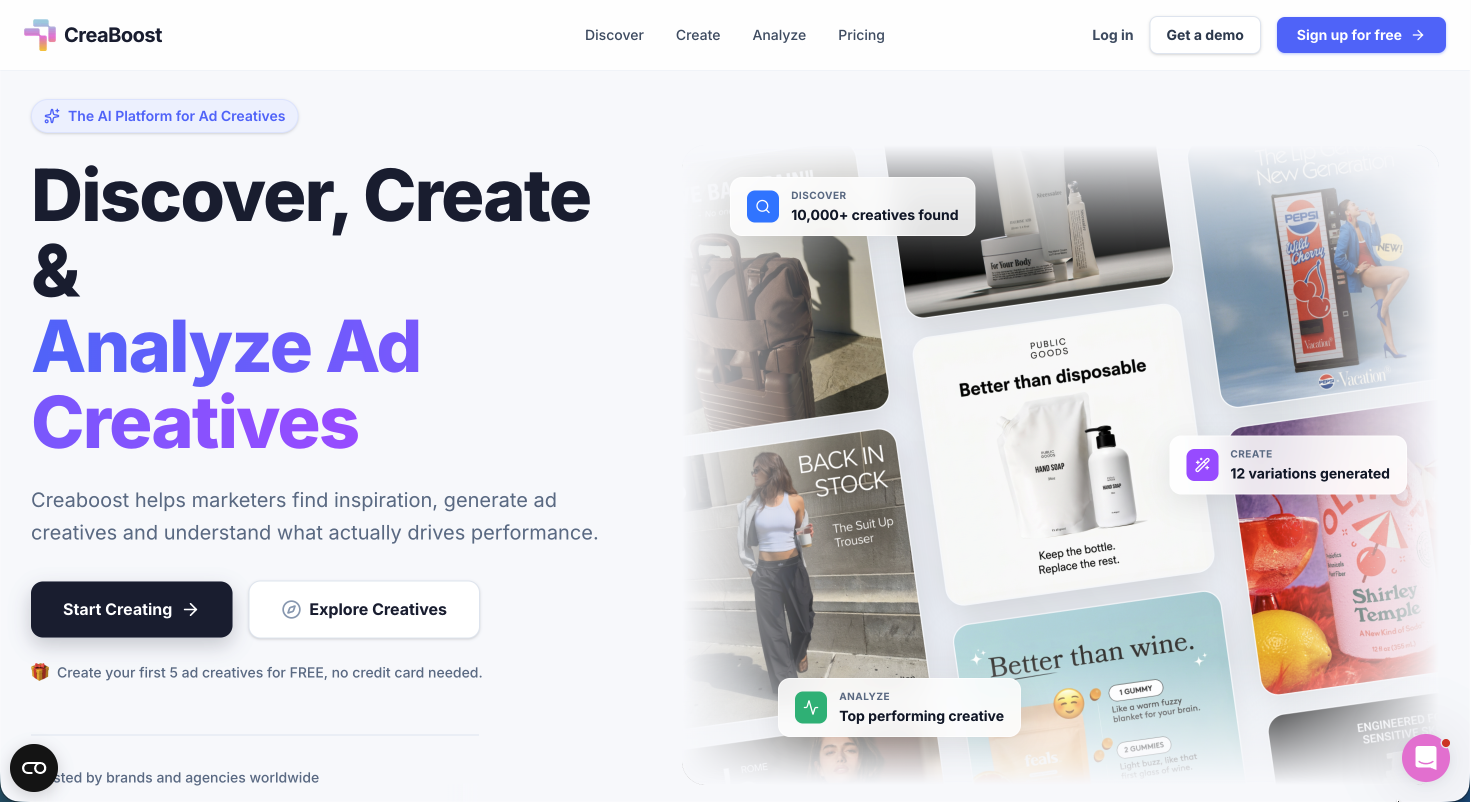
Creaboost connects directly to your Meta and TikTok ad accounts so you can analyze placement performance at the creative level, not just the campaign level. Auto-tagging by format, hook, and concept means you stop guessing which placements are driving ROAS and start making decisions based on real cohort data. When you are ready to act on those insights, you can generate high-performing creatives sized and formatted for every placement you need, in minutes rather than days. No more waiting on design queues while your best placements run stale assets. If you want to see what the full system looks like for your team, discover affordable plans and get your first placement-level performance report within the week.
Frequently asked questions
What is the difference between Feed and Stories ad placements on Meta?
Feed placements appear inside the scrolling content stream on Facebook and Instagram, while Stories and Reels placements are full-screen vertical formats that take over the entire screen for a more immersive, fast-paced experience.
Which TikTok placement reaches the largest audience?
The For You Feed aggregates the largest and most diverse audience on TikTok, pulling together Profile Feed, Following Feed, Search Feed, and more into a single high-reach placement.
Should I use automatic placement or select manually for best ROI?
Automatic placement maximizes reach and lets the algorithm optimize distribution, but manual selection gives you tighter creative control and cleaner performance data per placement, which is essential for serious optimization work.
What is the Audience Network and when should I use it?
Audience Network extends your Meta ads to third-party apps and websites, offering lower CPMs and broader reach, but it typically delivers weaker purchase intent than Feed or Stories placements and works best as a supplemental reach layer.
Do ad placements affect creative performance testing?
Yes, significantly. Different placements reward different creative formats, lengths, and styles, so testing creative without isolating placement variables often produces misleading results that are hard to act on at scale.