

Agencies that haven't touched AI yet are already running a lap behind. Research shows that AI slashes operational prep from 20 hours down to just 4 hours per week for agency founders handling client work, proposals, and content calendars. That's not a marginal improvement. That's 16 hours handed back to your team every single week, which compounds into a structural advantage over competitors still grinding through manual workflows. And this isn't a luxury reserved for enterprise holding companies with massive tech budgets. Agencies of every size are using AI to ship faster, analyze deeper, and win accounts they couldn't have touched two years ago.
Table of Contents
- The productivity lift: How AI automates agency workflows
- Content at scale: Generative AI's game-changing ROI
- Agencies lead the AI adoption curve: Data and competitive advantage
- Human expertise vs. AI: Where agencies add unique value
- Why most agencies underestimate the strategic power of AI
- Level up your agency with AI-powered creative solutions
- Frequently asked questions
Key Takeaways
| Point | Details |
|---|---|
| Massive time savings | AI slashes repetitive agency workload by up to 16 hours per person weekly. |
| More content, higher ROI | Generative AI enables triple the ad creative and over four times the content production return on investment. |
| Strategic agency edge | Agencies that invest in AI outperform brands especially in advanced measurement and insights. |
| Human creativity still matters | While AI excels at automation, original creative strategy and storytelling remain essential agency differentiators. |
The productivity lift: How AI automates agency workflows
Let's start with the work that nobody wants to talk about: the admin layer that quietly eats your team's best hours. Proposals, status decks, project tracking, content calendar assembly, weekly reporting. None of it is glamorous. All of it is necessary. And historically, all of it falls on the most capable people in your agency because those are the only people who can do it without making a mess.
AI automates these repetitive tasks in ways that are practical and immediate, not theoretical. A team lead who used to spend Monday morning assembling a client status report from three different spreadsheets can now have that report generated, formatted, and ready to send in minutes. That same person can get a first draft proposal built around a client brief in the time it used to take just to open the right template.
Here's a practical look at where the time savings stack up across a typical agency week:
| Task | Traditional time per week | AI-assisted time per week | Hours saved |
|---|---|---|---|
| Client prep and onboarding | 5 hours | 1 hour | 4 hours |
| Proposal drafting | 4 hours | 45 minutes | 3.25 hours |
| Content calendar assembly | 4 hours | 30 minutes | 3.5 hours |
| Weekly reporting and analytics | 4 hours | 1 hour | 3 hours |
| Project tracking updates | 3 hours | 30 minutes | 2.5 hours |
| Total | 20 hours | 3.75 hours | 16.25 hours |
That's more than two full working days returned to your agency every week. For a team of five, you're looking at nearly two additional full-time employees worth of capacity, without adding headcount.
The real strategic shift here isn't just efficiency. It's what your team does with that reclaimed time. When AI creative content generation handles the mechanical layer, creative directors spend their time on ideas. Strategists spend their time on positioning. Media buyers spend their time on signal reading rather than spreadsheet formatting.
"The agency bottleneck has never been a shortage of talented people. It's always been talented people stuck doing work that a system could do. AI doesn't replace the team. It removes the ceiling on what the team can accomplish."
Pro Tip: Audit your agency's last two weeks of calendar time before rolling out any AI tool. Document where hours are actually going, not where you think they are. The gaps between perception and reality are usually where the biggest wins hide.
Once you have a clear picture of the time drain, you can connect those workflows to AI for campaign analytics and operational tooling that closes the loop rather than just speeding up one stage.
Content at scale: Generative AI's game-changing ROI
If the productivity argument gets your attention, the ROI argument should get your budget. Agencies deploying generative AI in their content operations aren't just working faster. They're producing fundamentally more output while improving returns on every campaign dollar their clients spend.

The numbers are striking. Generative AI delivers 3.2x average ROI across marketing applications broadly, but content creation specifically hits 4.1x ROI, with time savings averaging 12 hours per week per marketer and output multiplied by 3.4x. Think about what that means for an agency running performance creative for eCommerce brands. If your team currently ships 10 ad variations per week per client, AI-enabled workflows push that to 34 variations in the same timeframe.
That matters enormously for Meta and TikTok specifically, where the platforms reward volume and speed of creative learning. More variations mean more data. More data means faster signal on what works. Faster signal means your client's campaigns start compounding returns while competitors are still waiting for their design queue to clear.
Here's how traditional and AI-enabled content workflows compare in a real agency context:
| Workflow stage | Traditional approach | AI-enabled approach |
|---|---|---|
| Brief to first creative | 3 to 5 days | Same day |
| Static ad variations per product | 2 to 4 per week | 20 to 40 per week |
| Format resizing for Meta and TikTok | 1 to 2 hours per asset | Automatic batch resizing |
| A/B test hypotheses tested per month | 4 to 6 | 20 to 30 |
| Creative refresh cycle | Every 3 to 4 weeks | Every 1 to 2 weeks |
The eCommerce angle is where this gets especially powerful. Brands running seasonal campaigns, flash sales, or product launches need creative volume on a timeline that no human design team can match without burning out. AI-driven creative tools change that equation entirely. A product URL becomes a full set of platform-ready static ads in minutes. Background swaps, hook variations, and format adjustments become clicks rather than revision rounds.
The core benefits for agencies serving eCommerce clients:
- Faster A/B testing cycles mean clients get to winning creative sooner, reducing wasted spend in the learning phase
- Creative refresh on demand prevents audience fatigue from tanking results mid-campaign
- Format coverage across Meta and TikTok without doubling the workload for every new placement
- Lower cost per creative asset improves agency margins or allows competitive pricing against in-house teams
- Consistent brand execution even when producing at high volume, because the AI works within set brand parameters
The agencies that understand this stop pitching on how many designers they have. They start pitching on how fast they can learn and iterate on behalf of clients. That's a completely different conversation, and it's one that wins business.
Agencies lead the AI adoption curve: Data and competitive advantage
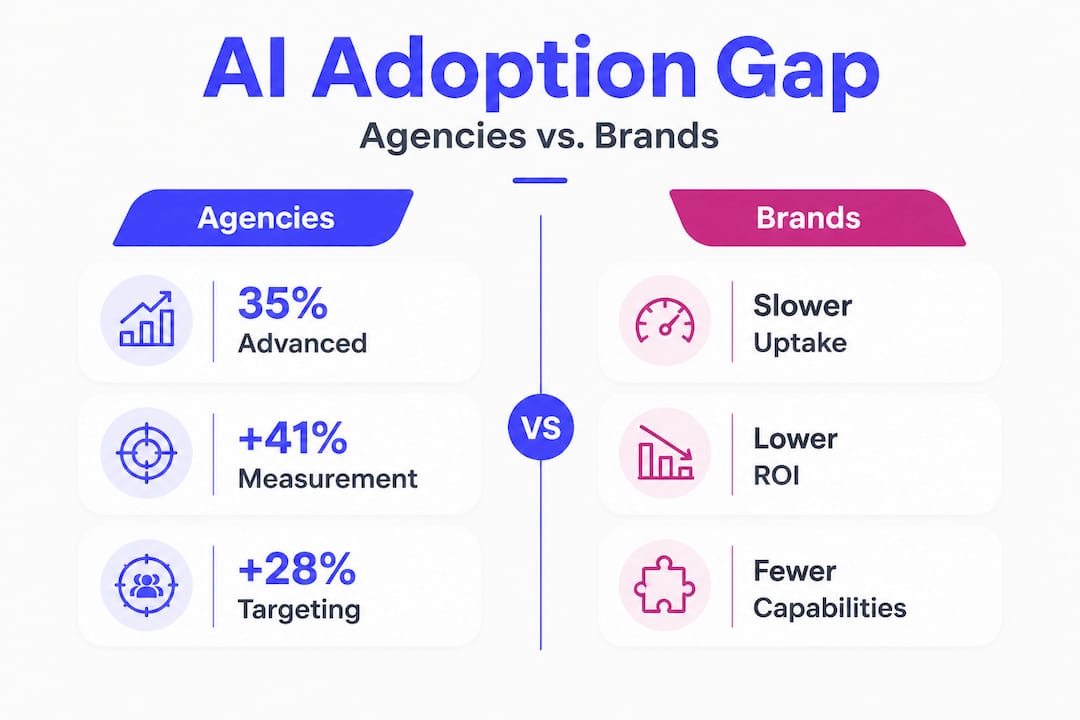
Here's something that often surprises brand-side marketers: agencies are running significantly ahead in AI adoption, and the gap is widening. Agencies are 35% more advanced than brands in overall AI adoption, according to BCG research, with particularly pronounced leads in measurement (57% more advanced), audience insights (20% more advanced), and audience targeting (22% more advanced).
That translates directly into campaign performance. An agency using AI for measurement can attribute creative performance at a level of precision that brand-side teams using legacy reporting simply cannot match. An agency using AI for audience insights can identify emerging segments and shifting behaviors faster than a brand's quarterly strategy review cycle allows.
| AI capability area | Agency adoption | Brand adoption | Agency advantage |
|---|---|---|---|
| Overall AI adoption | High | Moderate | 35% more advanced |
| Campaign measurement | Very high | Moderate | 57% more advanced |
| Audience insights | High | Moderate | 20% more advanced |
| Audience targeting | High | Moderate to low | 22% more advanced |
For agency leaders, this data is both encouraging and a call to action. The agencies building AI capability now are establishing gaps that will be very hard for slower movers to close. The question isn't whether to build AI into your practice. It's how fast you can move before the early adopters lock in the best clients and the clearest case studies.
Here's how a forward-thinking agency uses AI-powered analytics to win and retain top-tier clients:
- Connect AI analytics to client ad accounts on day one. Immediately start generating performance data tagged by creative format, hook type, and concept angle.
- Build a performance baseline within the first two weeks. Show the client what their creative portfolio actually looks like from a data perspective, not just an aesthetic one.
- Identify the top 20% of creatives driving 80% of results. This single insight usually pays for the agency relationship immediately.
- Spot creative fatigue two weeks before the client notices CPA drift. Present the proactive recommendation before the problem becomes visible.
- Use AI insights to brief the next creative cycle. Every sprint starts with real performance data, not gut instinct.
- Deliver monthly performance reports that actually explain performance. Not just numbers, but the creative decisions behind the numbers and what they mean for the next sprint.
Clients don't leave agencies that make them smarter. They fire agencies that make them guessing.
Human expertise vs. AI: Where agencies add unique value
All of this efficiency and scale only matters if your agency still brings something irreplaceable to the table. The good news is that it does. The important move is being clear-eyed about which parts of your work AI should own and which parts define your agency's actual value.
AI handles execution and optimization, while human talent focuses on strategy. Meta Advantage+ and TikTok Smart+ are already automating bidding, placement, and audience targeting at a platform level. Fighting those systems costs money. What they can't automate is the creative thinking, brand positioning, and strategic insight that makes your output worth optimizing in the first place.
What AI does best in creative agency contexts:
- Generating multiple variations of an approved creative concept
- Resizing and reformatting assets for different placements and platforms
- Tagging creative assets by format, hook, and concept for analytics
- Monitoring campaign performance and flagging anomalies
- Identifying creative fatigue signals before they hit headline metrics
- Pausing underperformers and reallocating budget based on preset rules
Where human judgment remains irreplaceable:
- Developing the original insight that becomes a winning campaign angle
- Writing the brand voice that makes a client's ads feel distinct from every competitor
- Recognizing when a client's category is shifting and repositioning accordingly
- Making the bold creative bet that data wouldn't have suggested but that changes everything
- Building the client relationship that earns trust for riskier strategic swings
- Evaluating AI-generated output against brand strategy that lives in people's heads
The agencies that thrive in this environment use AI-powered creative strategies as a multiplier for human judgment rather than a replacement for it. They're not using AI to produce generic content faster. They're using AI to execute on specific creative hypotheses at a speed that makes their strategic thinking far more valuable than it was before.
Pro Tip: When briefing creative work, always separate the strategic insight from the execution brief. The insight needs a human. The execution can be accelerated by AI. Keeping these two layers distinct helps your team use tools without diluting the thinking that makes your work worth buying.
Why most agencies underestimate the strategic power of AI
The conversation most agency leaders have about AI is the wrong one. They're asking "will it replace our creatives?" when the real question is "will agencies that use AI replace us?"
The threat isn't internal. It's competitive. An agency with 12 designers and no AI infrastructure is competing against an agency with 8 designers and a fully integrated AI creative pipeline. The second agency produces more output, learns faster, and probably charges less because their cost per creative asset is lower. That's not a future scenario. That's happening in pitches right now.
The fixation on AI as a job threat leads agencies to adopt a defensive posture that actually slows them down. They trial tools nervously, avoid committing to a platform, and end up with a frankenstack of subscriptions that nobody uses consistently. Meanwhile, their more decisive competitors are shipping 30 creative variations per week per client, catching fatigue two weeks early, and walking into QBRs with performance data that tells a story their clients can't get anywhere else.
The mindset shifts that actually move agencies forward:
- From "AI vs. human" to "what does each do best" so you stop having the wrong argument internally
- From "we'll test it when we have time" to "we're building the system now" because the time never appears on its own
- From volume as a cost to volume as a competitive weapon because the agencies shipping more creative are winning the learning race
- From unlocking high-impact creative thinking as a side project to embedding it in every brief so strategic insight drives every cycle instead of just the big ones
The agencies that will define the next five years aren't the ones with the best designers or the biggest ad spend under management. They're the ones with the tightest creative loop: more ideas tested, more data collected, faster pivots made. AI is what makes that loop tight enough to win.
Level up your agency with AI-powered creative solutions
The pattern is clear across agencies that have made the jump: AI doesn't just improve efficiency. It restructures how a team operates, what it can deliver, and how fast it can grow. The teams pulling ahead right now are the ones who stopped treating AI as an experiment and started building it into the core of how they work.
Creaboost is purpose-built for performance creative teams managing Meta and TikTok at scale. If your agency is feeling the pressure of creative volume, scattered analytics, or rising CPAs that nobody flagged in time, the platform addresses every layer of that problem. Use AI ad creative generation to go from product URL to dozens of platform-ready variations in minutes, with brand identity baked in and every Meta and TikTok format covered. Connect creative performance analytics directly to your ad accounts and get auto-tagged performance data that tells you exactly which concepts, hooks, and formats are driving real results, not just impressions. Your team stops guessing and starts knowing. Get started at creaboost.com.
Frequently asked questions
What are the first steps for a creative agency to get started with AI?
Start by automating repetitive tasks like calendaring, proposal prep, and status reporting, then expand into AI-driven content creation and performance analytics once those workflows are stable.
How does AI increase the number of ad creatives an agency can produce?
Generative AI tools let agencies create multiple ad variations from a single brief in minutes, with 3.4x more content output than traditional workflows allow.
Do agencies have a competitive advantage over brands by using AI?
Yes. Agencies are 35% more advanced than brands in AI adoption overall, with significant leads in measurement, targeting, and audience insights that translate directly into better campaign performance.
Which agency tasks should remain human-led even as AI advances?
Strategic creative thinking, brand storytelling, and high-level positioning require human expertise, since AI handles execution while humans must own the judgment that makes that execution worth running.