
Most performance marketers assume TikTok success comes down to catching a trend at the right moment, finding a charismatic creator, or getting lucky with the algorithm. That framing keeps teams stuck in a reactive posture, chasing virality instead of building systems. TikTok Smart Creative flips that model entirely. It puts AI at the center of creative optimization, replacing gut-feel decisions with real-time performance signals. This guide breaks down exactly what Smart Creative is, how it works inside live campaigns, and how e-commerce brands can use it to stop guessing and start scaling.
Table of Contents
- What is TikTok Smart Creative?
- How TikTok Smart Creative works inside campaigns
- Benefits of TikTok Smart Creative for e-commerce brands
- Practical tips for maximizing Smart Creative results
- Why most marketers underestimate Smart Creative's potential
- Elevate your TikTok ad strategy with Creaboost
- Frequently asked questions
Key Takeaways
| Point | Details |
|---|---|
| Smart Creative definition | TikTok Smart Creative uses AI to automate and optimize ad content for better performance. |
| Workflow advantages | Smart Creative streamlines creative testing, saving time and improving campaign outcomes. |
| Performance boost | Marketers report higher ROAS and conversion rates with Smart Creative-enabled campaigns. |
| Best practice tactics | Rotating creatives and leveraging CTA strategies maximize Smart Creative results. |
| Expert perspective | Automation leads to scalable success—don’t rely solely on gut instinct. |
What is TikTok Smart Creative?
TikTok Smart Creative is TikTok's AI-powered system for automating the generation and optimization of ad creatives within the TikTok Ads Manager platform. Instead of manually building each variation of a creative, uploading it, waiting for data, and then starting over, Smart Creative handles much of that cycle automatically. It takes your uploaded assets, applies machine learning to identify high-performing combinations, and serves variations to audiences based on real-time engagement signals.
The system pulls from several core capabilities. First, it generates creative variations from your existing assets, including images, video clips, text overlays, and audio. Second, it analyzes performance signals such as click-through rate, view completion, and conversion rate across those variations. Third, it reallocates delivery toward the combinations that are actually working, without requiring a manual bid adjustment or a new campaign setup.
Here is a quick breakdown of how Smart Creative compares to a fully manual approach:
| Feature | Manual creative | TikTok Smart Creative |
|---|---|---|
| Variation testing | Human-driven | Automated and continuous |
| Performance analysis | Requires manual pull | Real-time, in-platform |
| Creative adaptation | New brief and production cycle | Dynamic asset recombination |
| Speed to insight | Days to weeks | Hours to days |
| Team bandwidth required | High | Moderate |
The differences are significant. A manual workflow requires a strategist to identify a hypothesis, brief a designer, wait for production, upload assets, let them run for a meaningful window, pull the data, and repeat. Smart Creative compresses that loop dramatically.
Key features worth knowing:
- Automated video generation from static product assets
- Dynamic text and overlay variations tested in real time
- Integration with TikTok's branded content templates
- Compatibility with performance goals like conversions, app installs, and traffic
- Creative combination scoring, so you know which elements are pulling weight
Pro Tip: Even when Smart Creative is running, give it at least 10 to 15 distinct asset inputs. The more raw material you provide, the wider the variation surface and the faster the system finds winning combinations. Teams that upload three assets and call it a day are leaving most of the system's value on the table.
Building solid ad creative best practices into your asset library before activating Smart Creative will make every automated variation stronger from the start.
How TikTok Smart Creative works inside campaigns
With the basics covered, let us explore how Smart Creative operates within real TikTok campaigns.
The workflow follows a clear sequence, and understanding it helps you set campaigns up for success rather than just hoping the automation figures it out on its own.
Step-by-step campaign setup:
- Upload your creative assets. This includes video clips, static images, text variants, and audio files. The richer your asset library, the more combinations Smart Creative can generate and test.
- Set your campaign objective. Smart Creative adapts its optimization logic depending on whether your goal is conversions, traffic, or engagement. Your objective anchors the performance signals the system prioritizes.
- Define your audience parameters. Smart Creative optimizes creative delivery, not audience targeting. Set your targeting inputs deliberately, because the system will find the best creative for your audience, not the best audience for your creative.
- Activate Smart Creative at the ad group level. Once live, TikTok's system begins distributing variations and collecting performance data.
- Monitor the performance dashboard. After a 48 to 72-hour learning period, you will see which combinations are being favored and which are being deprioritized. Use this to inform your next creative cycle.
- Feed learnings back into your asset library. Pull the hooks, visuals, and text treatments that are winning, and brief new content around those patterns.
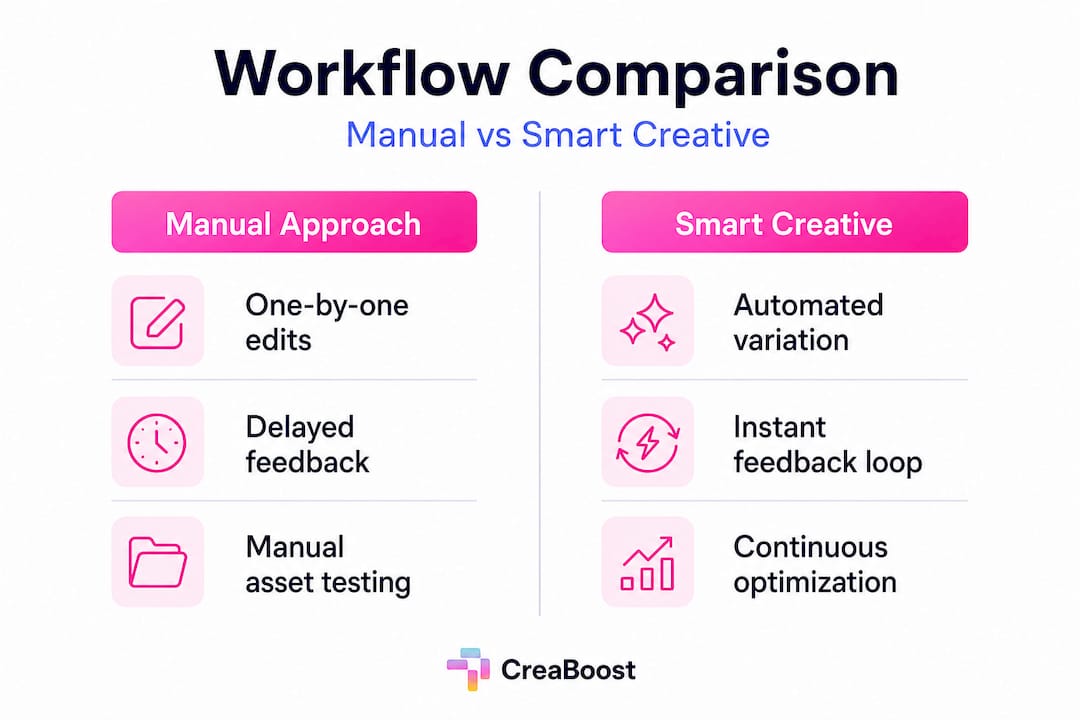
| Workflow stage | Manual approach | Smart Creative approach |
|---|---|---|
| Asset variation | One at a time, by request | Batch generated from uploads |
| Testing speed | One test per campaign cycle | Continuous parallel testing |
| Optimization trigger | Manual budget reallocation | Automatic delivery adjustment |
| Creative fatigue detection | Spotted in hindsight | Flagged by performance drop signals |
| Time investment per cycle | 5 to 10 hours | Under 2 hours |
The automated feedback loop is where Smart Creative earns its value. Instead of waiting for a CPA spike to tell you a creative has burned out, the system catches declining engagement early and shifts delivery to fresher combinations.
For teams working on scaling TikTok ads profitably, this kind of responsive automation removes a significant amount of the manual monitoring burden that typically slows scaling decisions down. And if you are still figuring out where your ads actually appear, understanding your ad placements for TikTok is a prerequisite for interpreting Smart Creative performance data accurately.
Pro Tip: Set a weekly review cadence specifically for your Smart Creative asset performance reports. Not to micromanage, but to extract the signal. The system tells you what is working at the element level, and those insights are gold for briefing your next production batch.
Benefits of TikTok Smart Creative for e-commerce brands
Understanding the workflow, consider what Smart Creative actually delivers for e-commerce marketers striving for better returns.
The clearest benefit is speed. Traditional creative testing at scale requires teams to build, upload, and analyze individual ad sets in sequence. Smart Creative runs those tests in parallel, continuously, across multiple asset combinations at once. What used to take a full sprint can happen in the first week of a campaign.
Core benefits for e-commerce teams:
- Higher creative throughput. More variations tested means more chances to find a winner. E-commerce brands with large catalogs especially benefit because Smart Creative can test product-specific angles without building each one manually.
- Reduced manual workload. Performance teams spend less time on repetitive upload and analysis tasks. That bandwidth shifts toward strategy and creative direction instead of operational grunt work.
- Lower cost per learning. Every creative test costs budget. Running smarter tests that adapt faster means you extract more insight per dollar spent.
- Faster fatigue detection. Creative fatigue is one of the most budget-draining problems in paid social. Smart Creative identifies declining engagement patterns earlier than manual monitoring typically catches them.
- Improved ROAS consistency. By continuously routing delivery toward your strongest creative combinations, the system defends your ROAS floor rather than letting it erode while you wait for data to surface.
"The brands that win on TikTok are not the ones with the biggest creative budgets. They are the ones running the tightest feedback loops between creative output and performance data."
That insight gets to the heart of why Smart Creative matters. The platform's feed is relentlessly competitive. Attention windows are measured in seconds. The teams that iterate fastest, test widest, and respond to signals in near-real time will consistently outperform those running static creative strategies.
Testing high-converting TikTok CTAs within your Smart Creative asset uploads is one of the fastest ways to generate actionable data. Small text variations on the same visual can move conversion rates meaningfully, and Smart Creative will surface the winner without a separate test setup. Studying real ecommerce TikTok ad examples from high-performing campaigns can also help you identify what to include in your initial asset library before Smart Creative starts running.
Practical tips for maximizing Smart Creative results
Armed with the benefits, here is how you can get even more from TikTok Smart Creative by following proven tactics that experienced performance teams use.
Rotate creatives on a structured schedule. Smart Creative extends the life of your assets, but it does not make them immortal. Plan a fresh asset drop every two to three weeks. New hooks, new visual treatments, new product angles. Give the system fresh material to work with consistently.
Do not abandon manual creative review. Smart Creative tells you what is performing, not why. That interpretive layer still requires human judgment. Review winning combinations regularly, identify the pattern driving performance (is it the hook? the product demo? the text overlay?), and brief new content that doubles down on that pattern.
Build asset libraries with variety in mind. Strong inputs produce strong outputs. When building your asset library for Smart Creative, include:
- Multiple hook variations (curiosity, problem-solution, social proof, transformation)
- Different visual treatments (lifestyle, product close-up, user-generated style, motion)
- Multiple text overlay lengths and tones
- At least three distinct call-to-action phrasings
- Both square and vertical aspect ratios
Use historical winners as templates. If you have run TikTok campaigns before, pull your top-performing creatives and reverse-engineer the structural elements. Feed those element types into your Smart Creative asset library as your baseline. The system will then test variations around a proven foundation rather than starting from zero.
Integrate Smart Creative data across platforms. The performance signals you collect on TikTok are not siloed insights. Hook retention patterns, CTA click-through rates, and visual engagement data can directly inform creative decisions on Meta and other paid channels.
Pro Tip: Treat your Smart Creative reports as a brief-writing tool, not just a reporting tool. When a combination wins, pull the exact elements, document them in a structured format, and make that your creative brief for the next production cycle. Teams that build this habit close the loop between performance data and creative production faster than any tool can do alone. Pair this with disciplined use of creative best practices and your learning compounds every cycle. Reviewing ecommerce ad examples from your vertical regularly keeps your hypotheses anchored in what real buyers are actually responding to.
Why most marketers underestimate Smart Creative's potential
Here is where conventional wisdom breaks down. Most performance marketers who are skeptical of Smart Creative are not skeptical of automation in general. They accept automated bidding. They accept algorithmic audience expansion. But they draw a line at creative, because creative feels like the last domain where human judgment should reign.
That instinct is understandable. But it is also costing teams money.
The reality is that human creative intuition is excellent at generating novel concepts and maintaining brand voice. It is genuinely poor at predicting which specific combination of hook, visual, and copy will convert a cold audience at 11pm on a Tuesday. That is not a creative judgment call. It is a probability problem, and machines solve probability problems faster and more accurately than people do.
"Trusting your gut on creative strategy is not a virtue. It is a data gap dressed up as experience."
The teams that outperform on TikTok are not abandoning creative thinking. They are applying it earlier in the process, at the concept and strategy level, and letting systems handle the execution-level optimization. That is a fundamentally different division of labor than most marketing teams currently operate with.
The shift also changes how you measure creative talent. The best creative strategists on high-performing teams are not the ones with the strongest aesthetic instincts. They are the ones who can read performance data, extract the structural insight, and turn it into a better brief. Smart Creative creates the performance data. The strategist's job is to interpret it and act. Reviewing creative best practices through the lens of what your data is already telling you is how that interpretation becomes a repeatable skill rather than a one-time insight.
The teams that figure this out earliest will build a compounding advantage. Every cycle, they get a little more signal. Every cycle, their asset library gets a little stronger. And the gap between them and teams still running static creative strategies gets a little wider.
Elevate your TikTok ad strategy with Creaboost
If Smart Creative is TikTok's optimization engine, Creaboost is the system that feeds it and interprets its output. Most teams hit the same ceiling: they understand Smart Creative in theory but lack the infrastructure to generate enough quality asset variations and then make sense of what the data is telling them.
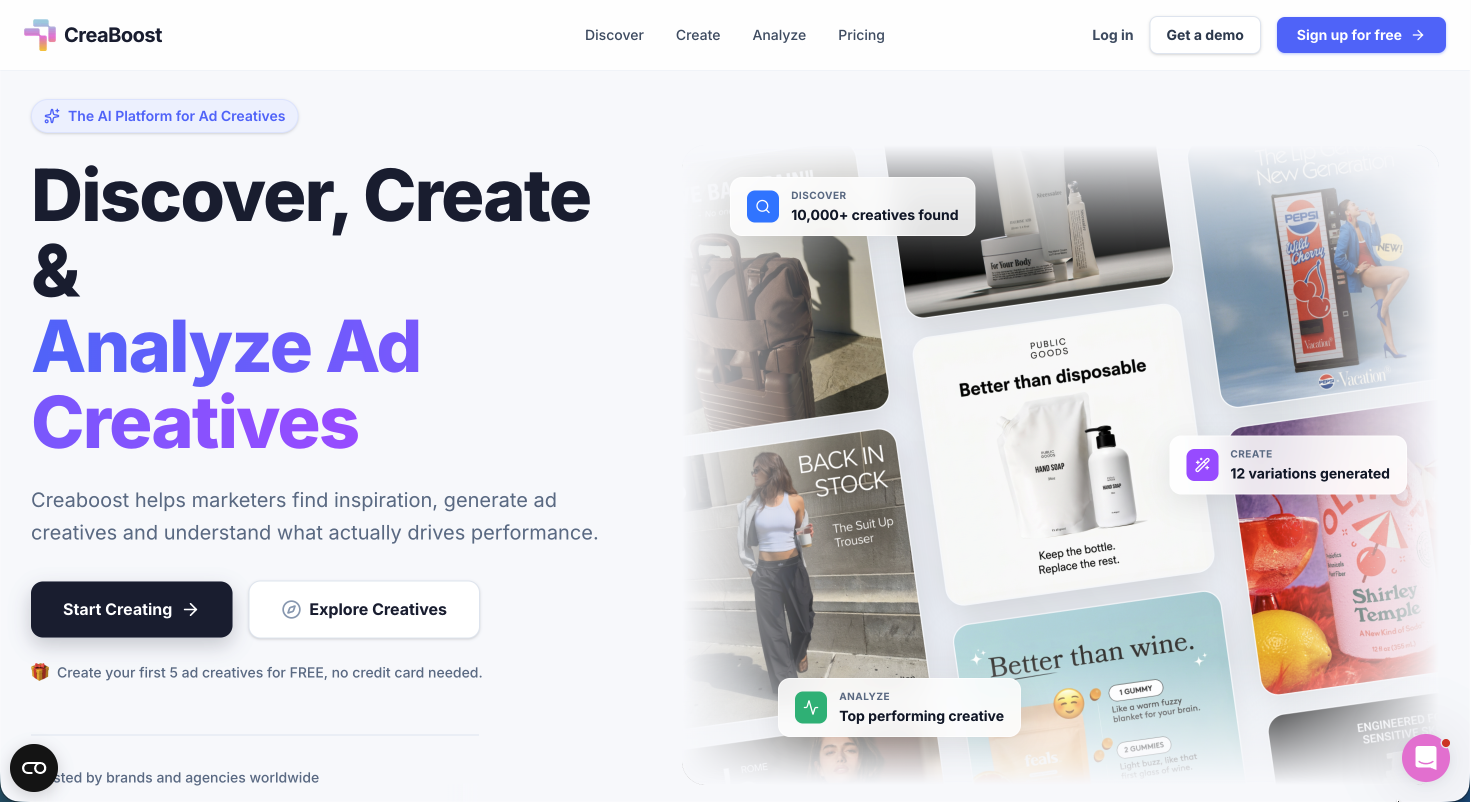
Creaboost's AI ad creative generation lets you turn a product URL into dozens of on-brand TikTok-ready variations in minutes, giving Smart Creative the rich asset library it needs to find winners fast. And once your campaigns are live, creative analytics for TikTok auto-tags every creative by hook type, format, and concept, so you always know which angles are driving ROAS and which are burning budget. No more spreadsheets, no more manual tagging, no more guessing. Just a tighter loop between creative production and performance insight, running continuously.
Frequently asked questions
Can small e-commerce brands benefit from TikTok Smart Creative?
Yes, Smart Creative automates testing and optimization, making it especially valuable for smaller teams that cannot afford to run large manual testing programs. Even with limited budgets, the system surfaces winning combinations faster than a manual approach would.
How do I measure success with Smart Creative?
Track ROAS, conversion rate, and creative-level engagement metrics including hook retention and click-through rate to understand which combinations are actually driving results versus just receiving impressions.
Does TikTok Smart Creative replace manual creative work?
No. Smart Creative handles execution-level optimization, but your team still needs to supply high-quality asset inputs, interpret performance data, and brief new creative directions. The division of labor shifts, but human judgment remains essential.
Is Smart Creative available across all TikTok ad formats?
Most major TikTok ad formats support Smart Creative, including in-feed video and collection ads, but you should check TikTok's current documentation directly since feature availability evolves regularly.
Can I use Smart Creative data to improve other channels?
Absolutely. Hook performance data, CTA response rates, and visual engagement insights from TikTok Smart Creative campaigns translate directly into stronger creative hypotheses for Meta and other paid social platforms.