

Most performance teams don't struggle to find ad examples. They struggle to find the right ones. With every brand publishing creative teardowns and every agency sharing their "top ads of the month," the signal-to-noise ratio has collapsed. What actually separates a scroll-stopping ad from a budget-burning one comes down to specific creative decisions, and knowing how to read those decisions is what separates teams that scale from teams that guess. This article breaks down seven proven ecommerce ad examples, explains exactly what makes each one work, and gives you a framework for choosing the right format for your next campaign.
Table of Contents
- What makes a winning ecommerce ad: Criteria for selection
- Top ecommerce ad examples for Meta and TikTok
- Ecommerce ad comparison table: Features, pros, and best use cases
- How to choose the right ad type for your ecommerce brand
- Why obsessing over ad examples can backfire—and what to do instead
- Supercharge your ecommerce ad strategy with CreaBoost
- Frequently asked questions
Key Takeaways
| Point | Details |
|---|---|
| Winning ad features | Top performers use strong visuals, clear offers, and mobile-first design to grab attention. |
| Diverse ad types | Use a variety of ad formats like video, carousels, and social proof to maximize reach and ROI. |
| Let data guide you | Analytics and testing are essential for understanding which ad examples truly resonate and scale. |
| Don’t copy blindly | Adapt ad examples to your brand’s funnel and audience for the best results. |
What makes a winning ecommerce ad: Criteria for selection
Before you can learn from ad examples, you need a clear lens for evaluating them. Not every high-impression ad is a high-performance ad. Plenty of creatives rack up views and generate almost no revenue. The criteria below are the ones that actually correlate with sales, not just engagement.
What to look for in a winning ecommerce ad:
- Scroll-stopping visuals: The first 1.5 seconds on TikTok and the first frame on Meta determine whether anyone sees the rest. Motion, contrast, and pattern interruption all help.
- Clear value proposition: A viewer should understand what the product does and why it matters within three seconds. Ambiguity kills conversion.
- Direct response CTAs: "Shop now," "Claim your discount," and "Get yours before it's gone" outperform vague CTAs like "Learn more" in most ecommerce contexts.
- Mobile-first design: Over 90% of Meta and TikTok traffic is mobile. Vertical formats, large text, and thumb-friendly layouts are non-negotiable.
- Concise copy: Fewer words, more impact. Long body copy works in email. In paid social, it's a liability.
- Social proof: Reviews, star ratings, user counts, and testimonials reduce purchase anxiety and increase conversion rates, especially for cold audiences.
Meta and TikTok also reward different creative styles. On Meta, polished brand creative and direct-response static ads still perform well, particularly in retargeting. On TikTok, native-feeling content that blends into the organic feed consistently outperforms ads that look like ads. Understanding this distinction matters when you're selecting examples to learn from. Learning to build high-performing ad creatives means respecting the platform context, not just copying a visual style.

Analytics should drive which examples you prioritize. Boosting creative performance through testing and data is the foundation of every winning ecommerce ad strategy, not gut feel.
Pro Tip: Segment your creative testing by funnel stage. Prospecting audiences need awareness-building hooks and strong value propositions. Retargeting audiences already know your product, so urgency, social proof, and offer-focused CTAs will convert better. Running the same creative across both stages is one of the most common and costly mistakes in paid social.
Top ecommerce ad examples for Meta and TikTok
These seven examples represent formats and creative approaches that consistently outperform in ecommerce. Each one illustrates specific principles from the criteria above.
-
The carousel product showcase (Meta). A skincare brand ran a six-card carousel featuring individual product benefits on each frame, with a "swipe to see results" hook in the first card. The format rewarded curiosity and kept users engaged longer than a single static image. Carousel ads on Meta allow you to tell a sequential story, and when each card adds new information rather than repeating the same message, time-on-ad increases sharply. The key here was that each card had its own CTA, so users could convert at any point in the sequence.
-
UGC-style video (TikTok). A home goods brand partnered with micro-creators to produce 15-second "unboxing reaction" videos filmed on phones, not cameras. The raw, authentic feel matched TikTok's native content style. These ads generated a 3.2x higher click-through rate than the brand's polished studio videos. The lesson: on TikTok, production quality is not a proxy for performance. Authenticity is.
-
Limited-time offer with countdown (Meta and TikTok). A fashion brand ran a static ad featuring a bold "48-hour sale" headline with a visible countdown timer graphic. Urgency is one of the oldest direct-response tools, and it still works. The ad used a single product image, one line of copy, and a "Shop the sale" CTA. No clutter. No distractions. The simplicity was the strategy.
-
Dynamic product ads (Meta). A footwear brand used Meta's dynamic product ads to automatically serve retargeting creatives showing the exact product a user had viewed on their website. These ads require minimal manual creative work but deliver highly personalized experiences. When someone sees the specific shoe they browsed yesterday, conversion intent is already high. Dynamic product ads consistently deliver strong ROAS in retargeting because the creative matches the user's demonstrated interest.
-
Influencer integration (TikTok). A supplement brand worked with a fitness creator who filmed a "day in my life" video that naturally featured the product. The ad was labeled as a paid partnership but felt organic because the creator's audience trusted their recommendations. This format works because it borrows the creator's credibility and delivers it to a warm audience. The brand saw a 40% lower cost per acquisition compared to their standard video ads during the same period.
-
Before-and-after split (Meta and TikTok). A cleaning products brand ran a simple side-by-side video showing a grimy surface transformed in under 10 seconds. No voiceover. No text overlay. Just the visual result. This format works because it demonstrates value instantly and requires zero cognitive effort from the viewer. The result speaks for itself. Before-and-after ads are especially effective for products where the transformation is visible and dramatic.
-
Social proof wall (Meta). A direct-to-consumer (DTC) supplement brand compiled 12 real customer reviews into a single static image with a five-star rating graphic at the top. The headline read: "Over 50,000 customers can't be wrong." This ad targeted cold audiences and outperformed the brand's product-focused creatives by a significant margin in cost per purchase. Social proof reduces the perceived risk of buying from a brand someone has never heard of.
"The brands winning on paid social in 2026 aren't the ones with the biggest budgets. They're the ones shipping the most creative variations and learning the fastest. Volume of testing, not perfection of execution, is the real competitive advantage."
AI-generated creatives can significantly shorten creative cycles and improve test volume, which is why more performance teams are incorporating AI generation into their workflow. Explore creative insights for ecommerce ads to see what's working across verticals right now.
Pro Tip: Build your ads from modular elements: hook, visual, offer, CTA. When you isolate each component, you can swap one variable at a time and learn exactly what drove a performance change. Testing an entirely new ad tells you something worked or didn't. Testing a new hook on the same ad tells you what worked.
Ecommerce ad comparison table: Features, pros, and best use cases
With the individual examples in view, here's a structured comparison to help you make faster decisions about which format fits your next campaign.
| Ad format | Creative highlights | Best use case | Potential drawbacks |
|---|---|---|---|
| Carousel product showcase | Sequential storytelling, multiple CTAs | Mid-funnel, product discovery | Requires strong individual card design |
| UGC-style video | Authentic, native feel, creator voice | Cold audience prospecting on TikTok | Quality control can be inconsistent |
| Limited-time offer | Urgency, minimal copy, bold headline | Flash sales, seasonal promotions | Loses impact if used too frequently |
| Dynamic product ads | Personalized, automated, high relevance | Retargeting warm and cart-abandon audiences | Requires product feed setup and maintenance |
| Influencer integration | Borrowed credibility, organic feel | Brand awareness and mid-funnel conversion | Creator costs and brand safety risks |
| Before-and-after split | Visual proof, zero cognitive load | Products with visible, dramatic results | Limited to transformation-friendly categories |
| Social proof wall | Trust signals, volume of validation | Cold audience conversion, new customer acquisition | Requires a real review base to be credible |
Key patterns from the comparison:
- Retargeting formats (dynamic product ads, social proof wall) rely on existing data or trust. They fall flat with cold audiences who have no prior brand exposure.
- TikTok-native formats (UGC, influencer) perform best when they don't look like ads. Any creative that signals "this is an advertisement" too early loses the TikTok audience fast.
- Urgency-based formats work in bursts. Overuse them and your audience becomes desensitized. Reserve them for genuine promotional windows.
- Before-and-after formats are underused in categories beyond cleaning and beauty. Any product with a measurable outcome (fitness, organization, home improvement) can adapt this structure effectively.
Creative analytics for ad performance help you identify which of these formats is actually resonating with your specific audience, not just which format worked for someone else's brand. Testing and analyzing ad creative performance is what separates informed decisions from expensive guesses.
How to choose the right ad type for your ecommerce brand
Knowing the formats is step one. Matching them to your specific situation is where the real work happens.
-
Map your creative to funnel stage first. Prospecting campaigns need formats that build awareness and curiosity fast: UGC videos, influencer integrations, and before-and-after splits. Retargeting campaigns need formats that close: dynamic product ads, social proof walls, and urgency-based offers. Mixing these up is one of the fastest ways to waste budget.
-
Decide between UGC and brand creative based on your audience temperature. Cold audiences on TikTok respond better to UGC because it feels native and trustworthy. Warm audiences on Meta who already know your brand can handle more polished creative because the trust is already established. The channel and the audience's familiarity with your brand should drive this decision, not your aesthetic preference.
-
Use creative templates to accelerate testing. Templates let you isolate variables without rebuilding every ad from scratch. If you have a strong performing static ad, create five versions with different headlines and run them simultaneously. The winning headline then becomes the foundation for your next round of tests. This approach multiplies your learning speed without multiplying your design workload.
-
Match your format to your creative bandwidth. Dynamic product ads and carousel formats require less ongoing creative production once set up. UGC and influencer formats require sourcing and coordination. If your team is already stretched, start with formats that scale without constant creative input.
-
Tie every test back to your core KPIs. Brands that align creative format with campaign objectives and audience consistently see higher ROAS. Define success before you launch: is this test optimizing for ROAS, CTR, cost per purchase, or something else? Without a clear KPI, you can't declare a winner.
For a detailed walkthrough of building and optimizing campaigns, the step-by-step guide for ad performance covers the full process from brief to analysis.
Pro Tip: Always tie your creative decisions back to specific KPIs before you launch. Deciding what success looks like after a test runs is how teams end up justifying mediocre results instead of learning from them.
Why obsessing over ad examples can backfire—and what to do instead
Here's the uncomfortable truth most creative roundups won't tell you: copying ad examples is one of the most common ways performance teams waste time and money.
It makes intuitive sense. You see a format that worked for a brand in your category, you replicate it, and you expect similar results. But what you're missing is everything you can't see. You don't know their audience temperature. You don't know their offer economics. You don't know whether that ad was running to a retargeting list of 200,000 warm buyers or a cold prospecting audience. You don't know if it actually drove revenue or just generated cheap clicks that never converted.
The format was the least important variable. The context was everything.
Real ad growth often comes from translating category best practices into bespoke tests for your own segmentation and funnel, not from lifting creative wholesale. The brands that consistently win aren't the ones with the best examples folder. They're the ones with the tightest feedback loop between creative output and performance data.
There's also a timing problem. The ad examples circulating in industry roundups today were likely running six to twelve months ago. The formats that dominated last year are now saturating the feed. Your audience has already seen them. What looked fresh and native six months ago now reads as a template. High-performing ad creative strategies require constant evolution, not static imitation.
Use examples as a starting point for hypotheses, not a destination. Ask: what principle does this ad demonstrate? Then test whether that principle applies to your brand, your offer, and your audience. That's the difference between learning from examples and being limited by them.
Supercharge your ecommerce ad strategy with CreaBoost
The seven ad formats covered in this article represent proven creative directions. But knowing what works in theory and executing it consistently at scale are two very different problems.
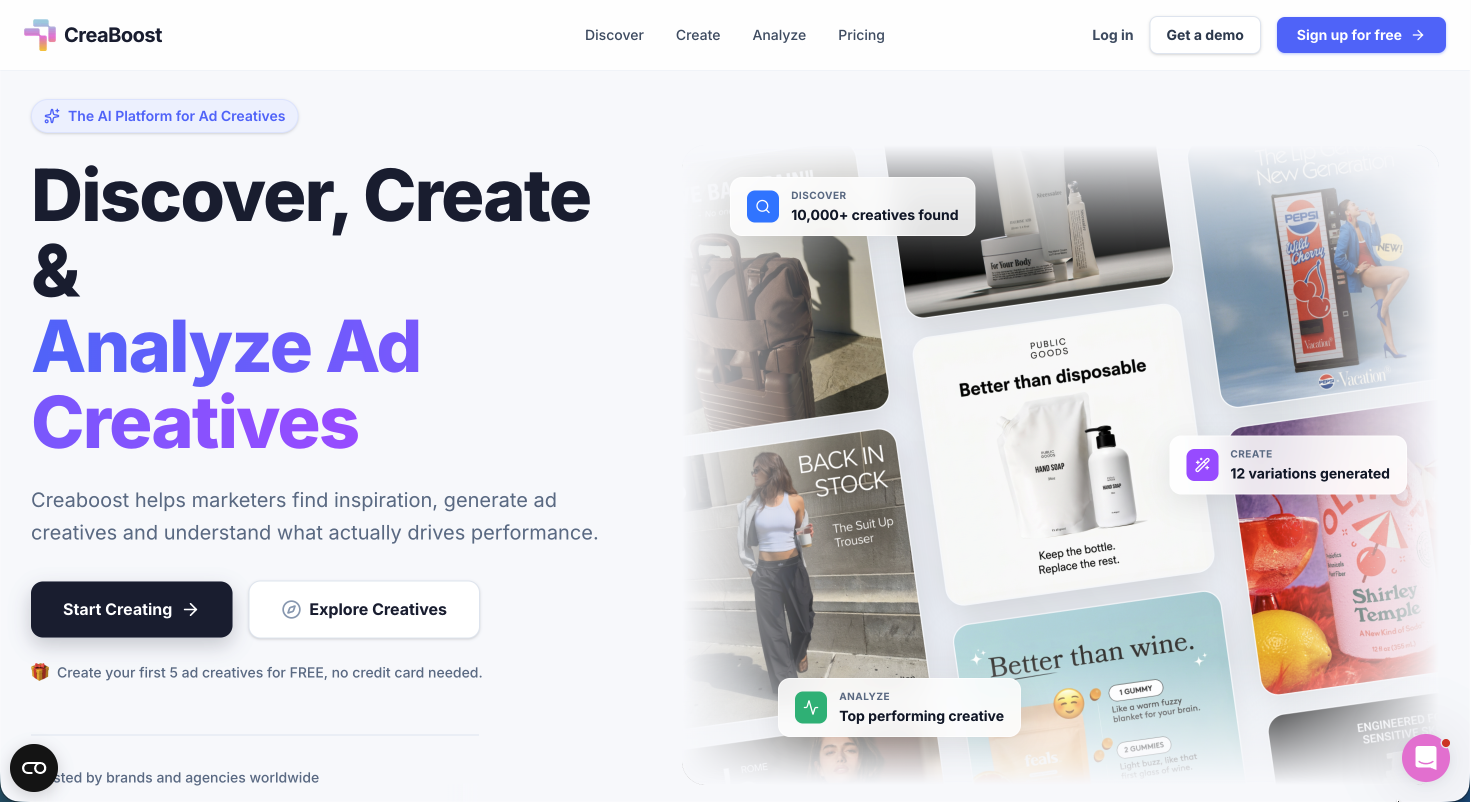
The CreaBoost platform is built to close that gap. With creative analytics features, you get automatic tagging by format, hook, and concept, so you can see which of these seven ad types is actually driving ROAS in your account, not just which one looks good in a case study. With AI creative generation tools, you can turn a product URL into dozens of platform-ready variations across every format covered here, in minutes. You stop waiting on design queues and start shipping the volume of tests that actually moves the needle. One platform. The entire creative loop. Plug in your ad accounts and start learning faster this week at creaboost.com.
Frequently asked questions
What are the most effective creative formats for ecommerce ads in 2026?
Short-form video, user-generated content, dynamic product ads, and carousels consistently perform well on Meta and TikTok. Testing and creative analytics show which formats are most effective for your specific audience and goals.
How often should ecommerce brands update their ad creatives?
Update creatives every two to four weeks or whenever performance begins to decline, since audience fatigue sets in faster than most teams expect. AI-generated creative tools allow for rapid creative refresh cycles without overwhelming your design team.
How do you measure ecommerce ad success?
Key metrics include ROAS, click-through rate, conversion rate, and cost per purchase, tracked through analytics dashboards that offer deep creative performance insights at the concept and format level.
Should ecommerce brands copy ad examples directly?
No. Brands get better results by adapting examples to their own audience, funnel, and offer. True ad success comes from testing, analyzing, and iterating on top of proven frameworks, not from copying them outright.