
The ad creative variation process is the systematic method of generating, testing, and iterating on multiple ad versions to identify which concepts, hooks, and formats drive the strongest campaign outcomes. Performance marketers who treat this as a structured discipline rather than a guessing game consistently outperform those who rely on intuition alone. Platforms like Meta Advantage+, Dynamic Creative Optimization (DCO), and Google Responsive Search Ads (RSA) have made algorithmic testing more accessible, but the process still breaks down without the right inputs, budget structure, and testing hierarchy. This guide covers the full workflow: from asset prerequisites to execution frameworks to the most common failure points teams hit at scale.
What prerequisites and tools make the ad creative variation process work
Before you run a single test, your asset library and account structure need to meet minimum thresholds. Skipping this step is the most common reason creative testing produces inconclusive data.
Platform asset requirements

Meta recommends 10 to 20 creative assets for Advantage+ Shopping campaigns to give the algorithm enough signal diversity to optimize meaningfully. That means the algorithm has real choices to make, not just two versions of the same concept with different button colors. Google RSA operates on a similar principle: you can supply up to 15 headlines and 4 descriptions, and filling those slots fully unlocks the combinatorial testing that makes RSA valuable. Pinning headlines to fixed positions reduces that potential significantly, so reserve pinning only for legal or brand-critical copy.
Seeding your creative pool with competitive intelligence
The fastest way to build a high-quality starting library is to study what is already working in your vertical. Meta's Ad Library gives you direct access to active competitor ads, including run duration, which is a reliable proxy for performance. Treat this as a research input, not a shortcut. You are looking for recurring angles, hook structures, and visual formats that appear across multiple advertisers. That pattern recognition seeds your own variation pool with hypotheses that have already survived real market exposure.
| Asset Type | Minimum Count | Recommended Count |
|---|---|---|
| Static images | 3 | 8 to 10 |
| Video creatives | 2 | 5 to 7 |
| Headlines (RSA) | 3 | 15 |
| Ad copy variants | 2 | 5 |
| Concept angles | 2 | 4 to 6 |
Budget and event thresholds
Asset volume alone is not enough. A minimum of 50 optimization events per ad set per 7-day rolling window is required for Meta to exit the learning phase reliably. Below that threshold, your ad set stays in Learning Limited status, and any performance data you collect is statistically unreliable. This means your budget allocation strategy is as much a prerequisite as your creative assets. Spreading $500 across ten ad sets will leave every single one of them in learning indefinitely.
Modular creative design
Design assets so that every component works independently. Headlines should not reference a specific visual. A video hook should not assume a particular overlay text. Modular component design prevents broken or mismatched pairings when DCO recombines your assets algorithmically. This is a structural decision you make before production, not something you can retrofit after the fact.
How to execute the ad creative variation process step by step
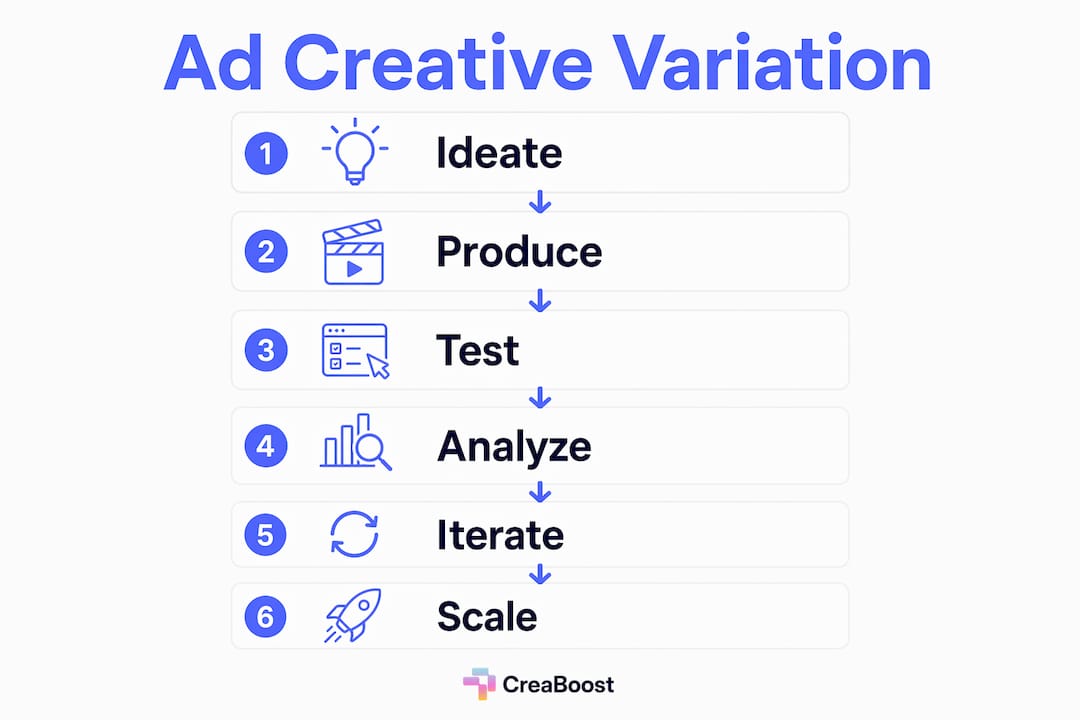
The testing loop that produces reliable winners follows a clear sequence: ideate, produce, test, analyze, iterate, and scale. Most teams collapse two or three of those stages together and then wonder why their data is muddy.
Prioritize concept and hook before copy or color
The highest-leverage variable in any ad is the concept and angle, not the button color or headline font. Test whether a "social proof" angle outperforms a "problem agitation" angle before you spend time optimizing the CTA wording. Format comes second. Does a UGC-style video outperform a static product image for this offer? Only after you have a winning concept and format does it make sense to run element-level refinements on copy, color, or overlay text.
Separate concept tests from element-level iteration
Manual A/B tests of 3 to 5 variants changing one element at a time over 7 to 14 days produce the cleanest concept-level learnings. That timeline matters because it gives the algorithm enough time to exit the learning phase and deliver statistically meaningful data. DCO is better suited for element-level variation once you have a winning concept, because it assembles combinations at speed and volume that manual testing cannot match. Mixing concept tests inside a DCO campaign blends signals and makes it nearly impossible to know which angle actually drove performance.
Pro Tip: Run your concept tests in isolated ad sets with controlled budgets. Once a concept wins, move its assets into a DCO campaign to optimize element combinations at scale. Never run both phases in the same campaign at the same time.
- Ideate: Build 3 to 5 distinct concept angles based on competitor research and customer insight. Each angle should represent a genuinely different message, not a surface variation.
- Produce: Create 2 to 3 executions per concept. Use modular components so assets can be recombined without mismatches.
- Test: Run controlled A/B tests for 7 to 14 days per concept pair. Maintain budget at a level that reaches 50 or more optimization events per ad set per week.
- Analyze: Identify the winning concept by ROAS, CPA, or your primary KPI. Look at cohort-level data, not just impression-weighted averages.
- Iterate: Move the winning concept into DCO for element-level optimization. Feed the losing concepts back into the ideation phase as negative signals.
- Scale: Increase budget on proven winners. Use the performance ad testing guide to set scaling thresholds before you touch the budget.
One critical rule during the test phase: hold campaigns steady for at least 7 days after launch before making any changes. Editing a campaign mid-test resets the learning phase and invalidates your data. This is the single most common mistake teams make when they get impatient with early results.
What challenges break the ad creative variation process
Even well-structured testing programs hit predictable failure points. Knowing them in advance means you can build around them rather than diagnose them after the fact.
- Budget fragmentation: Splitting budget across too many ad sets is the fastest way to keep every variant in learning indefinitely. Consolidate to fewer ad sets with sufficient per-set budgets before adding more variants.
- Insufficient creative disagreement: DCO converges on the least bad variant when input assets are too similar. If your five images are all product shots on white backgrounds, the algorithm has nothing meaningful to choose between. Genuine angle diversity, not just visual variety, is what drives DCO performance.
- Concept and element tests mixed together: Running concept-level and element-level tests in the same campaign produces data that cannot be cleanly attributed to either variable. Keep them in separate campaigns with separate budgets.
- Learning phase resets from premature edits: Any significant change to a live campaign, including budget increases above 20%, creative swaps, or audience edits, resets the learning phase. Build a hold period into your workflow and enforce it.
- Ad fatigue from stale asset pools: Audiences burn through creative faster than most teams refresh it. Rotating out the bottom 20 to 30% of performers every two weeks keeps the DCO pipeline fresh and prevents frequency-driven performance decay.
The teams that win at creative testing are not the ones running the most tests. They are the ones running the fewest tests with the cleanest signal. Budget consolidation, genuine concept diversity, and disciplined hold periods are what separate a learning machine from an expensive noise generator.
Remedies are straightforward once you identify the root cause. Budget consolidation means fewer ad sets with higher per-set spend. Proper test isolation means one variable per test, always. Competitor-sourced asset seeding means your creative pool starts with angles that have market validation. Scheduled refreshing means you replace underperformers on a calendar cadence, not when someone notices the CPA has drifted.
How do Meta Advantage+ Creative, DCO, and Flexible Ad Formats differ?
These three tools are frequently confused, and using the wrong one for the wrong job produces exactly the kind of muddy data described above.
Pro Tip: Disable Advantage+ Creative enhancements for brand-sensitive campaigns where visual consistency is non-negotiable. The efficiency gains are real, but so is the loss of control over how your creative actually renders.
| Feature | What it does | Best use case | Control level |
|---|---|---|---|
| Advantage+ Creative | Applies automated post-upload enhancements: brightness, cropping, text overlays | Single-creative optimization at the impression level | Low |
| Dynamic Creative Optimization | Assembles multiple asset combinations algorithmically and tests them at scale | Element-level variation after concept is validated | Medium |
| Flexible Ad Formats | Lets Meta choose format type per impression: video, image, or carousel | Broad reach campaigns where format preference is unknown | Very low |
Advantage+ Creative applies automated enhancements to a single uploaded creative, adjusting brightness, cropping, and overlays per impression. It is not a testing tool. It is an optimization layer applied after the fact. DCO, by contrast, takes multiple distinct assets and assembles them into combinations the algorithm then tests against each other. Flexible Ad Formats goes one level further, letting Meta decide whether to serve your asset as a video, static image, or carousel depending on what it predicts will perform best for each individual impression.
Each layer reduces your direct control in exchange for algorithmic efficiency. The practical implication is that layering all three simultaneously makes it nearly impossible to understand what is actually driving performance. For concept-level learning, turn off Advantage+ Creative enhancements and Flexible Ad Formats. Run clean assets in a controlled DCO setup. Once you have a validated winner, you can layer the automation back in to squeeze out efficiency gains at scale. The digital ad campaign tips for Meta and TikTok cover this layering logic in more detail for both platforms.
Key takeaways
A disciplined ad creative variation process requires concept-level testing before element-level optimization, sufficient budget per ad set to exit the learning phase, and modular asset design that enables clean algorithmic recombination.
| Point | Details |
|---|---|
| Asset volume matters | Meta Advantage+ needs 10 to 20 assets; Google RSA needs up to 15 headlines to optimize effectively. |
| Budget drives learning | Each ad set needs 50 or more optimization events per week to exit Meta's learning phase reliably. |
| Test hierarchy is non-negotiable | Test concept and hook before copy or color; never mix concept tests with DCO element tests. |
| Modular design enables DCO | Assets built as independent components recombine cleanly and produce more useful algorithmic signals. |
| Refresh on a schedule | Replace the bottom 20 to 30% of DCO assets every two weeks to prevent audience fatigue and performance decay. |
Why most teams are testing creatives in the wrong order
The most persistent mistake I see in performance marketing is teams running element-level tests before they have validated a concept. They spend three weeks optimizing button copy on an angle that was never going to convert. The hierarchy matters more than the volume of tests you run.
The second thing I have consistently found is that competitive research is treated as optional rather than foundational. Your creative pool should start with angles that have already survived real market exposure in your vertical. That is not copying. That is using available signal intelligently before you spend production budget on hypotheses that have no prior validation.
The third observation is about the relationship between budget and learning. Most teams under-budget individual ad sets to run more variants simultaneously. The math feels right but the outcome is wrong. Fewer, better-funded ad sets produce cleaner data faster than a dozen underfunded ones running in perpetual learning. Consolidate first, then expand once you have proven concepts to scale.
The distinction between DCO as a production tool and A/B testing as a learning tool is not academic. Teams that conflate them end up with neither clean learnings nor efficient production. They are genuinely different instruments for different phases of the creative cycle. Use them accordingly, and your ad creative performance will compound over time rather than plateau.
— Bythewise
How Creaboost supports your creative variation workflow
If the process described above sounds like it requires more operational infrastructure than your current setup can support, that is exactly the problem Creaboost is built to solve.
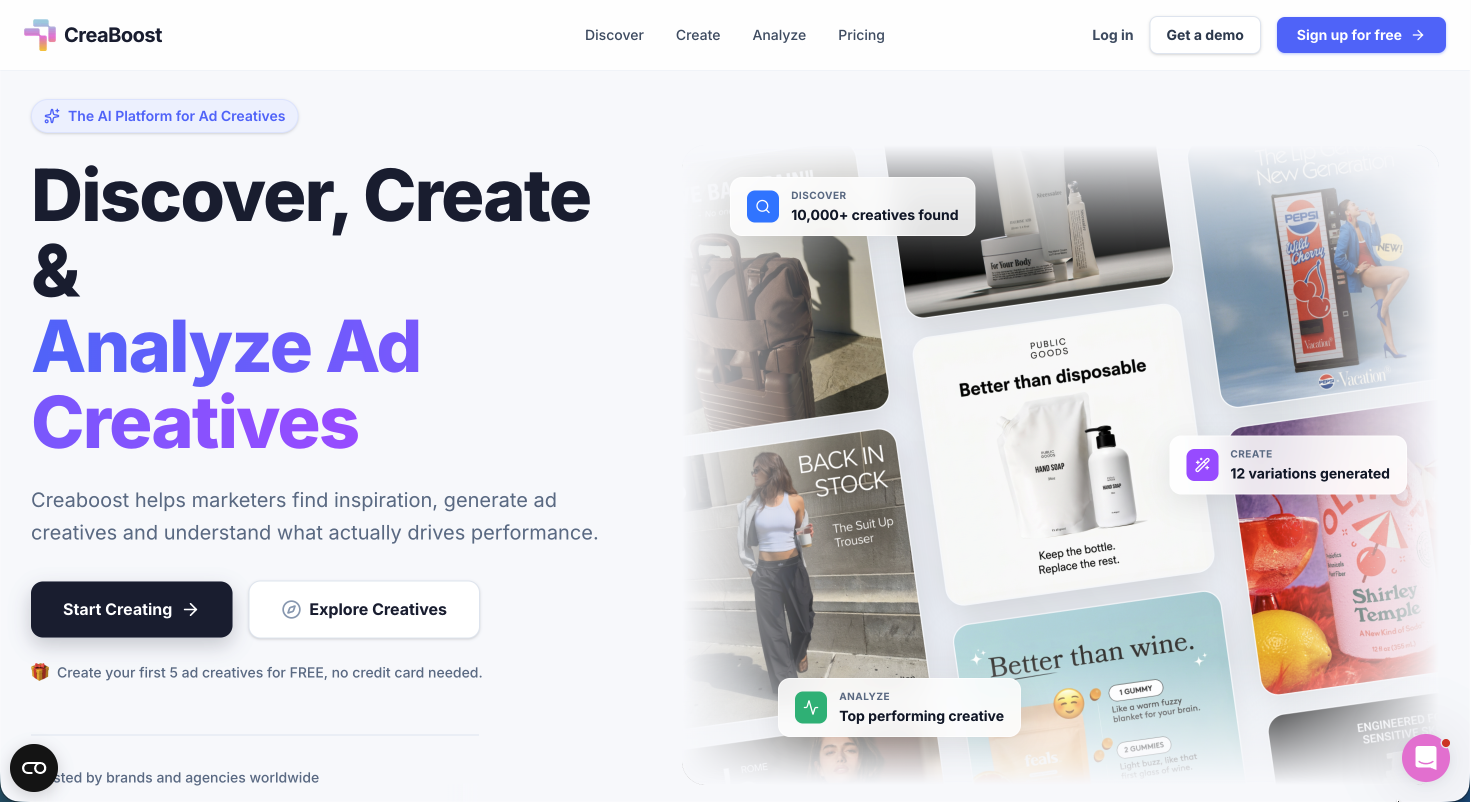
Creaboost covers the entire creative loop in one platform. The Discover module seeds your creative pool from real performance patterns in your vertical, so you stop briefing from a blank page. The Create module turns a product URL into dozens of platform-ready variants in minutes, not designer round-trips. And Creaboost's Analyze feature auto-tags every creative by hook, angle, and format, then connects directly to your ad accounts so you see which concepts are actually driving ROAS rather than just collecting impressions. You can also explore AI-powered creative generation to ship more variations without expanding your design team. Get started at creaboost.com.
FAQ
What is the ad creative variation process?
The ad creative variation process is the structured practice of generating multiple ad versions, testing them against each other, and iterating based on performance data to improve campaign outcomes. It covers concept development, asset production, controlled testing, and systematic scaling of winning variants.
How many creative assets do you need for Meta Advantage+?
Meta recommends 10 to 20 creative assets for Advantage+ Shopping campaigns to provide the algorithm with enough signal diversity to optimize effectively. Fewer assets limit the algorithm's ability to identify meaningful performance differences between variants.
What is the difference between DCO and A/B testing for ad creatives?
DCO assembles multiple assets into combinations algorithmically and tests them at speed, making it best for element-level variation after a concept is validated. Manual A/B testing isolates one variable at a time over 7 to 14 days and is better suited for concept-level learning where signal clarity matters more than speed.
How do you avoid resetting the learning phase during creative tests?
Hold campaigns steady for at least 7 days after launch before making any edits, including budget changes above 20% or creative swaps. Any significant modification resets the learning phase and invalidates the performance data you have collected up to that point.
How often should you refresh your DCO creative asset pool?
Replace the bottom 20 to 30% of performing assets every two weeks once metric rankings have stabilized. This cadence keeps the DCO pipeline optimized and prevents audience fatigue from degrading performance before you notice it in your headline metrics.