
Running ads on Meta and TikTok in 2026 is not simply a matter of setting a budget and watching results roll in. The digital ad campaign tips that actually move the needle go well beyond basic targeting. Most campaigns struggle because of structural problems: creative fatigue that goes undetected for weeks, learning phases that never stabilize, and testing frameworks built on gut instinct rather than statistical discipline. This article unpacks the specific, platform-aware moves that separate campaigns generating compounding returns from the ones quietly bleeding budget every week.
Table of Contents
- Key takeaways
- 1. Mastering the learning phase on Meta and TikTok
- 2. Recognizing and fighting creative fatigue before it costs you
- 3. Structuring campaigns and conversion events for algorithm efficiency
- 4. Building a real testing and iteration framework
- My honest take on what most teams get wrong
- How Creaboost closes the creative loop for Meta and TikTok teams
- FAQ
Key takeaways
| Point | Details |
|---|---|
| Protect your learning phase | Structure ad sets to hit 50 optimization events per week, using proxy events when purchase volume is low. |
| Rotate creatives proactively | Creative fatigue sets in above a frequency of 2.5 on Meta. Refresh assets before performance visibly drops. |
| Consolidate, don't fragment | Thin, overlapping audiences and too many ad sets dilute event volume and stall algorithm learning. |
| Test one variable at a time | Valid experiments require isolating single changes and targeting at least 1,000 visitors per variant. |
| Track conversions cleanly first | Misconfigured tracking is the most common root cause of poor campaign performance and bad algorithm signals. |
1. Mastering the learning phase on Meta and TikTok
The learning phase is not a formality you wait out. It is the period when the algorithm calibrates delivery based on the signals your campaign generates. If you do not feed it correctly, you end up with unstable CPAs and delivery that never finds its rhythm.
On Meta, exiting the learning phase requires roughly 50 optimization events per ad set within a 7-day window. Miss that threshold and your ad set gets flagged as "learning limited," which means erratic delivery and unpredictable costs. Most advertisers know this rule but still fail it because they set up too many ad sets that each capture too little volume.

When purchase volume is genuinely low, switch your optimization event to something that fires more frequently. Add to Cart and Initiate Checkout are natural proxies that generate the event density you need without waiting for enough purchases to accumulate. This is a structural fix, not a workaround.
A few other moves that directly support learning phase stability:
- Avoid editing active ad sets. Every significant change resets the learning counter and starts the 7-day window over.
- Use Campaign Budget Optimization so that Meta shifts budget dynamically toward the ad sets accumulating events fastest.
- Consolidate overlapping audiences into fewer, larger ad sets rather than slicing by minor demographic variations.
On TikTok, the principle is similar but the execution looks different. TikTok recommends broad conversion-optimized testing before you narrow audience parameters. Over-segmented audiences on TikTok stall the algorithm just as quickly as they do on Meta, and you lose the benefit of TikTok's own user-behavior signals.
Pro Tip: If you are managing multiple clients or product lines, treat each ad set's event volume as a first-class metric in your weekly review, not an afterthought. Low event volume kills learning faster than bad creative does.
2. Recognizing and fighting creative fatigue before it costs you
Creative fatigue is the silent CPA killer. By the time rising costs show up in your dashboard, the damage has been accumulating for days. The smarter move is to catch fatigue in the signal data before it reaches your headline numbers.
On Meta, frequency above 2.5 to 3.0 correlates with CPA increases of 10 to 25 percent. That range arrives faster than most teams expect, particularly in retargeting campaigns with tight audience pools. Setting a frequency alert at 2.5 gives you enough runway to swap in fresh assets before performance breaks.
When you do refresh, you do not always need to start from scratch. Partial creative refreshes outperform full re-briefs operationally because they preserve the algorithm's existing learnings while still presenting a new stimulus to tired audiences. Swap the hook, change the opening visual, or update the call-to-action copy. The ad feels new to the user, and the algorithm does not lose its calibration.
TikTok has a shorter fatigue cycle than Meta. TikTok rewards creative velocity with strong hooks in the first three seconds and recommends running three to five creatives per ad group with regular refreshes. Native-style videos that blend with organic content fatigue slower than polished brand productions because they feel less like interruptions.
Here is what a practical creative rotation system looks like:
- Run at least three to four active creative variants per ad set at any time.
- Schedule a proactive review every two to three weeks regardless of current performance.
- Keep a "ready queue" of at least two tested variants waiting to go live when fatigue indicators appear.
- Document which hooks, formats, and angles have already run so you are not recycling concepts your audience has seen.
Understanding why creatives drive ROAS on Meta and TikTok is the prerequisite for building a creative rotation system that holds up at scale.
Pro Tip: Do not wait for CTR to drop before acting. Frequency is a leading indicator. CTR and CPA are lagging ones. Build your alerts around frequency, and you will always be one step ahead.
3. Structuring campaigns and conversion events for algorithm efficiency
Campaign structure is one of the most underleveraged ad campaign optimization tips in circulation. Most underperforming accounts are not running bad creative. They are running good creative inside a structure that prevents the algorithm from learning properly.
Follow these structural principles to give the algorithm the best possible conditions:
- Match your optimization event to actual volume. Google's recommendation for App Campaigns is a minimum of 10 conversions per day to exit learning. On Meta, you need 50 per week per ad set. If your current event cannot hit those numbers, move up the funnel.
- Set budgets that support learning, not just delivery. Starting budget at 5x your target CPA on Meta and 50x on Google App Campaigns gives the algorithm room to gather meaningful data before it locks in delivery patterns.
- Scale incrementally. Increasing budget by no more than 20 percent every three to five days prevents re-learning shocks that reset the stability you have built.
- Segment by geo tier, not by interest. Mixing high-value and low-value geographic markets in one campaign dilutes the signal quality. A campaign optimizing for US conversions alongside lower-tier markets ends up confused about what a good conversion actually looks like.
- Cap campaign count on Google App. Google recommends no more than two to four campaigns per app to avoid fragmenting event volume across too many learning pools.
On Meta, the Advantage+ Shopping Campaign structure has simplified a lot of this for e-commerce, but performance marketers running lead gen or app installs still need to think carefully about consolidation. The fewer ad sets you run, the more volume each one captures, and the faster you exit learning.
4. Building a real testing and iteration framework
Most ad teams think they are testing when they are actually just changing things and hoping for different results. A proper ad campaign optimization guide treats testing as a discipline, not a habit.
The foundation is variable isolation. Every test should change exactly one thing: the hook, the headline, the offer framing, or the landing page. When you change two things at once and performance improves, you have no idea which change drove the result. You will make the wrong decision the next time.
Sample size matters more than most teams account for. Testing with 95% statistical confidence and at least 1,000 visitors per variant is the standard for reliable results. Running a test for 72 hours on low traffic and calling a winner is how you burn budget chasing false positives.
A few specific practices that separate disciplined testers from guessers:
- Write a hypothesis before you launch a test. "I believe changing the hook to a question format will increase CTR by 15 percent because our audience responds to curiosity gaps" is a hypothesis. "Let's try a new hook" is not.
- Benchmark against the right segment. A 2 percent CTR might be excellent for a cold awareness campaign and terrible for a warm retargeting audience. Accurate conversion tracking is a prerequisite for making any of this analysis meaningful.
- Use TikTok's early engagement signals. Hook retention rate and three-second video view rate are predictive metrics you can read within 48 hours. If a creative is not holding attention in the first three seconds, you know quickly without waiting for full conversion data.
- Diagnose the bottleneck before replacing creative. A high CTR with low conversion rate points to a landing page problem, not a creative problem. Diagnosing the true bottleneck before acting is what separates structured optimization from expensive guessing.
Pro Tip: Keep a testing log. Document every test, its hypothesis, its result, and what you did next. Within a quarter, you will have a knowledge base that makes every new test smarter than the last one.
My honest take on what most teams get wrong
I've seen media teams spend months iterating on creative while running on a broken tracking setup. They are measuring nothing accurately and optimizing against ghost data. When I audit underperforming accounts, misconfigured events are the single most common root cause of poor results. Not creative. Not targeting. Broken pixels and mismatched event windows.
My view is that most teams invert the priority order. They treat creative as the first lever because it is the most visible one. Tracking setup is invisible and unglamorous, so it gets skipped. But you cannot make good decisions from bad data, and no amount of creative velocity will fix a campaign that is optimizing against inaccurate signals.
The second thing I see consistently is structural fragmentation. Teams run eight ad sets when two would accumulate four times the event volume per set. The result is a perpetual learning phase that never stabilizes. Consolidation feels counterintuitive because it looks like you are doing less. You are actually doing more for the algorithm.
On TikTok specifically, I think most advertisers still under-invest in the concept testing phase. They go straight to execution before they know which angles work in their vertical. Separating concept testing from scaling is not just good practice. It is how you avoid burning your scaling budget on creative directions that were never going to convert.
The teams that consistently win are not the ones with the biggest budgets or the most creative firepower. They are the ones who have built tight systems around every part of the loop: clean tracking, consolidated structure, proactive fatigue management, and disciplined testing. The gap between them and everyone else compounds over time.
— Bythewise
How Creaboost closes the creative loop for Meta and TikTok teams
If these digital ad campaign tips surfaced problems you recognize in your own workflow, the next question is how to fix them systematically rather than campaign by campaign.
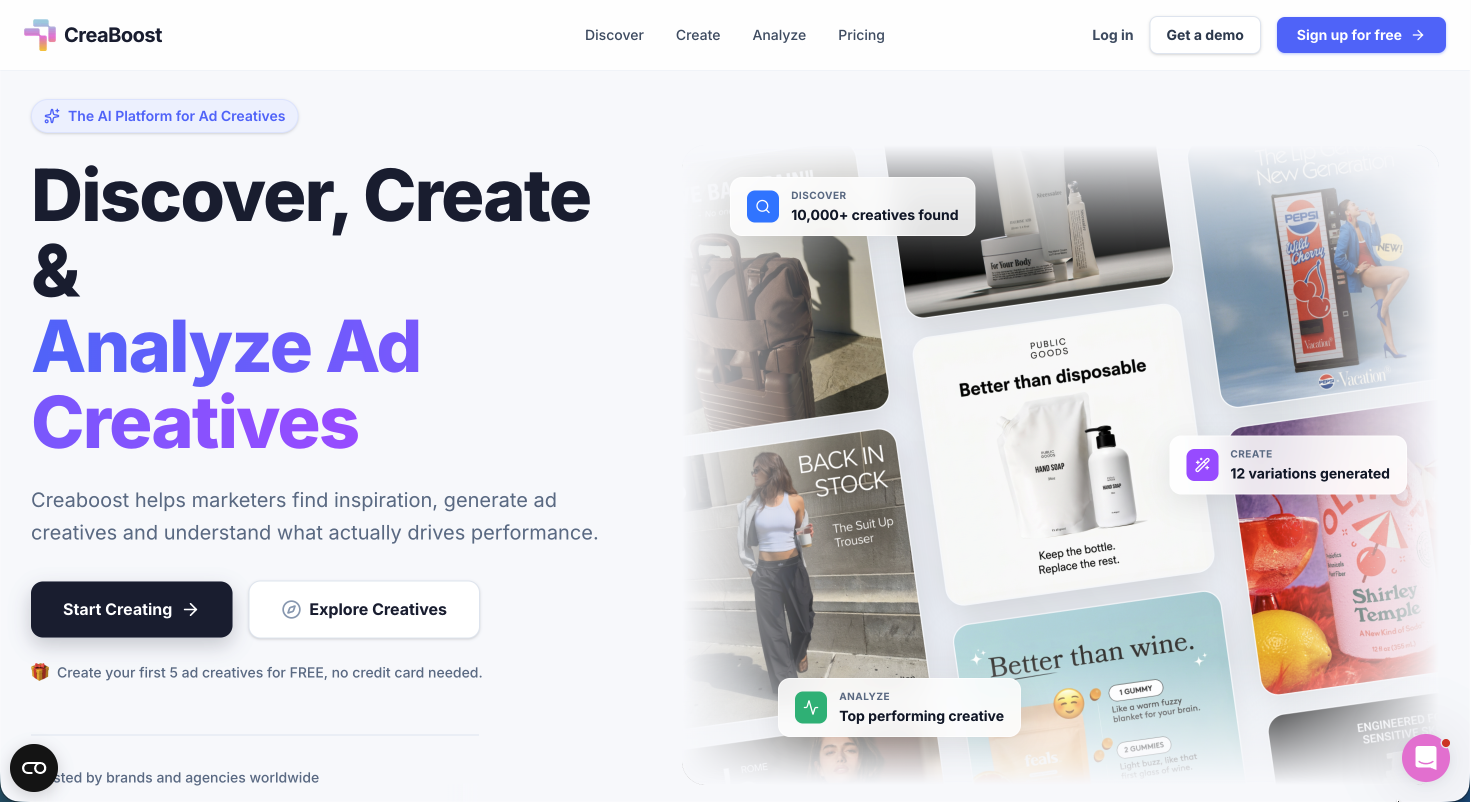
Creaboost is built specifically for the creative and operational problems that performance teams on Meta and TikTok face at scale. The Analyze feature connects directly to your ad accounts and auto-tags every creative by hook, angle, format, and concept. You see which concepts are actually driving ROAS, and you catch fatigue signals a week or two before they show up in your headline metrics. That is real budget you stop wasting. The Create feature turns your product URL into dozens of platform-ready static ad variants in minutes, covering every Meta and TikTok format you need, batch-resized and on-brand. Your team stops being the bottleneck and starts being the strategic layer. Get started at creaboost.com.
FAQ
What is the learning phase on Meta ads?
Meta's learning phase is the period when the algorithm calibrates ad delivery based on conversion signals. Each ad set needs approximately 50 optimization events within 7 days to exit it and achieve stable performance.
How often should you refresh ad creatives on Meta and TikTok?
On Meta, refresh creatives proactively when frequency approaches 2.5 to 3.0. On TikTok, the fatigue cycle is shorter and running three to five variants per ad group with regular rotation is the recommended practice.
What budget should you start with for a new Meta campaign?
Start your Meta campaign budget at roughly 5x your target CPA. This gives the algorithm enough room to gather meaningful optimization data before delivery patterns lock in.
How do you test ads without wasting budget?
Change one variable at a time and wait for at least 1,000 visitors per variant before calling a result. Write a hypothesis before launching each test to keep your iteration logical and traceable.
Why do campaigns stay in learning limited status?
Learning limited status usually means an ad set is not generating enough optimization events. The fix is consolidating audiences into fewer ad sets, switching to a higher-frequency proxy conversion event, or increasing budget to support faster event accumulation.