
Bidding strategies are largely automated now. Audience targeting has been handed off to platform algorithms that, in most cases, outperform manual setups. So if your ROAS is stuck, the variable you're still in control of, the one with the highest leverage, is the creative itself. Algorithm signals like CTR, engagement, and conversion rates are how Meta and TikTok decide who sees your ad, how often, and at what effective cost. That means the quality of your creative isn't just a brand consideration. It's a direct input into your auction competitiveness and your cost per acquisition.
Table of Contents
- How ad creatives shape platform algorithms and ROAS
- The metrics: Creative types and their ROAS impact
- Why authenticity wins: UGC, Spark Ads, and native signals
- Creative testing frameworks and best-in-class optimization routines
- A blunt truth: Creative isn't always the problem
- Unlock smarter ad creative and ROAS optimization
- Frequently asked questions
Key Takeaways
| Point | Details |
|---|---|
| Creative signals drive ROAS | Meta and TikTok algorithms now prioritize creative engagement over targeting, making creative decisions central to campaign returns. |
| Short, authentic wins | UGC and short videos deliver higher ROAS and lower CPA by maximizing relevance and engagement. |
| Benchmarks matter | Know your vertical’s ROAS and format benchmarks to set realistic goals and judge real progress. |
| Test and refresh systematically | Use evidence-based routines and frequent creative refreshes to avoid fatigue and sustain performance. |
| Audit holistically | Before replacing creatives, check offer and landing pages—90% of ROAS issues are rooted beyond the ad creative itself. |
How ad creatives shape platform algorithms and ROAS
To understand precisely why creative matters so much, let's look at how major platforms evaluate and reward strong ad creative.
Meta and TikTok don't distribute your ads randomly. Both platforms run real-time auctions where your bid is only one factor. The other factors, total value signals, include how likely a user is to engage with or convert from your ad. The platform learns this from early performance signals. A creative that earns strong click-through rates, high video completion, and healthy conversion rates gets rewarded with lower CPMs and wider distribution. A weak creative gets throttled, regardless of your budget.
This is the mechanism most performance marketers intellectually understand but emotionally underweight. When your CPA creeps up, the instinct is to audit your audiences, adjust your bid cap, or fiddle with campaign structure. But if your creative is sending weak signals to the algorithm, those changes are rearranging deck chairs. The real fix lives upstream.
"Creative quality and engagement diversity now outweigh manual audience inputs as primary drivers of ad delivery and ROAS on Meta and TikTok."
Here's how the key creative elements map to platform signals and ROAS outcomes:
| Creative element | Metrics affected | ROAS influence |
|---|---|---|
| Hook (first 2-3 seconds) | Thumb-stop rate, video view rate | High: drives initial delivery |
| Visual quality and relevance | CTR, engagement rate | High: affects auction competitiveness |
| Ad copy and offer clarity | Conversion rate, landing page CTR | High: drives down CPA |
| Format fit (native vs. polished) | Engagement, share rate | Medium: affects reach efficiency |
| Call-to-action strength | Click-to-purchase rate | High: directly impacts ROAS |
Following creative best practices for each of these elements isn't optional polish. It's how you influence the signals that determine your delivery costs. AI automation is increasingly helping brands generate more variations faster, but the underlying logic remains the same: better signals mean better distribution at lower cost. If you want to boost ad performance systematically, understanding this feedback loop is step one.
Key signals that shape your auction position include:
- Click-through rate (CTR): Low CTR signals poor creative-audience fit and raises your effective CPM.
- Engagement rate: Likes, shares, and comments tell the platform your ad feels relevant and native.
- Conversion rate: Post-click behavior is the strongest signal. A high CTR with low conversion tells the platform your ad is misleading or mismatched.
- Video completion rate: On TikTok especially, how long people watch determines how broadly your ad gets pushed.
The metrics: Creative types and their ROAS impact
Now that we know how creative influences platforms, it's essential to see what types of creatives actually drive superior ROAS numbers in real campaigns.
The format you choose carries real performance weight. Short videos of 6-15 seconds outperform long-form by 41% on TikTok and Meta. That's not a marginal difference. It's the kind of gap that separates profitable campaigns from ones that slowly drain budget. Meanwhile, e-commerce ROAS benchmarks in 2026 show Meta blended performance landing between 3-4.5x, while TikTok averages 1.4-2.5x with optimized campaigns reaching 4-6x. Fashion and beauty consistently outperform those baselines, hitting 4-8x on Meta and 2.5-7x on TikTok.
Here's how the major creative formats compare in real campaign performance:
| Creative format | Avg. Meta ROAS | Avg. TikTok ROAS | CPA impact |
|---|---|---|---|
| Short UGC video (6-15s) | 3.8-5.5x | 2.8-4.5x | -25-40% vs. static |
| Spark Ads (boosted creator content) | 4.0-6.0x | 3.0-5.0x | -23-35% |
| AI-generated static ads | 2.8-4.0x | 1.5-2.5x | Neutral to -10% |
| Long-form video (30s+) | 2.0-3.0x | 1.2-2.0x | Higher CPA |
| Traditional branded static | 2.5-3.5x | 1.4-2.2x | Baseline |
The pattern is clear. Authentic, short, native-feeling content wins on both platforms. AI-generated creative shows a meaningful 12% boost to CTR on Meta but consistently underperforms on TikTok, where audiences are conditioned to spot and scroll past overly polished or templated content. That distinction matters a lot if you're allocating creative production budget across both channels.
Looking at proven ad examples that boost ROAS across verticals, the pattern repeats: problem-solution hooks in the first two seconds, social proof in the middle, and a direct, urgent CTA at the end. It's not revolutionary. What's revolutionary is teams that actually ship enough variations to test it consistently.
Pro Tip: If you only have bandwidth to test one format this quarter, make it short UGC video. It outperforms across nearly every vertical on both platforms, and it's the format that's hardest for competitors with slow production pipelines to replicate at volume.
Knowing how to build high-performing ad creatives in 2026 starts with accepting that format selection is a strategic decision, not a production convenience.
Why authenticity wins: UGC, Spark Ads, and native signals
With that context, let's dig deeper into why authenticity and relatable content have become crucial for both platform signals and business results.
Here's what most brand teams miss: the platforms aren't just measuring whether people click. They're measuring whether the ad feels like it belongs in the feed. TikTok's algorithm is particularly aggressive about this. Content that mimics organic creator behavior earns better delivery. Content that looks like a TV commercial gets penalized in the auction before your audience even sees it.
UGC and Spark Ads reduce CPA by 23-40% compared to traditionally produced creative. That's a direct consequence of engagement signals. When a real person holds your product on camera, speaks casually, and delivers a genuine reaction, audiences engage more and scroll past less. The platform reads that engagement, rewards your ad with cheaper impressions, and your CPA drops.
"Authentic, creator-led formats consistently outperform polished brand content because they trigger the same engagement behaviors as organic posts, which is exactly what platform algorithms are designed to reward."
The core features of high-performing UGC and Spark Ads on both platforms share a recognizable pattern:
- Unpolished visuals that feel real: Shaky camera, natural lighting, casual framing. Counter-intuitive but consistently effective.
- First-person testimonial structure: "I tried this for two weeks and here's what happened" outperforms direct product pitches.
- Problem-first hooks: Lead with the pain, not the product. "My skin was completely breaking out until I found this" beats "Introducing our new serum."
- Native sound and music: Using trending audio on TikTok or natural ambient sound. Silence or branded music performs worse.
- Short duration with front-loaded value: The payoff has to arrive before the viewer's thumb does. Three seconds is all you get on TikTok.
Short-form creative outperforms long-form even when the longer versions carry more information. This trips up a lot of brand teams who believe they need more time to explain a complex product. In practice, the explanation is better handled post-click, on the landing page. The ad's job is to earn the click, not deliver the full pitch.
For teams trying to scale UGC without burning out their creative partners or exploding their production costs, look at ecommerce ad examples on Meta and TikTok that are working right now. The structure is learnable and replicable. Understanding how to allocate budget across digital campaigns while testing authentic formats is a key part of making this work at scale.
Pro Tip: Don't just boost UGC as Spark Ads. Brief your creators with a structured template that includes a specific hook, a specific problem to address, and a specific CTA. Fully organic briefs produce inconsistent results. Structured authenticity scales.
Creative testing frameworks and best-in-class optimization routines
Understanding what to test is only half the battle. Here's how top practitioners put these insights into systematic practice for ongoing performance.
The biggest mistake performance teams make with creative testing is running it informally. They swap out a creative when they feel like it's fatigued, kill an ad because a media buyer doesn't personally like it, and scale what worked last quarter without asking whether the context has changed. That's creative roulette. It produces inconsistent results and leaves serious ROAS on the table.
Systematic creative testing, including a 70/20/10 budget split, is the framework that separates teams who consistently improve ROAS from those who plateau. The logic is simple: 70% of spend goes to proven performers, 20% goes to structured tests of new variations, and 10% goes to exploratory creative that could become the next big winner. That ratio keeps the machine funded while continuously feeding new learnings into the system.
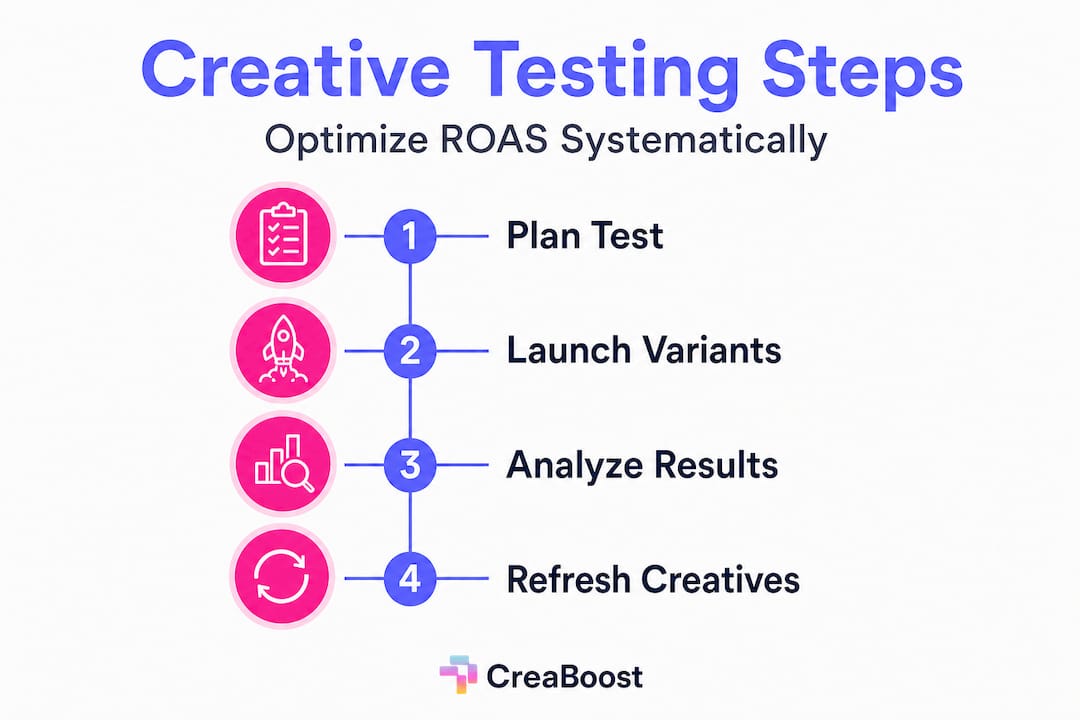
Asset uplift tests, frequency caps of 2.5-3.0, and modular refreshes using new hooks are the operational tools that keep fatigue from quietly killing your top performers. Most teams wait until CPAs visibly spike before they refresh. By then, the algorithm has already deprioritized those assets. The better move is proactive: monitor thumb-stop rates and frequency, and refresh before the metrics degrade.
Here are the essential optimization routines that winning teams run consistently:
- Weekly creative performance review: Pull ROAS, CTR, and thumb-stop rate by creative variant. Flag anything below your baseline thresholds.
- Frequency audit every two weeks: When frequency crosses 2.5-3.0 on a given asset, queue a creative refresh. Don't wait for CPA data to confirm what frequency data already predicts.
- Modular hook testing: Keep the body of a strong creative and swap only the first three seconds. This isolates the hook variable and is faster to produce than full creative refreshes.
- Asset uplift comparison: Run your new creative against your control at matching spend levels for 72-96 hours before making a scaling decision.
- 10% exploratory budget: Every month, dedicate a small budget to a creative direction you've never tried. It's the only way to find your next top performer before your competitors do.
The key metrics to track and act on look like this:
| Metric | Target threshold | Action when breached |
|---|---|---|
| Thumb-stop rate | Above 30% | Refresh hook, test new opener |
| Frequency | Below 2.5-3.0 | Rotate creative, add new variants |
| CTR | Above 1.5% (Meta), 1.0% (TikTok) | Review hook and offer clarity |
| ROAS | At or above target baseline | Scale; if below, pause and test |
| Video completion rate | Above 50% (15s video) | Audit first three seconds |
Knowing how to approach scaling ads profitably on Meta and TikTok requires this kind of disciplined framework. The creative insights available from teams running this process consistently show that it's not the ad with the biggest budget that wins. It's the ad that earns the best signals. You can also explore paid media strategies that connect creative testing to broader channel efficiency.
A blunt truth: Creative isn't always the problem
Here's where we push back on our own premise a little, because honesty serves you better than a clean narrative.
Creative testing drives growth. That's real. But there's a trap that performance marketers fall into regularly: when ROAS drops, they immediately start swapping creatives. New hooks, new formats, new UGC batches, a new creative direction every two weeks. And the results don't improve. Because the creative was never the problem.
Research suggests that 90% of persistent ROAS issues actually stem from offer problems, data quality issues, or landing page failures. The creative gets blamed because it's the most visible variable. But if your offer isn't competitive, no hook is going to save your CPA. If your pixel isn't firing correctly, the algorithm is optimizing on garbage signals. If your landing page loads in five seconds on mobile, you're bleeding conversions before the ad ever gets credit.
Before you brief another creative batch, run this audit:
- Is your offer genuinely competitive for this audience at this price point?
- Is your pixel or events API setup clean and passing full match keys?
- What's your landing page load time on mobile, and what does your post-click funnel look like?
- Is your attribution window aligned with your actual purchase cycle?
- Have you checked whether creative fatigue is real, or whether you're just assuming it based on CPA movement?
The ad performance troubleshooting guide covers this audit in detail. The point here is simple: creative optimization is one of the highest-leverage levers you have. But it only works when the surrounding infrastructure is sound. Churning creative variations when the real blocker is a 4-second landing page load time is expensive and demoralizing.
The teams that improve fastest are the ones that treat creative as part of a system, not a magic fix. They audit holistically, identify the actual constraint, and then apply creative testing with precision rather than desperation.
Unlock smarter ad creative and ROAS optimization
Applying the frameworks in this article requires one thing most teams don't have: a tight operational system that keeps creative testing consistent, fatigue visible, and top performers flagged before they start to decay.
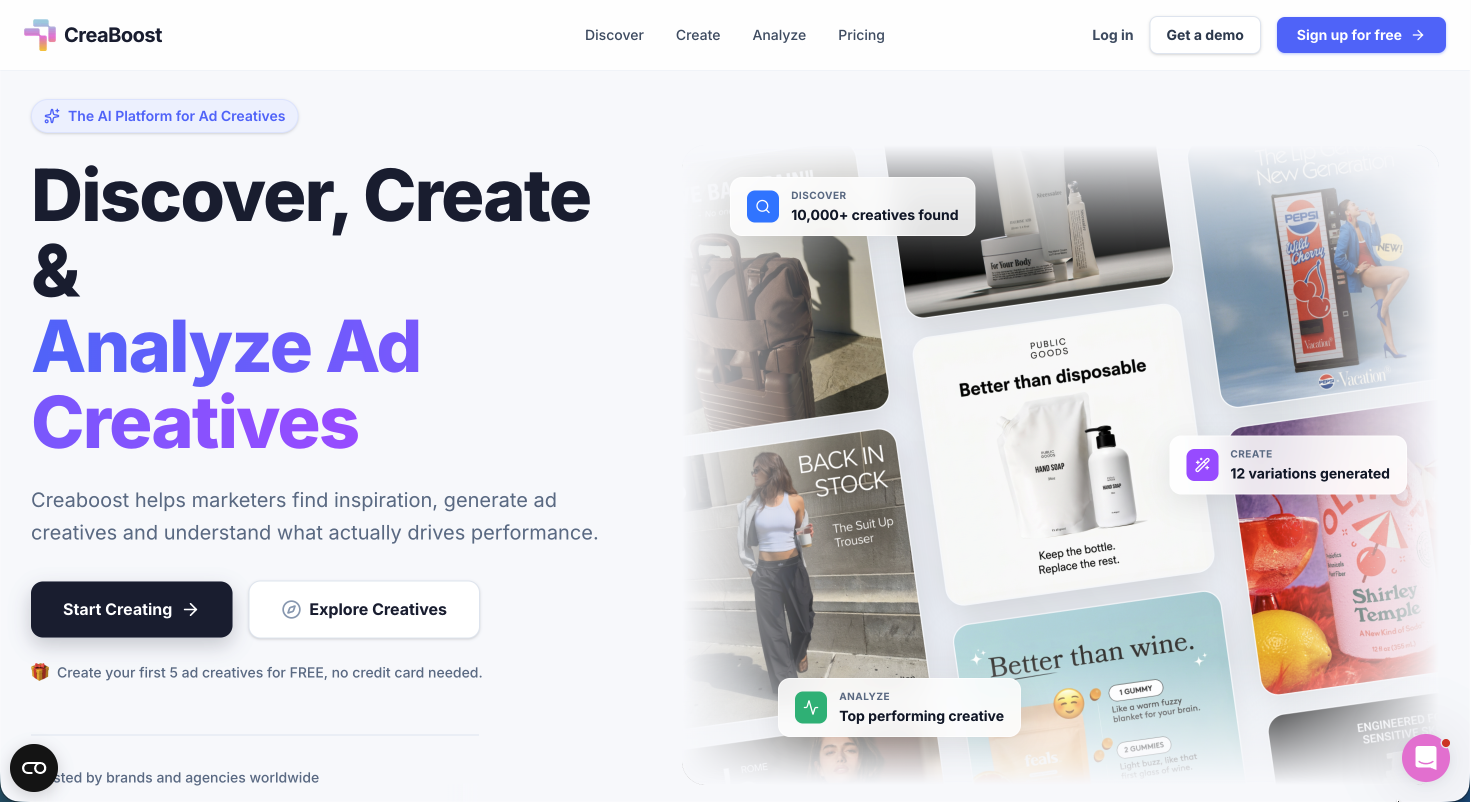
Creaboost gives performance teams one platform to cover the entire creative loop. Analyze creative performance directly from your ad accounts, with auto-tagging by format, hook, angle, and concept, so you always know which concepts are driving ROAS and which are coasting on old impressions. With AI-driven ad creative tools, you turn a product URL into dozens of platform-ready variations in minutes, enabling the kind of systematic testing described in this article without burning out your design team. If you're ready to close the gap between what you could be doing and what you're actually doing, Creaboost is built for exactly that. Get started at creaboost.com.
Frequently asked questions
What creative format delivers the highest ROAS on Meta and TikTok?
Short videos under 15 seconds and authentic UGC formats consistently outperform traditional creatives for ROAS on both platforms, outpacing long-form content by 41%.
Why is audience targeting less important than creative in 2026?
Meta and TikTok now prioritize creative quality and engagement signals over manual audience targeting in their algorithms, making the creative itself the primary lever for delivery efficiency and ROAS.
How often should ad creatives be refreshed to maintain strong ROAS?
Refresh core creative elements every two to four weeks, or earlier when frequency crosses 2.5-3.0, using modular hooks and systematic testing to extend strong performers rather than replacing them wholesale.
Is AI-generated creative always better for ad ROAS?
AI creative delivers a meaningful CTR boost on Meta, but authenticity-focused UGC formats consistently outperform AI-generated content on TikTok, where audiences respond to native, creator-style content.
What is a strong ROAS benchmark for e-commerce campaigns in 2026?
Top-performing Meta campaigns deliver 3-4.5x blended ROAS, while TikTok averages 1.4-2.5x with optimized campaigns in fashion and beauty reaching 4-6x and beyond.