
Every performance marketer knows the feeling: you launch a new creative, watch it get impressions, and wait. The feed is louder than ever, attention is fractured across formats, and the gap between an ad that converts and one that bleeds budget can come down to a single creative decision made three weeks ago in a brief. The good news is that high performance on Meta and TikTok is not accidental. It follows patterns. This article breaks down real ad examples, the specific tactics behind them, and the frameworks you can use to build campaigns that hit your ROAS targets consistently.
Table of Contents
- What makes a high-performing social media ad?
- Showcase: Six standout Meta and TikTok ad examples
- Comparing Meta vs. TikTok ad tactics: Key insights
- Situation-specific recommendations: Which ad type for your goals?
- The uncomfortable truth: Most "viral" ad tactics don't drive lasting results
- Discover, create, and analyze social ad success with CreaBoost
- Frequently asked questions
Key Takeaways
| Point | Details |
|---|---|
| Evidence drives performance | Campaigns using proof-backed strategies like catalog ads and retargeting outperform trend-focused tactics. |
| Platform strengths differ | Meta shines in deep targeting, while TikTok excels at rapid discovery and conversion. |
| Match format to objective | Align ad formats with campaign goals—conversion, retention, or awareness for best results. |
| Smart creative wins | AI-driven product showcases and engaging videos drive measurable ROAS and conversion lifts. |
What makes a high-performing social media ad?
Before looking at specific examples, you need a framework for evaluating ads objectively. Most teams skip this step and end up optimizing for metrics that feel good, like impressions or click-through rate, rather than the ones that actually tie to revenue.
A genuinely high-performing ad checks four boxes:
- Clear call-to-action (CTA): The user knows exactly what to do next. No ambiguity, no buried button, no "learn more" when you mean "buy now."
- Visual impact in the first two seconds: On TikTok, you have roughly 1.5 seconds before a thumb swipes. On Meta, the scroll is only slightly more forgiving. Your creative has to earn attention before it can spend it.
- Audience relevance: The ad speaks to a specific person with a specific problem. Generic messaging underperforms. Always.
- Measurable outcomes: You can only scale what you can measure. Every ad you ship should have a clear performance signal tied to ROAS, conversion lift, or add-to-cart rate.
The performance indicators that matter most at the campaign level are ROAS (return on ad spend), conversion lift measured against a holdout group, and add-to-cart rates as a leading indicator of purchase intent. If your reporting is built around impressions and reach alone, you are flying blind on the metrics that actually matter.
The evidence backs this up. Eyewear brand Quay used a combination of TikTok Catalog Ads, Retargeting, and Smart+ Web to achieve a 54% lift in purchases, a 417% lift in search, and a 70% lift in add-to-cart, while exceeding their ROAS targets by 91%. That is not a fluky result. It is what happens when your creative strategy, format selection, and retargeting logic are all working together.

Pro Tip: Start every creative review by filtering for add-to-cart rate before looking at CPA. Add-to-cart is often the earliest signal that a creative concept is resonating, sometimes by 48 to 72 hours ahead of your purchase data.
Understanding ad creative best practices at the format level is where most teams find the biggest untapped gains. And if you want a detailed walkthrough of the execution side, the guide on how to build high-performing creatives gives you a step-by-step framework for 2026.
"Performance creative is not art direction. It is hypothesis testing at scale, with revenue as your feedback loop."
Showcase: Six standout Meta and TikTok ad examples
With the criteria in place, let's break down specific ad campaigns that hit and exceed these benchmarks. Each example here is grounded in real tactics, not generic advice.
-
Quay's TikTok catalog ad with Smart+ Web retargeting. Quay targeted shoppers who had visited product pages but not purchased. Using TikTok Catalog Ads and Retargeting, they served dynamic product ads featuring the exact frames each user had browsed. The result was a 54% lift in purchases and 91% over their ROAS target. Why it worked: personalization at scale, with the algorithm doing the heavy lifting on delivery.
-
DTC skincare brand running Meta Dynamic Product Ads (DPAs). A mid-size skincare brand built a catalog of 40 product SKUs and let Meta's algorithm surface the right product to the right user based on browse and purchase history. By layering in a warm retargeting audience (site visitors from the past 30 days), they cut their CPA by 34% over a static creative test. The format removes creative fatigue risk because the product image rotates automatically.
-
Apparel brand using UGC-style video on TikTok for top-of-funnel awareness. A fast-fashion brand shot 12 low-production "try-on haul" style videos using real customers, not influencers. These ran as In-Feed ads targeting lookalike audiences built from past purchasers. The informal, native feel drove a 3.2x higher view-through rate compared to their polished studio ads. Lesson: on TikTok, content that looks like content outperforms content that looks like an ad.
-
Home goods brand A/B testing static vs. carousel on Meta. This brand tested a single lifestyle image against a five-card carousel showcasing their product in different room settings. The carousel drove 28% more product page visits and a 19% higher add-to-cart rate. The carousel format works here because it lets the user self-select the use case that matches their home, making the ad inherently more relevant.
-
Supplement brand using Meta Advantage+ Shopping Campaigns. Rather than manually building audience segments, this team let Advantage+ Shopping do the targeting work. They fed the campaign 24 creative variations across three hook angles: social proof, ingredient transparency, and transformation story. Advantage+ found the right creative-audience pairing 40% faster than their manually managed campaigns, and their blended ROAS improved by 22% over 60 days.
-
Electronics accessory brand combining TikTok Spark Ads with creator content. This brand partnered with three mid-tier creators (50k to 200k followers) and boosted their organic posts as Spark Ads. Because the content originated from real creator accounts, it carried native credibility. Their cost-per-click dropped 31% versus brand-originated video ads, and the comments section (visible to users) added a layer of social proof that no standalone ad can manufacture.
Pro Tip: When you analyze your top performers, tag them by hook angle, not just format. Knowing that "social proof hooks" outperform "urgency hooks" in your vertical is a signal worth more than knowing "video outperforms static" generically.
A thorough boost ad performance guide can help you systematize the testing process across these formats. And if you are making channel allocation decisions, understanding how to maximize ROI placements across Meta and TikTok is essential context.
Comparing Meta vs. TikTok ad tactics: Key insights
After reviewing standout ad campaigns, it is crucial to understand how platform choice influences tactics and success. Meta and TikTok are not interchangeable. They reward different creative approaches, serve different intent states, and give you different levers to pull.
| Factor | Meta | TikTok |
|---|---|---|
| Ad formats | Static, carousel, DPA, video, Stories, Reels | In-Feed, TopView, Spark Ads, Catalog, Smart+ |
| Targeting depth | Deep first-party and lookalike targeting | Interest-based, behavioral, Catalog retargeting |
| Creative requirements | Flexible; static can outperform video | Video-first; native feel strongly preferred |
| Audience intent | Ranges from cold to warm; retargeting is strong | Skews toward discovery and impulse |
| ROI potential | High for mid to lower funnel; DPAs excel | High for acquisition and catalog retargeting |
| Best for | Retention, retargeting, catalog conversion | Top-of-funnel growth, viral acquisition |
The most important insight from Quay's results is what happens when you stop treating these platforms as either/or choices. Their 54% purchase lift and 417% search lift came from combining TikTok's catalog and retargeting capabilities with Smart+ Web, a setup that is easy to overlook if you think of TikTok purely as an awareness channel.
Platform-specific best practices worth knowing:
- On Meta, your creative lifespan is typically two to three weeks before frequency-driven fatigue sets in. Build your content calendar accordingly.
- On TikTok, the algorithm rewards engagement signals heavily. Comments and shares in the first six hours of a post going live influence how broadly it gets served.
- Retargeting on both platforms consistently outperforms cold prospecting on a CPA basis, but you need enough top-of-funnel volume to keep retargeting pools fresh.
- Catalog ads on both platforms require clean product feed hygiene. Inaccurate titles, missing images, or outdated pricing kill performance silently.
"The brands winning on TikTok in 2026 are not treating it like a cheaper YouTube. They are building creative specifically for the scroll, with product catalog logic underneath."
If you want a deeper look at how to approach scaling ads profitably across both platforms without blowing your budget on underperforming placements, that guide covers the channel-specific logic in detail.
Situation-specific recommendations: Which ad type for your goals?
Now that we have compared platforms, let us match ad types to goals for maximum ROI. The right format depends entirely on what you are trying to accomplish in a given campaign cycle.
-
Goal: New customer acquisition (cold audiences). Recommended format: TikTok In-Feed video or Meta Advantage+ Shopping with diverse creative. Why it works: cold audiences need narrative and emotional resonance before they are ready to convert. Short-form video on TikTok delivers that at scale, while Advantage+ can surface the right creative angle to the right user segment without manual audience building.
-
Goal: Converting warm audiences who have visited your site. Recommended format: TikTok Catalog Ads with Retargeting, or Meta Dynamic Product Ads. Why it works: these users already know your brand. Showing them the exact product they browsed, with a clean CTA, removes friction and accelerates the purchase decision. As Quay demonstrated, this combination can exceed ROAS targets by 91% when executed properly.
-
Goal: Retention and repeat purchase from existing customers. Recommended format: Meta carousel or collection ads targeting past purchasers with complementary products. Why it works: existing customers have high purchase intent and low friction. Carousel formats let you cross-sell or upsell naturally, and Meta's targeting precision makes it easy to exclude prospecting audiences and focus budget on your highest-value segment.
-
Goal: Viral growth and brand discovery. Recommended format: TikTok Spark Ads amplifying existing organic creator content. Why it works: Spark Ads inherit the social proof of the original post (real likes, real comments, real shares). This format is especially effective for brands in lifestyle, fashion, beauty, and home, where peer validation is a powerful purchase trigger.
-
Goal: Testing new creative concepts with minimal risk. Recommended format: Meta split test with a static control vs. new concept challenger. Why it works: Meta's split testing tool gives you statistical confidence with smaller budgets. You get a clean signal on whether a new concept is worth scaling before committing significant spend.
Pro Tip: Layer catalog and retargeting formats on top of any awareness campaign you run. Awareness without retargeting is like filling a leaky bucket. The catalog closes the loop by recapturing users that awareness brought in but did not yet convert.
For ongoing creative direction grounded in what is actually working in your vertical, the Creaboost blog is a consistent resource for performance marketers looking to stay ahead of format shifts and creative trends.
The uncomfortable truth: Most "viral" ad tactics don't drive lasting results
Here is something most agencies will not tell you: chasing virality is a budget leak disguised as a strategy. A video that racks up a million views on TikTok and generates zero incremental purchases is not a win. It is an expensive brand awareness exercise with no measurable return.
We have seen this pattern repeat itself with brands that shift their entire creative budget toward trend-jacking and influencer-led content, only to find that their ROAS flatlines while their impression count climbs. The numbers look exciting in the weekly report. The CFO stops being impressed by month three.
What actually drives lasting results is the opposite of viral thinking. It is systematic, evidence-driven creative strategy. It means testing the same underlying concept across five different hooks and learning which angle resonates with which segment. It means tracking fatigue before it shows up in your headline metrics, not after your CPA has already drifted 40% above target. It means building a library of proven angles, not a graveyard of one-hit creatives that spiked once and never repeated.
The brands with durable performance are the ones treating creative as a production system, not a content lottery. They brief from patterns, not blank pages. They tag everything. They scale what works and kill what does not, on a weekly cadence, not a quarterly panic. Following best practices that lift ROAS consistently is more valuable than landing one viral moment that your team cannot reproduce.
Virality is a side effect of great performance creative. It should never be the goal.
Discover, create, and analyze social ad success with CreaBoost
The examples and frameworks in this article point to a clear operational reality: the teams that win consistently do not just have better creative ideas. They have a tighter system for discovering what works, producing variations fast, and catching winners and losers before the budget makes the decision for them.
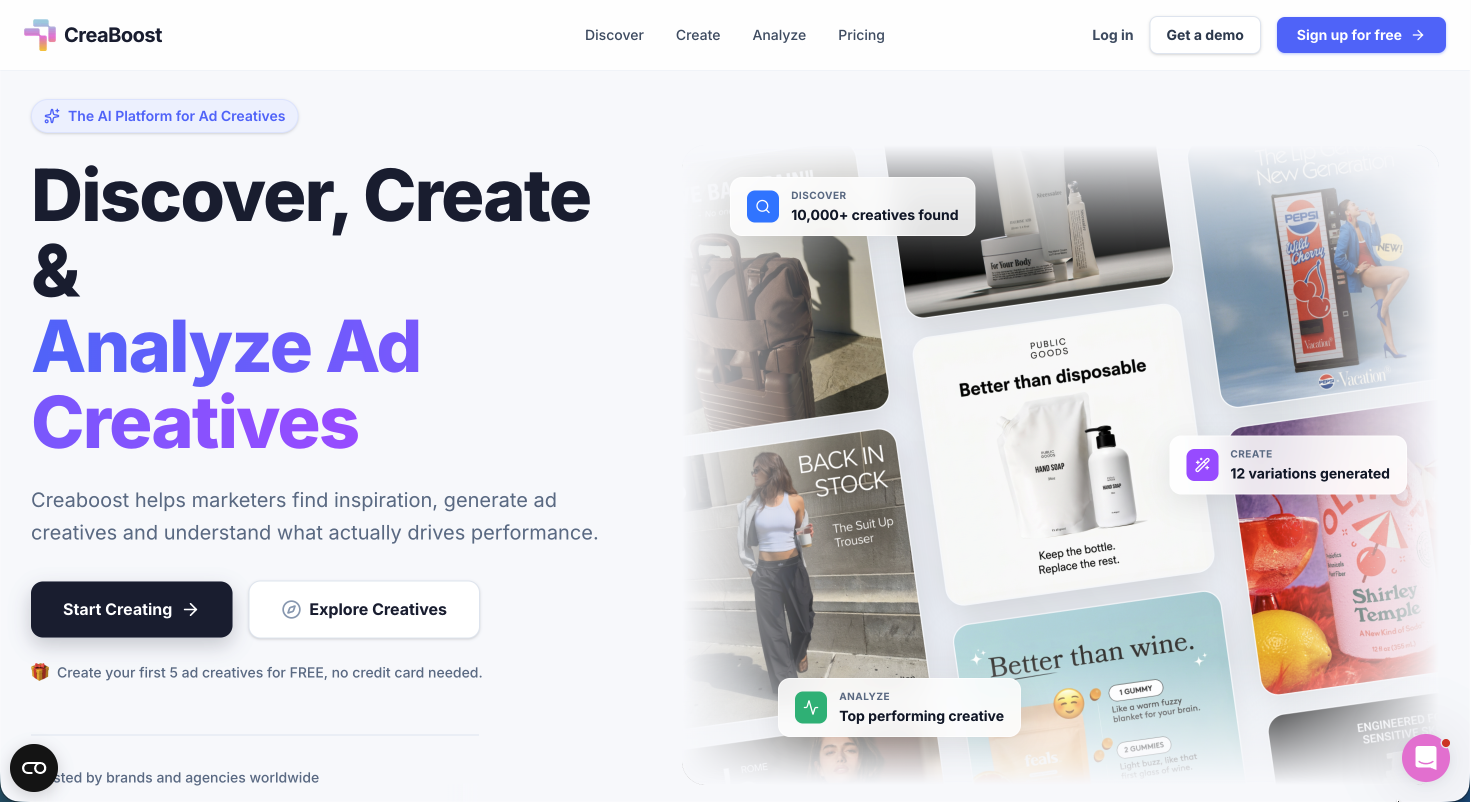
CreaBoost is built exactly for that system. The ad creative analytics tool auto-tags every creative by hook, format, and concept, so you can see which angles are actually driving ROAS instead of just getting served impressions. The AI ad creative tools turn a product URL into dozens of platform-ready variations in minutes, not days. And the Discover feature means your team starts every brief anchored in real vertical data, not gut instinct. If you are ready to close the gap between what your campaigns could be doing and what they are doing right now, explore CreaBoost's pricing and get your first campaign assets live within the week.
Frequently asked questions
What defines a successful ad creative on TikTok vs. Meta?
A successful creative balances visual impact, audience relevance, and measurable outcomes tied to ROAS or conversion lift. TikTok rewards catalog and retargeting formats with native creative style, while Meta offers deeper targeting precision and dynamic product ads that excel at lower-funnel conversion.
How do catalog ads and retargeting drive higher conversions?
Catalog ads and retargeting serve personalized product recommendations to users who have already shown purchase intent, dramatically reducing friction. Quay's campaign using TikTok Catalog Ads and Retargeting produced a 54% purchase lift and exceeded ROAS targets by 91%.
What campaign objectives should guide ad format selection?
Define your goal first: catalog ads work best for conversion, short-form video for awareness and acquisition, and retargeting for retention and warm audience conversion. Matching format to objective is what separates efficient spend from wasted budget.
How can budget-limited marketers maximize ad performance?
Prioritize formats with proven conversion lift, specifically catalog ads and retargeting, and build a consistent creative testing cadence. Even modest budgets generate meaningful learning when every creative is tagged, measured, and iterated on rather than replaced wholesale each cycle.