

Most performance marketers assume the path to better returns is picking the one platform that's working and squeezing every dollar out of it. It's a clean mental model. It also quietly destroys your ability to scale. When you concentrate your entire budget on a single channel, you're not just betting on that platform's algorithm staying stable — you're creating blind spots in your measurement, accelerating creative fatigue, and leaving cross-channel learnings completely untouched. This guide explains exactly why multi-platform advertising has moved from nice-to-have to essential infrastructure for any e-commerce team serious about growth in 2026.
Table of Contents
- The limitations of single-platform ad campaigns
- How multi-platform ads power more accurate attribution and insights
- Operational advantages: Efficiency and synergy across Meta, TikTok, and beyond
- Practical steps to integrate and optimize multi-platform ad strategies
- Why marketers who double down on one platform are leaving growth on the table
- Boost your multi-platform ad performance with CreaBoost
- Frequently asked questions
Key Takeaways
| Point | Details |
|---|---|
| Single-channel risk | Relying solely on one ad platform leads to biased measurement and missed growth potential. |
| Multi-touch attribution | Spreading campaigns across platforms delivers more accurate, actionable insights for optimization. |
| Operational efficiency | Unified platforms reduce workload and boost creative performance across teams. |
| Practical integration steps | A structured process streamlines multi-platform deployment and ROI improvement. |
The limitations of single-platform ad campaigns
The first sign that a single-platform strategy is running out of road usually isn't a dramatic CPA spike. It's a slow drift. Your best creatives stop performing the way they used to. Your CPMs creep up. Your frequency numbers look fine on paper, but engagement has gone flat. These are the early signals of a contained ecosystem hitting its ceiling.
The deeper structural problem is attribution. Last-click attribution creates systematic bias toward bottom-funnel channels and against top-funnel platforms that initiate purchase journeys. If you're only running on one platform, your reporting looks clean — every conversion traces back to a touchpoint you can see. But that's false clarity. You're measuring a fraction of the actual journey and optimizing for it as if it were the whole picture.
Consider what happens when a user discovers your brand through a TikTok video, spends three days thinking about the product, then converts after seeing a retargeting ad on Meta. In a single-platform Meta setup, you never see the TikTok touchpoint. You optimize for the retargeting creative that closed the deal and under-invest in the awareness content that started it. Over time, your top-of-funnel inventory shrinks, your retargeting audiences dry up, and you wonder why scaling the budget no longer produces proportional returns.
There are several compounding risks that come with single-channel concentration:
- Algorithm dependency. Major platform updates can shift delivery, targeting logic, or auction dynamics overnight. With no alternative channel, your entire revenue stream absorbs the shock.
- Audience pool saturation. Every platform has a finite addressable audience for your niche. Once you've exhausted your best segments, CPMs rise and performance drops.
- Creative fatigue acceleration. Users see the same creative repeatedly across a single platform with no variation in context, which drives frequency-adjusted engagement down faster than most teams track.
- Siloed creative learnings. Without cross-platform signals, you can't identify which creative themes resonate broadly versus which ones only work in one specific feed environment.
When you try to lift ROAS with creative best practices inside a single-platform setup, you hit a ceiling quickly. The learnings you generate don't transfer because you have nothing to compare them against. Your optimization loop gets smaller over time instead of larger.
How multi-platform ads power more accurate attribution and insights
Once you spread spend across Meta, TikTok, and potentially other channels, your attribution picture gets more complicated — but also far more honest. Single-platform reporting doesn't just miss touchpoints; it actively misattributes conversions by assuming one ad did the entire job of moving a user from cold to converted.
The fix is multi-touch measurement across platforms that distributes credit across every meaningful touchpoint in the customer journey, not just the final click. This changes how you allocate budget, which creatives you scale, and where you invest in building new audiences.
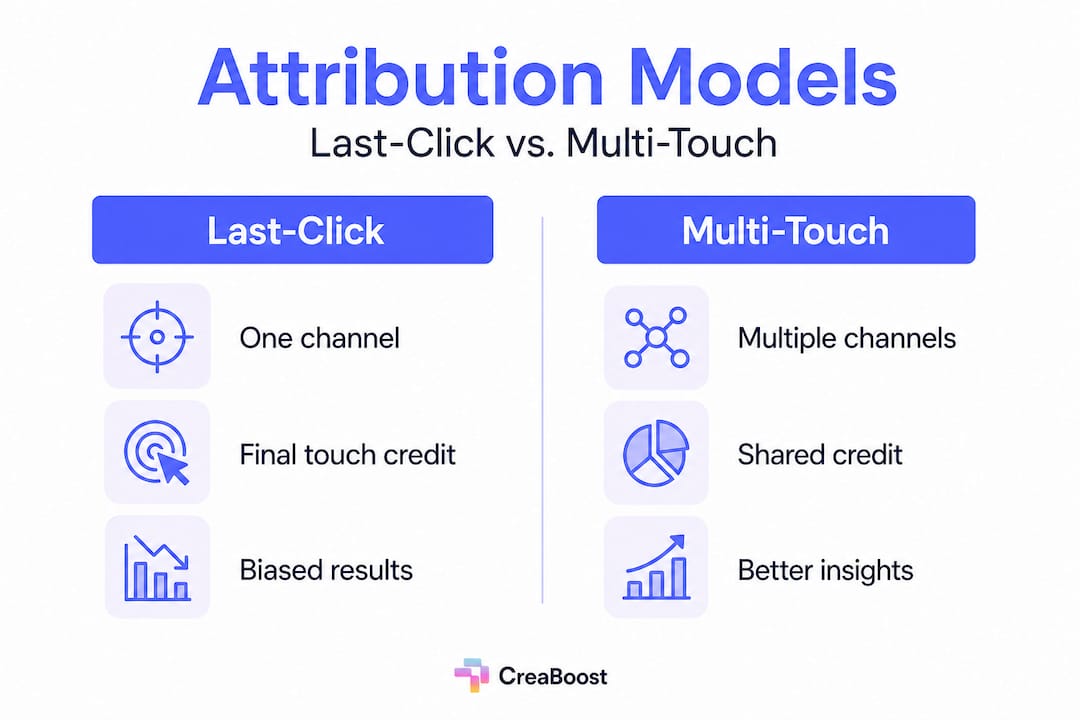
Here's a direct comparison of what changes between models:
| Dimension | Last-click attribution | Multi-touch attribution |
|---|---|---|
| Credit distribution | 100% to final touchpoint | Spread across all touchpoints |
| Upper-funnel visibility | Near zero | Clearly tracked and valued |
| Creative optimization bias | Favors closers | Balances awareness and conversion |
| Budget allocation logic | Concentrates on bottom funnel | Supports full-funnel investment |
| Scaling accuracy | Misleading at scale | Reflects actual ROAS drivers |
| Risk of misoptimization | High | Significantly reduced |
The practical impact of this shift is substantial. Teams using multi-touch models can identify that a TikTok awareness creative is responsible for initiating 40% of eventual conversions even when it never gets the final click. That creative gets scaled. Under last-click logic, it would have been cut for underperformance.
Cross-platform user flow data also tells you something even more valuable: where users drop off in the journey. If your TikTok ads generate strong click-through rates but those sessions rarely convert, the problem might be your landing page experience, not the creative. You'd never surface that insight inside a single-platform setup because you wouldn't have the comparative data.
Pro Tip: Connect your analytics stack, whether that's Google Analytics 4, Northbeam, Triple Whale, or a custom data warehouse, so every platform's data flows into a single measurement layer. Last-touch numbers from Meta or TikTok's native dashboards are directionally useful but structurally incomplete. A step-by-step ad performance guide can help you build the right measurement foundation before you scale. Centralized creative performance analytics are what separate teams making data-driven decisions from teams guessing.
Operational advantages: Efficiency and synergy across Meta, TikTok, and beyond
The attribution benefits are compelling on their own. But the operational gains from running unified multi-platform campaigns are what most teams underestimate until they've actually done it.

Moving to a unified buying and measurement layer is a direct response to the fragmentation and conflicting optimization logic that happens when separate teams manage separate platforms with separate reporting. When Meta and TikTok campaigns are measured in isolation, you get two teams optimizing toward incompatible goals, duplicated creative builds for assets that could have been adapted, and no shared vocabulary for what "good performance" actually looks like.
A unified approach eliminates most of that waste. When your creative team builds assets against a shared taxonomy — hook type, visual style, offer angle, format — those learnings become portable. A direct-response hook that crushed it on TikTok gets tested on Meta Reels with minor format adjustments. A lifestyle visual that drove strong brand search lift on Meta gets repurposed as a TikTok organic-style asset. Neither of these things happens naturally when teams operate in silos.
The efficiency gains show up in measurable ways:
| Workflow element | Fragmented execution | Unified execution |
|---|---|---|
| Creative briefing time | Separate briefs per platform | One brief, multi-format output |
| Asset tagging consistency | Often abandoned after 30 days | Maintained automatically |
| Performance review cadence | Weekly per platform, siloed | Single review covering all channels |
| Attribution reconciliation | Manual and error-prone | Automated across sources |
| Fatigue detection speed | Lags 7 to 14 days | Real-time signal available |
The most underrated benefit is communication accuracy. When your media buyer, creative director, and growth lead are all looking at the same data with the same labels, decision-making speeds up and errors drop. No one is arguing about which platform "gets credit" for a good week. Everyone is optimizing the same loop.
- Build a shared creative taxonomy before launching multi-platform campaigns. Consistent labeling is what makes cross-platform learnings extractable.
- Assign one person to own cross-channel measurement, even if each platform has its own manager.
- Use fatigue signals proactively. Don't wait for CPAs to drift visibly before refreshing creative.
Pro Tip: When a creative concept performs well on one platform, don't rebuild from scratch for the other. Adapt it with platform-native elements — vertical format, caption style, audio presence — while keeping the core concept and offer identical. You'll multiply the impact of your best ideas without proportionally increasing production costs. Explore creative insights for performance teams to see how top e-commerce brands structure their cross-platform creative process.
Practical steps to integrate and optimize multi-platform ad strategies
Strategy without execution is just theory. Here's a concrete action plan for teams moving from single-channel to a properly integrated multi-platform setup.
- Audit your current creative assets and performance data. Before you add a new platform or change attribution models, understand what you're already working with. Catalog your active creatives by concept, format, and performance. You'll quickly see gaps and redundancies.
- Align on attribution models before you scale. Decide which attribution framework your team will use for cross-channel reporting. Last-click numbers from individual platforms will still exist, but they shouldn't drive optimization decisions.
- Centralize your measurement dashboard. Every platform's data should feed into one reporting layer. This is the single most important operational step. Teams that skip it end up back in the fragmentation problem within 60 days.
- Build platform-specific creative variants from a shared brief. Write one brief that defines the core concept, offer, and audience insight. Then create format-specific executions for Meta feed, Meta Stories, TikTok feed, and TikTok Spark Ads. Same core idea, platform-native delivery.
- Run incrementality tests before making major budget shifts. Distributing credit across touchpoints through attribution modeling is important, but true lift measurement through holdout tests gives you the clearest signal of what each channel is actually contributing.
- Review cross-platform performance weekly, not per-platform daily. Daily platform-level reviews create noise and lead to premature optimization. Weekly cross-platform reviews reveal the actual trends worth acting on.
The most common mistake brands make when integrating multiple platforms is treating Meta and TikTok as interchangeable delivery surfaces. They're not. TikTok users expect native-feeling content with visible creator presence and audio. Meta users are used to polished product visuals and direct offers. An ad that converts well on one platform often falls flat on the other if it hasn't been adapted.
"A DTC apparel brand running only Meta ads had stable ROAS for eight months before a major algorithm update dropped their delivery efficiency by 30%. They had no TikTok presence, no cross-channel data, and no creative learnings outside of Meta's ecosystem. By the time they rebuilt, they'd lost two months of growth momentum to a problem that diversification would have buffered."
Audience overlap is the other overlooked risk. When you run the same offer to the same audience on Meta and TikTok simultaneously without frequency caps, you create redundant impressions that inflate your apparent reach without adding actual touchpoints. Build exclusion audiences and coordinate your targeting logic across platforms from day one. Resources on scaling ads profitably and maximizing ROI on ad placements can sharpen your execution at each stage.
Why marketers who double down on one platform are leaving growth on the table
Here's the uncomfortable reality: single-platform focus can look like discipline when it's actually avoidance. It's easier to get deep expertise in one ecosystem. It's more comfortable to build a team around one set of tools. The problem is that "comfortable" and "competitive" are not the same thing.
We've seen brands build genuinely impressive Meta operations — tight creative systems, strong tagging discipline, deep algorithmic understanding — and then watch a privacy policy change or a CPM inflation cycle wipe out their margins in a quarter. They had a brilliant setup inside a fragile container.
The real function of multi-platform strategy isn't just reach. It's resilience and learning velocity. When your TikTok campaigns teach you something about which emotional hooks resonate with cold audiences, that insight sharpens your Meta prospecting. When your Meta retargeting data tells you which product angles close best, that informs your TikTok content strategy. The platforms cross-pollinate when you treat them as connected parts of one system.
True creative and analytical maturity means using platform variety to generate signals your single-platform competitors can't access. The brand that knows why a concept works, not just that it works on one specific feed, has a compounding advantage. They build hypotheses faster, test smarter, and scale with more confidence.
The best teams we see operating at scale in 2026 are not the ones with the biggest budgets. They're the ones who commit to building high-performing ad creatives across platforms and treat every campaign as a learning asset, not just a spend vehicle. Platform diversity isn't complexity for complexity's sake. It's how you future-proof a brand in an ecosystem where no single platform's algorithm, cost structure, or user behavior is guaranteed to stay stable.
Boost your multi-platform ad performance with CreaBoost
Running multi-platform campaigns at scale is genuinely hard without a system designed for it. Most teams end up stitching together a creative generator, a separate analytics dashboard, a naming convention spreadsheet, and a Slack thread of screenshots — and still end up with blind spots.
CreaBoost is built to close that gap. From a single platform, your team can generate platform-ready creative variations for both Meta and TikTok, auto-tag every asset by concept and format, and surface the performance signals that tell you what to scale and what to cut. The creative analytics for multi-platform ads connect directly to your ad accounts and flag fatigue before it shows up in your CPA. The AI-powered creative generation means your design team stops being the bottleneck and starts being the strategic layer they were hired to be. See CreaBoost pricing and start shipping better multi-platform creative within the week.
Frequently asked questions
What is multi-platform advertising?
Multi-platform advertising means running coordinated ad campaigns across more than one platform, like Meta and TikTok, for broader reach and more complete measurement of the full customer journey.
How does multi-platform attribution improve reporting?
It distributes credit across touchpoints instead of concentrating it on the final click, which removes the systematic bias that causes teams to under-invest in upper-funnel awareness channels.
Can I use the same creative assets on Meta and TikTok?
You can and should adapt high-performing creatives across platforms, but native formats and audience expectations differ enough that direct reposts without adjustment typically underperform platform-native content.
What are the biggest risks of only advertising on one platform?
Algorithm changes, CPM inflation, audience saturation, and creative fatigue can all hit simultaneously without alternative channels to buffer performance or generate comparative creative learnings.
How do I start building an integrated multi-platform ad strategy?
Start by centralizing your reporting, auditing your existing creatives for cross-platform adaptability, and aligning your team on a shared attribution model and measurement framework before you increase spend.