
Most agency teams treat creative analysis like an autopsy. The campaign ends, you pull the numbers, and you write a report nobody reads twice. That framing costs you real money. Effective creative analysis for agencies is a forward-moving discipline. It shapes briefs before spend is committed, catches fatigue before CPAs drift, and builds an institutional knowledge base that compounds over time. This guide covers the frameworks, metrics, testing hierarchies, and AI tools you need to make creative analysis a genuine competitive edge, not a post-mortem ritual.
Table of Contents
- Key takeaways
- What effective creative analysis for agencies actually requires
- Frameworks and methodologies that actually work
- Building a systematic testing program
- Key metrics and how to read them
- My take on where creative analysis is actually heading
- How Creaboost makes this work at agency scale
- FAQ
Key takeaways
| Point | Details |
|---|---|
| Tag at the element level | Granular tagging by hook type, format, and copy length is what separates useful data from noise. |
| Follow the testing hierarchy | Run concept tests before execution or element tests to protect budget and maximize ROI. |
| Track fatigue proactively | Rising cost per view with stable bids is an early warning sign most teams catch too late. |
| Use the ABCD framework | Structured creative following ABCD principles delivers measurably higher brand lift and recall. |
| Document every test | A structured testing log is your most valuable long-term creative asset. |
What effective creative analysis for agencies actually requires
Most agencies have analytics. Far fewer have analysis. The difference is whether your data connects creative decisions to business outcomes, or just describes what happened.
The foundation of any serious agency creative insights operation is automated creative tagging at the element level. That means every ad is tagged not just by campaign or client, but by hook type, visual style, copy length, call to action format, and creative concept. Element-level tagging enables platforms to surface performance correlations that would be invisible in aggregate reporting. When you can see that problem-aware hooks outperform curiosity hooks by 40% for a specific client vertical, that is not a reporting output. That is a brief.
Multi-client dashboard management matters just as much. At agency scale, you are running creative experiments across dozens of accounts simultaneously. Without a unified view, your best learnings stay siloed inside individual client folders. The goal is a cross-client pattern library that your strategists can draw from when building the next brief.
Here is what a mature creative analysis setup covers at minimum:
- Automated tagging: Format, hook type, visual style, copy length, offer type, creator archetype
- Cross-platform data: Meta, Google, and TikTok at minimum, with unified attribution logic
- Performance correlation: Linking creative elements to ROAS, conversion rate, and cost per acquisition, not just click-through rate
- Fatigue detection: Frequency and performance trend monitoring to flag assets before they deteriorate
The table below shows how basic reporting differs from genuine creative performance analysis:
| Dimension | Basic reporting | Creative performance analysis |
|---|---|---|
| Granularity | Campaign or ad set level | Element level (hook, format, copy) |
| Direction | Retrospective | Ongoing and predictive |
| Output | Metrics summary | Brief-ready creative hypotheses |
| Fatigue detection | Visible in headline CPA | Flagged 1 to 2 weeks early |
| Cross-client learning | None | Structured pattern library |
Frameworks and methodologies that actually work
Having a framework is not about following a checklist for its own sake. It is about making creative decisions defensible and repeatable.
The ABCD framework
Google's ABCD framework (Attract, Brand, Connect, Direct) is the most evidence-backed structure available for video creative. Video ads built to ABCD principles deliver up to 30% higher brand lift and 23% better ad recall compared to non-structured creative. That is not a marginal improvement. For agencies managing large video budgets, ABCD should be part of every creative brief and every post-flight review.
The testing hierarchy
Not all creative tests are equal. Testing concepts first before moving to execution and then element-level variables is the most efficient path to ROI. The hierarchy works like this:
- Concept tests: Which creative angle or narrative frame resonates with this audience? (Problem aware vs. aspirational, testimonial vs. demonstration)
- Execution tests: Given a winning concept, which production format performs best? (Static vs. video, UGC vs. polished, short vs. long form)
- Element tests: Once concept and execution are proven, optimize individual components. (Opening hook, headline copy, CTA button text)
Agencies that skip straight to element tests are optimizing the window display before they have confirmed the store itself is in the right location. The testing sequence matters because concept-level bets drive the biggest ROI swings. Element-level refinements are meaningful only when the concept underneath them already has legs.
AI pre-launch evaluation
The shift from post-campaign reporting to pre-launch creative engineering is real. The system developed by Omnicom and Google shows effectiveness scores ranging 44% to 80% for specific creatives before they ever go live, with specific guidance on what to fix. That is a fundamentally different workflow. Your creative director gets feedback before the campaign ships, not after the budget is spent.
For agencies, the practical implication is straightforward. AI pre-launch scoring reduces the cost of learning. You run fewer losing concepts at scale and iterate faster on the ones that show pre-launch signal.
Pro Tip: Use AI pre-launch scoring as a filter, not a gatekeeper. Let it eliminate the obvious losers before they enter your testing budget, but keep your creative strategists making the final call on what gets tested.
Building a systematic testing program
The difference between an agency that learns and one that guesses is whether testing is a system or a habit. Systems survive team turnover. Habits do not.
Start with hypotheses, not experiments. Every creative test should begin with a specific, falsifiable prediction. "We believe a problem-aware hook will outperform a social proof hook for this audience because they are in discovery mode, not comparison mode." That framing forces clarity before spend is committed, and it makes the results usable afterward.

Build your testing infrastructure deliberately. That means dedicated test campaigns with clean budget separation, consistent naming conventions across clients, and explicit rules for how long a test runs before you read results. Google's Performance Max now supports built-in asset A/B testing with customizable traffic splits and a recommended duration of four to six weeks, which gives you a concrete baseline for how long to run single-variable tests before drawing conclusions.
Here is what a functioning agency testing infrastructure looks like in practice:
- Hypothesis log: Every test documented before launch with the prediction, metric, and decision rule
- Budget allocation: A standing test budget (typically 10 to 15% of total creative spend) reserved for concept experiments
- Naming convention: Encoded into asset names so tagging does not depend on manual discipline
- Decision criteria: Pre-agreed thresholds for declaring a winner, pausing a loser, or extending a test
Pro Tip: Your testing log is institutional memory. An ad hoc experiment nobody documents is a cost, not an investment. Treat every test result as a permanent entry in your agency's creative knowledge base.
Once you find a winner, scale gradually. A creative that outperforms at $500 of daily spend often behaves differently at $5,000 because audience saturation changes the dynamic. Create iterative variations of the winning concept to extend its lifespan. Creative rotation every 3 to 4 weeks reduces CPMs by 20 to 35% compared to running the same assets for 8 to 12 weeks straight.
Key metrics and how to read them
Knowing which number to watch is half the job. Knowing what it actually means is the other half.
| Metric | What it measures | Warning threshold | Common misread |
|---|---|---|---|
| Hook rate | % who watch past 3 seconds | Below 25% signals hook failure | High hook rate with low conversion means concept is wrong, not hook |
| View-through rate | % who watch 50 to 75% of video | Declining trend signals fatigue | Often confused with reach; they are independent |
| Cost per view | Efficiency of earning attention | Rising CPV with stable bids signals saturation | Teams blame bidding when creative is the real issue |
| CTR by creative | Click intent per creative variant | Relative, not absolute | High CTR with low conversion = audience mismatch |
| Conversion rate by creative | Actual business outcome per variant | Ultimate performance arbiter | Often overlooked in favor of upstream metrics |
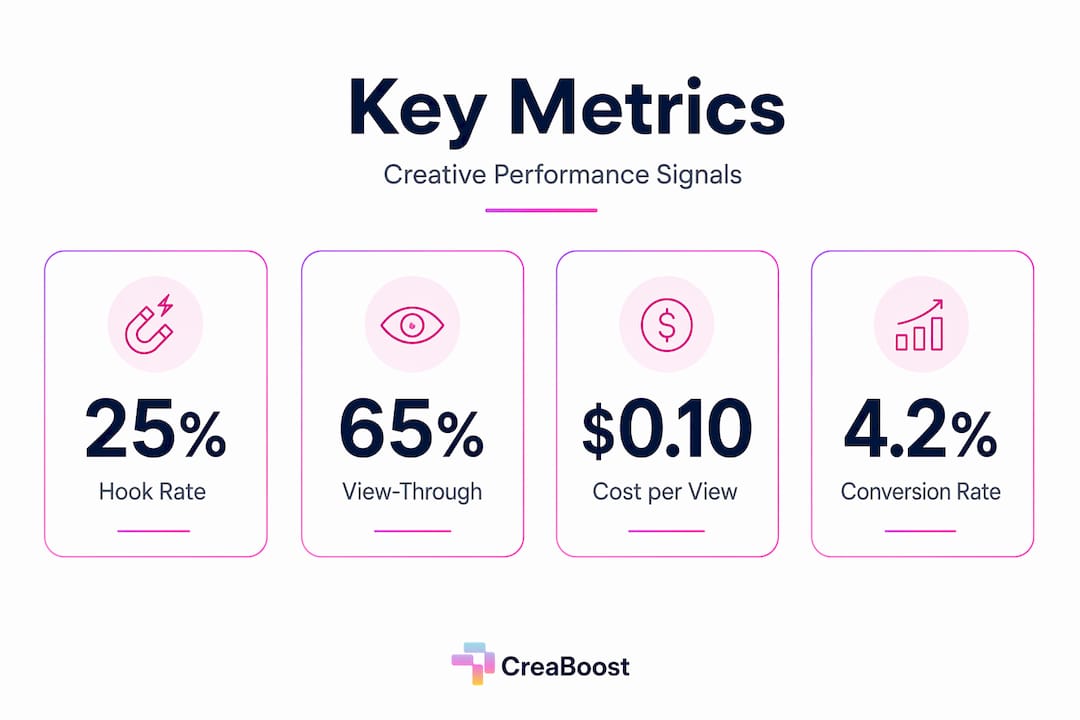
A hook rate below 25% tells you the first three seconds are failing, and no amount of landing page optimization fixes that. Rising cost per view with no change in bids is one of the clearest early signals of creative fatigue, usually visible in your data one to two weeks before CPA visibly deteriorates.
The most common misinterpretation in creative performance analysis is confusing impression volume with effectiveness. An asset that received the most impressions is often the one the platform defaulted to, not the one that actually performed best. When you rely on creative performance metrics tied to conversion outcomes rather than delivery volume, the real picture changes substantially. Frequently, the creative getting the fewest impressions is your actual winner waiting to be scaled.
My take on where creative analysis is actually heading
I've spent enough time working inside and alongside agency creative teams to have a strong opinion here. The teams that are pulling ahead right now are not necessarily the ones with the best designers or the biggest budgets. They are the ones who have rebuilt how they think about creative decisions.
What I've seen change most in the last two years is the move from reactive reporting to what I'd call creative engineering. That shift is real, and the agencies still treating analysis as a recap are falling further behind every quarter.
That said, I think there is a real risk of overcorrecting toward pure data dependence. AI pre-launch scoring and automated tagging are genuine advantages. But I've also seen teams use them as a way to avoid the hard creative thinking that no algorithm replaces. The ABCD framework and testing hierarchies are only as good as the hypotheses your strategists bring to the table. Data tells you what happened. It does not tell you what to try next.
The discipline I've found actually works is writing the brief before looking at the data. Form a hypothesis from experience and strategic intuition, then check it against the numbers. When you do it in reverse, you tend to find patterns that confirm what you already wanted to do. That is not analysis. That is validation shopping.
The agencies that will win the next phase of creative performance are the ones that hold both things at once: serious analytical rigor and the creative confidence to test something nobody has done before.
— Bythewise
How Creaboost makes this work at agency scale
If the frameworks and metrics above describe where you want to be, Creaboost is built to close the gap between that aspiration and your Monday morning reality.
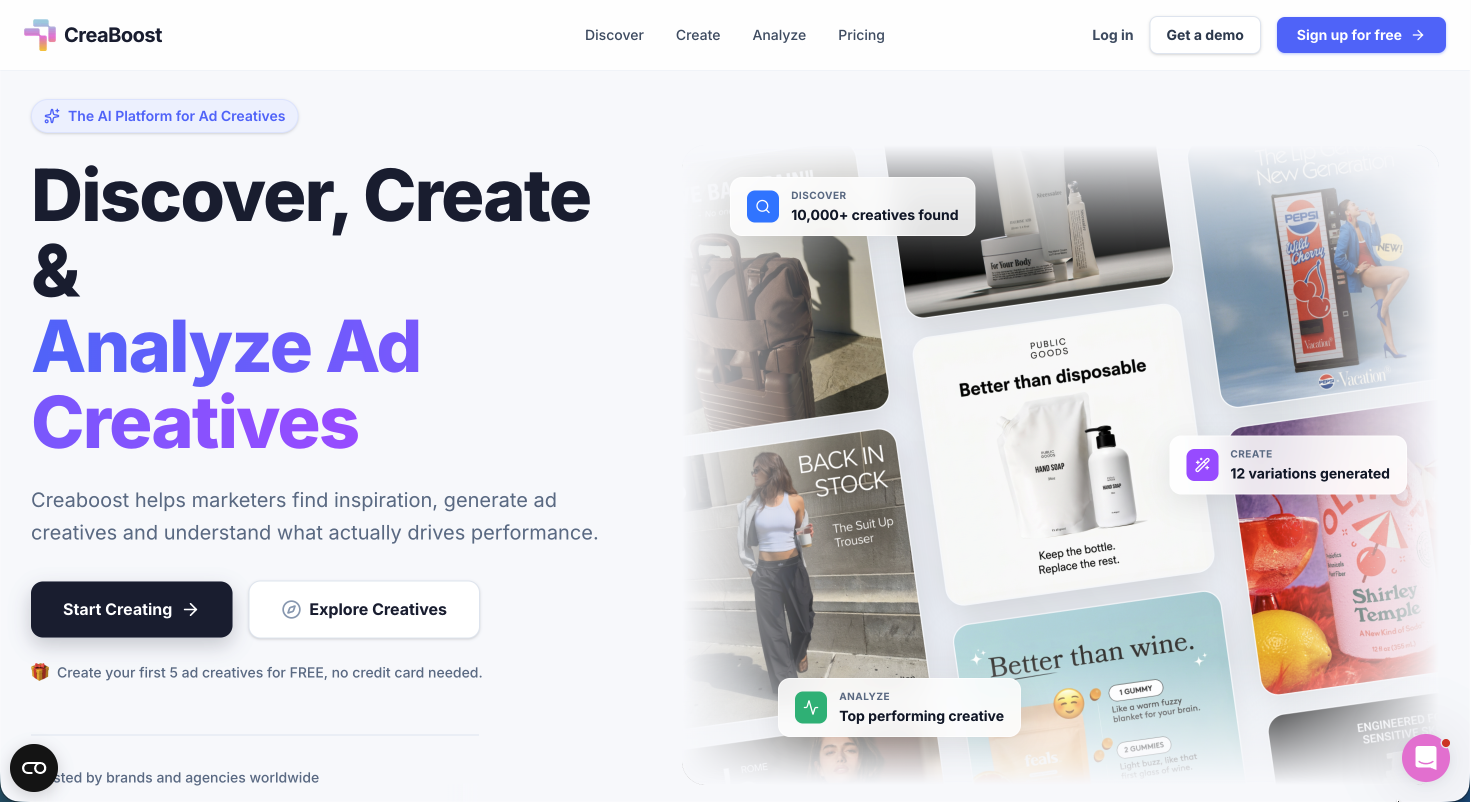
Creaboost's Analyze feature connects directly to your ad accounts and auto-tags every creative by format, hook, angle, and concept. The tagging discipline most agency teams abandon within a quarter becomes a system that runs without manual effort. You see which concepts are driving ROAS at the cohort level, catch fatigue one to two weeks before your headline metrics move, and scale real winners with confidence. Pair that with the AI ad creative generation inside Create, and your team goes from briefing to live variations in minutes rather than days. One platform. One source of truth. Get started at creaboost.com.
FAQ
What is creative analysis for agencies?
Creative analysis for agencies is the ongoing process of evaluating ad creative performance at the element level (hook, format, copy, concept) to identify what drives conversions and ROAS. It goes beyond post-campaign reporting to inform briefs, catch fatigue early, and build repeatable testing systems.
What metrics matter most in creative performance analysis?
Hook rate, view-through rate, cost per view, and conversion rate by creative variant are the most critical signals. A hook rate below 25% indicates a failed opening, while rising cost per view with stable bids is a reliable early indicator of creative fatigue.
How should agencies structure their creative testing?
Always test concept first, then execution, then individual elements. This hierarchy protects budget by validating the core idea before optimizing details. An agency-level testing program needs a hypothesis log, dedicated test budget, and pre-agreed decision criteria.
How does the ABCD framework improve creative performance?
The ABCD framework (Attract, Brand, Connect, Direct) gives video creative a data-backed structure. Ads built to these principles deliver up to 30% higher brand lift and 23% better ad recall compared to unstructured creative.
How can agencies detect and prevent creative fatigue?
Rotate creative every 3 to 4 weeks rather than every 8 to 12. Frequent rotation reduces CPMs by 20 to 35%. Monitor cost per view trends daily. Platforms typically flag fatigue in headline metrics only after you have already been bleeding budget for one to two weeks.