
Most digital marketers know their ads could perform better. They just aren't sure which variable to blame. A proper performance ad testing guide solves that. Without a structured system, you're spending budget to learn almost nothing. Optimization is multi-dimensional, requiring signal quality, creative velocity, and economic control working together. This guide walks you through every phase: setting up correctly, designing tests that produce clean data, executing without contaminating results, and reading outcomes well enough to make confident decisions on Meta, TikTok, and beyond.
Table of Contents
- Key takeaways
- Your performance ad testing guide starts here
- Designing tests that produce real answers
- Running tests without contaminating results
- Analyzing results and deciding what comes next
- My honest take on building a testing program that lasts
- Take your testing further with Creaboost
- FAQ
Key takeaways
| Point | Details |
|---|---|
| Fix your tracking first | Without Pixel and Conversions API in place, your test data will be incomplete and your conclusions unreliable. |
| Test one variable at a time | Isolating a single element per test is the only way to know what actually moved performance. |
| Use kill criteria from day one | Define pause thresholds before you launch so emotion doesn't override your data. |
| Read the full funnel | CTR tells you about attention. ROAS tells you about revenue. You need both to make a sound call. |
| Document why creatives win or fail | Building a creative intelligence log lets you replicate success patterns instead of rediscovering them each cycle. |
Your performance ad testing guide starts here
Before you run a single test, you need the right infrastructure. Skipping this step is the number one reason marketers collect data they cannot trust.
Tracking: the non-negotiable foundation
On Meta, you need both Pixel and Conversions API running together. Using Conversions API with Meta Pixel increases matched conversion events by 10 to 20%, which shortens your learning phase and lowers CPA. The Meta algorithm needs roughly 50 optimization events per ad set per week to exit the learning phase. If your setup is leaking signals, you will never hit that threshold cleanly, and every test result you read is built on sand.
On TikTok, the Events API serves the same function. Run both browser and server-side tracking in parallel. Overlap is preferable to gaps.
Minimum data requirements
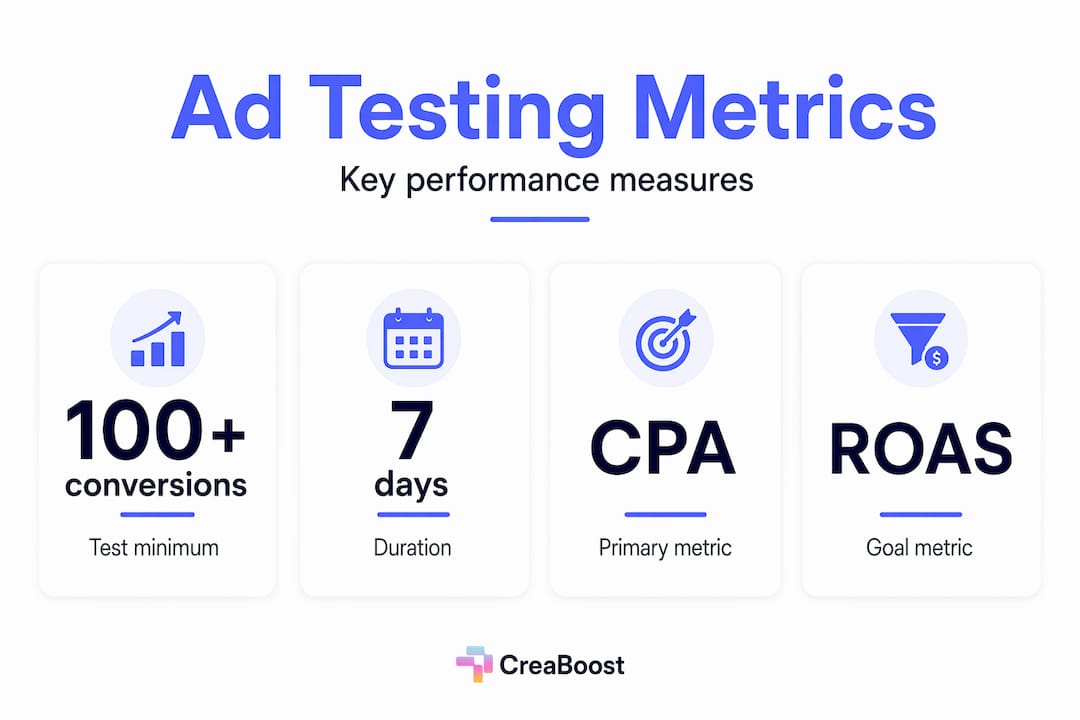
One of the most common mistakes in ad testing is calling a winner too early. For reliable test results, you should run each test for at least one full week and collect a minimum of 100 conversions or 1,000 impressions per variant. For B2B campaigns on platforms like LinkedIn or Google, reaching statistical significance typically requires $500 to $1,000 in budget per variant.
On Meta and TikTok, lower CPMs can get you there faster, but the one-week minimum still applies because of weekly seasonality patterns. A test that runs Monday to Wednesday is not telling you the same story as a full seven-day window.
Tools you actually need
Here is a practical starting checklist before any test goes live:
- Meta Pixel and Conversions API (or TikTok Events API) fully verified in Events Manager
- UTM parameters applied consistently across all variants
- A dedicated naming convention that separates test campaigns from live campaigns
- A spreadsheet or creative analytics tool to log hypotheses, variables, and outcomes
- Access to your attribution window settings so you are comparing apples to apples
Pro Tip: Set your attribution window to the same setting across all ad sets in a test. Comparing a 7-day click window to a 1-day click window will make your data look inconsistent even when performance is identical.
Designing tests that produce real answers
Good test design is what separates teams that learn from teams that just collect data. The design phase is where most campaigns quietly go wrong.

Concept testing vs. element testing
Effective ad testing separates concept testing from element testing. Concept testing pits different messaging stories against each other: a fear-of-missing-out angle versus a social proof angle, for example. Element testing runs variations within a concept that is already working: five different hooks on the same offer, or three different visuals with the same copy.
Run concept tests first. Once you know which message resonates, then optimize the individual elements inside it. Skipping to element testing before you have a winning concept means you are polishing something that may never convert.
Choosing your variable and writing your hypothesis
Good tests avoid changing hooks, visuals, CTA, and formats simultaneously. Change one thing. Write a hypothesis before you launch. A proper hypothesis looks like: "Changing the hook from a question to a bold claim will increase thumb-stop rate, because our audience responds better to direct statements than to open-ended prompts."
Here is a simple framework for prioritizing what to test first:
- Offer — What you are promising the customer. This has the highest potential impact on conversion rate.
- Angle — The emotional or rational frame around the offer. Fear, aspiration, social proof, curiosity.
- Hook — The first three seconds of a video or the headline of a static. This determines whether anyone keeps watching.
- Format — Video versus static, carousel versus single image, short-form versus long-form.
- CTA — Often the last thing worth testing, but can matter when the top of the funnel is already working.
Defining success before you start
Pick one primary metric aligned to your business goal. If you are optimizing for purchases, CPA or ROAS is your primary metric. CTR is a secondary signal, not the decision-maker. Define your decision rule in advance: "If Variant B achieves a CPA at least 15% lower than Variant A after 100 conversions, we scale Variant B."
| Hypothesis | Variable tested | Primary metric | Decision rule |
|---|---|---|---|
| Bold claim hook outperforms question hook | Hook copy | Thumb-stop rate + CPA | Scale if CPA drops 15%+ at 100 conversions |
| User-generated style beats branded video | Creative format | ROAS | Scale if ROAS improves 20%+ after 7 days |
| Discount offer outperforms free shipping offer | Offer framing | Conversion rate | Scale if CVR lifts 10%+ at 1,000 clicks |
Pro Tip: Write your decision rule before you look at any data. Waiting until you can see early results and then setting the threshold is how confirmation bias corrupts test outcomes.
Running tests without contaminating results
The execution phase is where structurally sound tests can still fall apart.
Isolate your test campaigns
Blending test ads with live campaigns contaminates results because the algorithm allocates budget based on historical performance signals, not test fairness. Your control variant will receive more spend if it has a longer history, which skews every metric you read. Dedicated test campaigns with equal starting budgets are the only clean setup.
Launch all variants at the same time. A staggered launch introduces timing bias. Consumer behavior shifts across days of the week and times of day, so a variant that launches on Tuesday and one that launches Thursday are not running the same race.
Kill criteria and monitoring
Set predefined kill criteria before you launch. A practical standard: pause any variant that has spent $50 to $100 without generating a single conversion, or after 48 to 72 hours if it is performing more than 50% worse than the control on your primary metric. Launching controlled variants with predefined kill criteria like these accelerates your learning velocity without burning budget on obvious losers.
Watch for these signals while tests are running:
- CPA rising more than 20% versus your baseline with no external cause
- Frequency climbing above 3.0 within the first week, suggesting audience exhaustion
- CTR dropping 20% over two weeks, which points to creative fatigue rather than a test variable
- Delivery becoming highly uneven across variants, which signals algorithm interference
Maintaining creative velocity
High-performing accounts produce 8 to 12 active test variations per campaign and refresh 25 to 30% of their creative pool monthly. At $50k or more in monthly spend, top teams are generating 10 or more new concepts weekly. That cadence is not achievable through a manual design process alone. AI-powered creative generation paired with disciplined analysis accelerates testing cycles significantly without sacrificing the hypothesis-driven structure that makes results meaningful.
Pro Tip: If your creative refresh rate is slower than your audience's attention span, your winners will fatigue before you finish scaling them. Treat creative production as infrastructure, not a project.
Analyzing results and deciding what comes next
Collecting data is easy. Reading it correctly is the skill that separates good media buyers from great ones.
Statistical significance and sample size
Do not call a winner based on small sample sizes. A 10% CPA difference over 30 conversions is noise. That same difference over 300 conversions is a signal. Experts recommend against stopping tests after initial winners emerge. Continuous small iterative tests sustain performance far better than one big test followed by months of running the winner untouched.
Reading beyond surface metrics
CTR tells you about creative appeal. Click-to-purchase rate tells you about offer-audience fit. ROAS tells you about revenue efficiency. All three together tell you whether your ad is doing its job. A creative with a high CTR and poor ROAS is driving curious clicks, not buyers. That is useful information, but it does not mean the creative works.
Here is a post-test analysis checklist worth running on every concluded experiment:
- Did the winning variant beat control on your pre-defined primary metric by the threshold you set?
- Does the pattern hold across different audience segments or just one?
- Was delivery balanced across variants throughout the test period?
- Does the winner's performance hold over days 5 through 7, or did it peak early and fade?
Building a creative intelligence loop
High-performing testing systems maintain creative intelligence loops that document why creatives win or lose. Not just "Video A beat Video B" but "Video A won because the hook addressed the specific fear of [problem] before showing the product, while Video B opened with product features." That level of documentation lets you build pattern libraries that inform your next brief, your next test, and your next scaling decision.
Without this loop, you rediscover the same lessons every quarter. With it, your creative program compounds over time.
My honest take on building a testing program that lasts
I've seen teams with $20k monthly budgets outperform teams with $200k budgets because of one thing: they tested with discipline and documented everything. The teams losing money aren't necessarily running bad ads. They're running tests without hypotheses, calling winners after 40 conversions, and mixing test variables because they want to move fast.
The uncomfortable truth I've learned is that most "best practices for ad testing" content online treats statistical significance as an advanced concept. It isn't. It's the minimum requirement for not wasting your budget on false conclusions. What I've found actually works is treating every test like a small scientific experiment: one question, one variable, one clear answer before you move on.
I've also watched teams abandon their testing programs the moment a single winner emerged. They scaled the winner, stopped testing, and then panicked six weeks later when CPAs climbed and they had no pipeline of creative to replace what had fatigued. The teams I respect most treat testing as a permanent operating rhythm, not a project you complete.
Automation helps. You absolutely should be using platform signals and AI tools to accelerate creative generation. But the strategic judgment, the hypothesis writing, the pattern recognition, none of that can be automated. The discipline has to come from you.
— Bythewise
Take your testing further with Creaboost
The framework in this guide works. The bottleneck for most teams isn't knowledge. It's execution speed and operational clarity.
Creaboost is built for performance teams that need to move faster without losing structure. The Analyze feature auto-tags every creative by hook, angle, format, and concept the moment it connects to your ad accounts, giving you the creative intelligence loop described above without any manual tagging. You see which concepts are driving ROAS at the cohort level, and you catch fatigue signals before they show up in your headline numbers. Pair that with the Create feature to generate platform-ready variations in minutes, and your testing velocity goes from constrained to consistent. If the gap between what you know you should be testing and what you're actually shipping has been growing, Creaboost closes it.
FAQ
What is a performance ad testing guide?
A performance ad testing guide is a structured framework for designing, running, and analyzing ad experiments to improve metrics like CPA, ROAS, and CTR. It covers tracking setup, hypothesis design, test execution, and result interpretation.
How long should you run an ad test?
Run tests for a minimum of seven days to account for weekly seasonality, and collect at least 100 conversions or 1,000 impressions per variant before drawing any conclusions.
What is the most important variable to test first?
Test your offer before anything else. The promise you make to the customer has the highest potential impact on conversion rate, making it the highest-leverage variable in any ad testing hierarchy.
How do you know when a creative is fatiguing?
Watch for a CTR drop of 20% or more over two weeks, frequency climbing above 4.0, or CPA rising without any change to your offer or landing page. These signals typically appear one to two weeks before performance visibly collapses in your top-line metrics.
Why should test campaigns be separate from live campaigns?
Mixing test and live campaigns lets the algorithm favor creatives with historical performance data, which distorts budget allocation and makes it impossible to attribute results cleanly to the variable you are testing.