
Most performance marketers assume that better-looking ads perform better. Cleaner design, more professional production, higher resolution. That assumption is quietly bleeding budgets across thousands of DTC accounts every day. True ad creative quality, as Meta and TikTok actually measure and reward it, is about driving engagement signals that keep delivery efficient and audiences responsive. Polish is optional. Sustained engagement is not. This guide breaks down what creative quality really means, how it drives or destroys ROAS, and how to operationalize it before fatigue does the damage for you.
Table of Contents
- What is ad creative quality (really)?
- How creative quality drives (and loses) performance
- TikTok vs. Meta: Platform-specific creative quality explained
- Actionable frameworks: Diagnosing, testing, and refreshing creative quality
- AI-generated creatives: When to use them, benchmarks, and caveats
- Our perspective: Why creative systems beat creative intuition
- Level up your creative quality with CreaBoost
- Frequently asked questions
Key Takeaways
| Point | Details |
|---|---|
| Focus on engagement | True ad creative quality is measured by attention, retention, and relevance, not polish alone. |
| Manage creative fatigue | Identify fatigue through falling CTR and rising frequency, then refresh before performance drops. |
| Adapt for each platform | Tailor your creative approach for TikTok’s speed and Meta’s need for variety and relevance. |
| System beats guesswork | A repeatable, data-driven loop of testing and refreshing outperforms intuition or chasing one winning ad. |
| AI is a tool, not a cure-all | AI-generated ads can increase CTR but must be checked for conversion and contextual fit in your funnel. |
What is ad creative quality (really)?
With the misconception addressed, let's clarify what "ad creative quality" means in practice.
Most teams define creative quality by what they can see: typography, color palette, production value, whether the voiceover sounds professional. These things matter for brand presentation, but they are not what the auction cares about. The platforms care about what happens after the impression is served.
"Creative quality is not only about polish or artistic merit; it is an auction + engagement + relevance system. In practice, quality is what earns attention (hook/opening), retains it (pacing/watch), and makes the next step believable (message-to-landing match)." — Search Engine Land
This framing is worth internalizing. You are not designing for a gallery. You are building a three-part sequence: earn attention in the first two seconds, hold it through the body, and land the promise on the destination page. If any of those three steps break, the platform reads it as low quality regardless of how much the video cost to produce.
What actually signals quality to the algorithm includes:
- Hook rate: the percentage of viewers who watch past the first three seconds
- Watch time and completion rate: how much of the creative the average viewer consumes
- CTR: whether the call-to-action generates clicks at an efficient rate
- Landing page relevance: whether the message in the ad matches what the user finds when they click
- Frequency-adjusted responsiveness: how the audience reacts over repeated exposures
For marketers working on building high-performing creatives, the shift from "does this look good?" to "does this earn attention and sustain it?" changes every brief, every concept, and every creative review.
How creative quality drives (and loses) performance

Once you grasp what quality actually means, it's crucial to see how it materially impacts campaign performance.
The mechanism is straightforward. When a creative earns strong engagement signals early, the platform's delivery system reads it as relevant and allocates more impressions at lower cost. CPMs drop. ROAS improves. The creative scales. Now flip that. When the same audience sees the same ad repeatedly, responsiveness degrades and performance declines. This is creative fatigue, and it is the most common and most underdiagnosed cause of CPA drift in scaling DTC accounts.
Fatigue doesn't announce itself. It shows up as a slow rise in frequency, a gradual decline in CTR, and a CPA that drifts upward over one to two weeks before it's visible in your headline metrics. By the time your weekly report flags it, you've likely been overpaying for impressions for seven to ten days.
The core diagnostic signals for fatigue:
| Signal | Healthy range | Fatigue indicator |
|---|---|---|
| Frequency | 1.5 to 2.5 per week | Consistently above 3.0 |
| CTR (link click) | 1.5%+ (varies by vertical) | Declining week-over-week |
| Hook rate | 25%+ | Dropping below 20% |
| ROAS trend | Stable or improving | Down 15%+ from baseline |
| CPA trend | Stable | Rising 10%+ with no budget change |
A practical approach to creative quality management is measuring and refreshing using early fatigue signals before manual reporting catches the decline. Most teams wait for the CPA to rise. The better teams watch CTR and frequency weekly and act earlier, often catching the problem a full week before it shows up in the bottom-line numbers.
Incremental ROAS is the other metric worth watching. Total ROAS can hold steady while your best-performing creative is being cannibalized by a fatiguing one, masking the real problem. Looking at creative-level incrementality, especially when you have real winners buried under a pile of mediocre performers, is where the largest efficiency gains hide. You can find real-world ad examples and supporting analysis on the creative insights blog.
TikTok vs. Meta: Platform-specific creative quality explained
Understanding platform impact, let's compare what quality means on Meta versus TikTok.
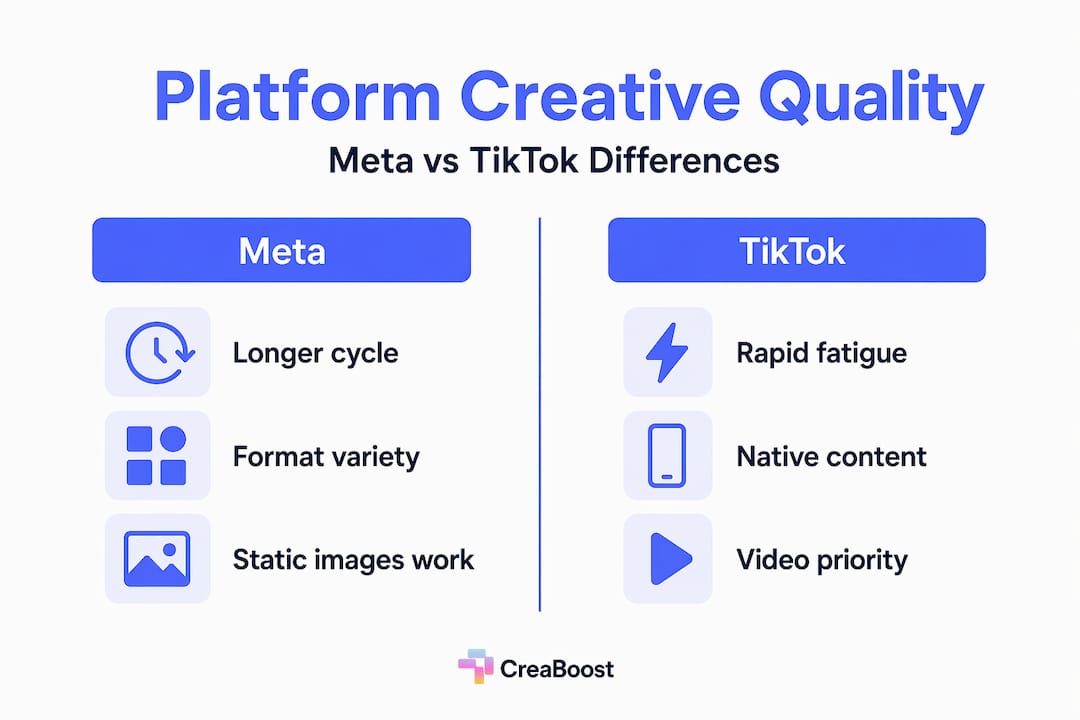
These two platforms share the same broad principle (engagement drives delivery efficiency) but differ significantly in what they define as engaging and how fast they punish stale creative.
Platform creative quality comparison:
| Factor | Meta | TikTok |
|---|---|---|
| Fatigue timeline | 3 to 5 weeks typical | 1 to 2 weeks typical |
| Native style importance | Moderate | Critical |
| Hook window | First 3 seconds | First 1 to 2 seconds |
| Creative variety needed | Monthly refresh | Weekly to bi-weekly |
| Format flexibility | High (image, video, carousel) | Primarily vertical video |
| Authenticity weighting | Medium | Very high |
On TikTok, creative success is a content problem, not a production problem. The platform's users are trained to skip anything that looks like an ad. Native feel, pacing that matches organic content, creators that speak like real people, and hooks that mirror what the For You page already serves, these are the inputs the TikTok algorithm rewards. A high-budget video that looks like a traditional TV commercial will almost always underperform a phone-shot UGC clip with a compelling hook and genuine energy.
Critically, repurposing Meta creatives to TikTok without reworking them for native style consistently underperforms. The audiences are different, the scroll behavior is different, and the creative language is different. What converts cold traffic on Meta feeds often feels out of place on TikTok and gets skipped immediately.
Meta, by contrast, has a longer fatigue runway and rewards creative variety across formats. Static images still perform. Carousels work for certain categories. The delivery algorithm responds to consistent engagement across a rotation of concepts rather than demanding constant fresh content. You have more time to scale a winner before fatigue erodes it.
Pro Tip: Build TikTok creative batches in series of four to six assets using the same core angle but different hooks. Swap hooks first before replacing the entire concept. This extends lifespan without resetting everything that's working.
To make platform-specific creative quality decisions easier, the ad placement strategies guide covers format considerations in depth, and the scaling across Meta and TikTok guide covers what to do once you've found winners.
Actionable frameworks: Diagnosing, testing, and refreshing creative quality
To put quality insights into action, we need operational frameworks marketers can implement right away.
Most performance teams don't lack the will to manage creative quality. They lack the system. Without a repeatable process, fatigue detection becomes reactive, testing becomes random, and refresh decisions get made based on whoever is most vocal in the Slack channel that week.
Here is a structured framework for managing creative quality continuously:
- Set fatigue detection triggers. Define thresholds in your analytics layer: frequency above 3.0, CTR down more than 15% week-over-week, or hook rate below 20%. These should generate alerts, not manual lookups.
- Build an angles and hooks matrix before production. Map your core offer to three to five distinct angles (social proof, problem/solution, transformation, comparison, curiosity). For each angle, write three to five hook variants. This gives you fifteen to twenty-five test combinations from a single brief.
- Run structured batches with enough volume. Don't call winners on fewer than 2,000 impressions or 100 clicks per creative. Underpowered decisions are one of the biggest sources of wasted refresh budget.
- Scale winners through variations, not replacements. When you find a strong performer, extend its lifespan by iterating on secondary elements: swap the background, change the CTA text, recut the first frame. Replacing it entirely is often premature.
- Respect the learning window. Meta's algorithm typically needs seven to ten days and around 50 conversion events per ad set to exit the learning phase. Refreshing creative aggressively inside that window resets learning and can artificially suppress performance that would have improved on its own.
- Assign refresh cadence by platform. TikTok: review weekly, refresh bi-weekly at minimum. Meta: review weekly, refresh monthly for evergreen concepts and bi-weekly for seasonal pushes.
"A pragmatic approach to avoid over-polished creative is to test 'uglier' or more native-looking production and validate via structured testing." — Search Engine Land
A repeatable creative quality system for DTC marketers is exactly this kind of loop: define angles and hooks, build a testing matrix, run for enough impressions before declaring winners, then scale via variations to extend lifespan. That system, when it runs consistently, separates teams that improve ROAS quarter over quarter from teams that are perpetually surprised by CPA drift.
The ad creative best practices resource covers additional tactical details for building and managing this loop.
AI-generated creatives: When to use them, benchmarks, and caveats
An emerging tool in creative quality: AI-generated ads. Let's clarify where these fit and their real-world results.
AI-generated creatives have moved from novelty to legitimate production tool for DTC brands running volume. The use case is clearest for static ad variations, background swaps, copy iterations, and format resizing. These are tasks that previously required designer time and now take minutes.
On performance benchmarks, the picture is nuanced. AI-generated creatives can improve CTR on Meta meaningfully, with some practitioner data pointing to click-through improvements in the range of 10 to 15% for scroll-stopping static formats. However, the same aggregations suggest that for higher-consideration products (typically above $100 AOV) and more complex purchase decisions, AI creatives may lag on conversion rate compared to human-produced, story-driven content. Clicks are easier to earn than purchases.
Where AI-generated creative earns its place in the workflow:
- Angle diversity testing: Generate ten versions of a static ad testing different value propositions in the headline, all from the same product image, in minutes rather than days
- Hook testing at scale: Produce multiple opening frame variations to identify which hook concept earns the best three-second view rate before investing in full video production
- Format adaptation: Resize and reformat winning concepts for different placements (Stories, Feed, TikTok vertical) without a designer round-trip
- Seasonal refreshes: Swap backgrounds and seasonal overlays on proven performers to extend lifespan without rebuilding the concept from scratch
Pro Tip: Use AI generation for your first-round hypothesis testing and reserve human creative direction for concepts that have already proven angle viability. You stop spending production budget on concepts that were never going to resonate.
The practical ceiling of AI creative is in emotional storytelling and brand narrative, particularly for products where trust and consideration are high. A skincare brand selling a $25 SPF can test aggressively with AI-generated statics. A supplement brand asking customers to commit to a $180 three-month program usually needs more narrative depth than AI alone can deliver today. Know where your product sits on that spectrum and explore AI ad creative generation with that context in mind.
Our perspective: Why creative systems beat creative intuition
Having covered frameworks and benchmarks, here is our perspective on what actually drives success in creative quality.
The teams we see consistently improving ROAS quarter over quarter are not the ones with the most talented designers or the biggest production budgets. They are the ones with the tightest feedback loops. Creative intuition, the feeling in your gut that a concept is a winner, has a terrible track record as a standalone input. The "hero ad" myth, the belief that one great creative can carry a campaign for months, is responsible for more budget waste than almost any other misconception in performance marketing.
What works is structure. Defining hypotheses before production. Running enough volume to make valid calls. Scaling via variation, not replacement. And critically, respecting campaign learning windows so that aggressive creative refresh doesn't reset the algorithm's optimization right when it's starting to work.
The other thing most marketers miss is the feedback cadence lag. Your ad account data has latency. Conversion reporting on Meta has latency. By the time your dashboard clearly shows a fatiguing creative, you are already a week or two into the problem. The only way to stay ahead of it is proactive monitoring at the leading indicator level, not waiting for CPA to confirm what CTR already told you.
We built the creative analytics inside Creaboost specifically to address that lag, auto-tagging creative by concept and surfacing fatigue signals before they reach your headline numbers. The system catches what manual monitoring consistently misses.
Level up your creative quality with CreaBoost
For those ready to put these systems to work, here's how Creaboost supports data-driven creative quality across Meta, TikTok, and beyond.
Everything covered in this guide, fatigue detection, structured testing, AI-powered variation, and platform-specific refresh cadences, requires an operational layer that most teams are still trying to build manually across spreadsheets, dashboards, and Slack threads.
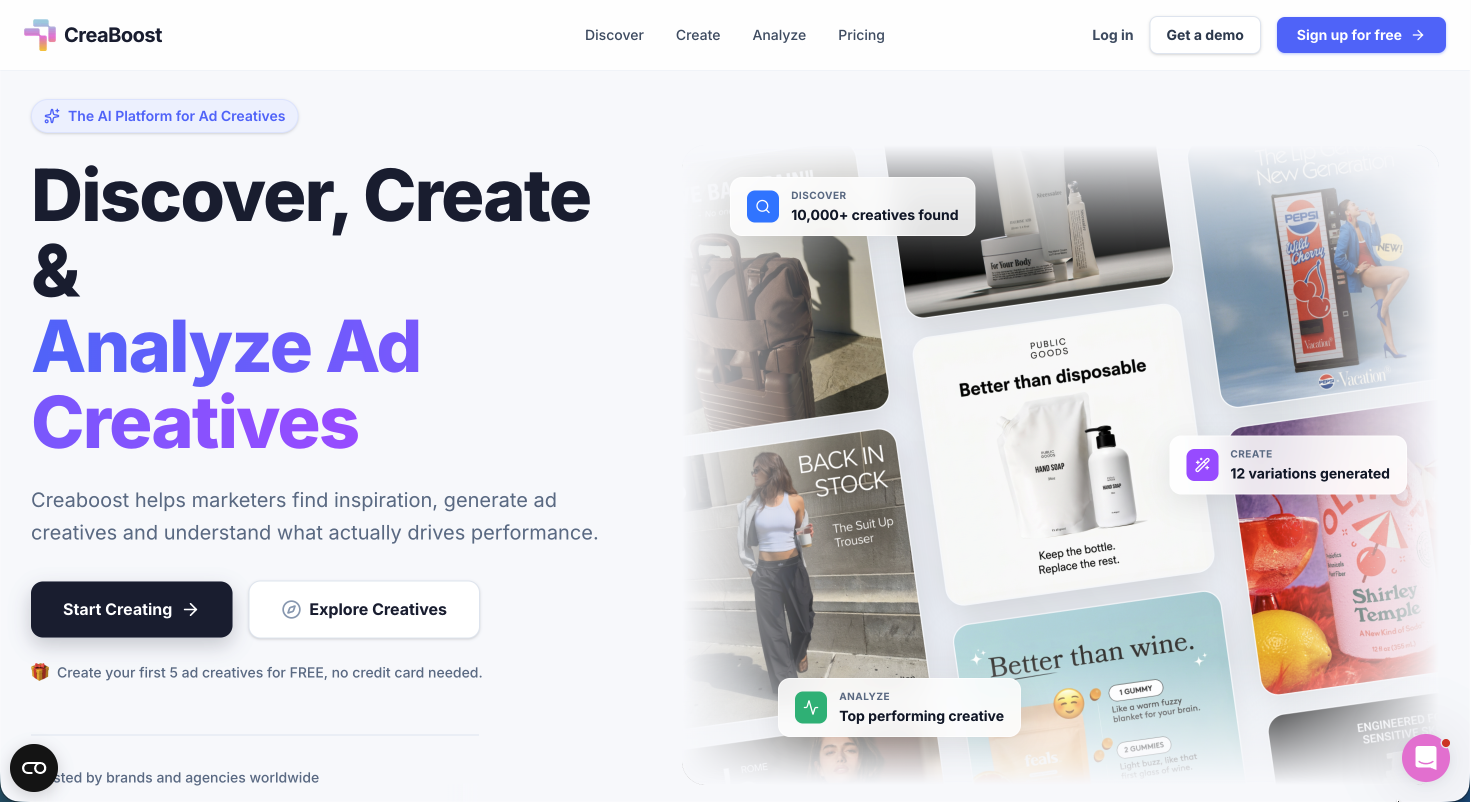
Creaboost brings the entire creative loop into one platform. Analyze your ad performance with auto-tagged creative data that surfaces real fatigue signals ahead of CPA drift, so you are acting on leading indicators instead of lagging ones. Create AI-powered ad creative that lets you test angles and hooks at volume without bottlenecking your design team. And manage the operational layer underneath with automation rules, naming conventions, and quota-based alerts that keep your accounts clean and your team focused on strategy. The teams using Creaboost ship more, learn faster, and spend less time on the manual work that quietly drains performance teams.
Frequently asked questions
How do I know when my ad creative is fatigued?
Monitor for rising audience frequency and declining CTR simultaneously. These are the core early warning signals of creative fatigue onset, and they typically appear one to two weeks before CPA drift becomes visible in standard reports.
Does ad creative quality matter more on TikTok or Meta?
Creative quality is central to both platforms, but TikTok demands more rapid iteration and native-first creative, while Meta rewards sustained variety and relevance. TikTok creative wear-out can happen in one to two weeks versus Meta's typical three to five week runway.
What's the risk of refreshing creative too often?
Refreshing creative too quickly resets campaign learning and can suppress ROAS during the algorithm's optimization phase. Refreshing too aggressively can undermine performance gains that were already in progress, so balance urgency with platform learning requirements.
Are AI-generated ads always better than human-created ones?
AI-generated ads can boost CTR meaningfully but may lag on conversion for higher-priced or complex products where narrative and trust are critical purchase drivers. Always validate AI creative performance in your specific funnel before scaling.