
Ad concept generation is the structured process of transforming audience insights, brand values, and product positioning into distinct, testable advertising angles called concepts, which then guide creative production and campaign strategy. The industry term for this practice is ad conceptualization, and it sits upstream of everything else in your creative pipeline. Before a single asset gets designed or a video gets filmed, concept generation determines whether your campaign has a real shot at resonating with cold audiences. For eCommerce marketing teams running Meta Ads at scale, this process is the difference between a creative pipeline that compounds results and one that burns budget on executions that were never going to work.

What is ad concept generation and how does it work?
Ad concept generation is defined as the structured process turning audience, brand, and product insights into testable advertising angles, distinct from creatives which are the actual executions of those angles. A concept is a strategic idea: "We show a busy parent who can't find a supplement that actually works, and our product solves that in 30 seconds." A creative is the video, static image, or carousel that brings that idea to life. Conflating the two is the most expensive mistake eCommerce teams make, because it sends production into motion before anyone has validated whether the underlying idea resonates.
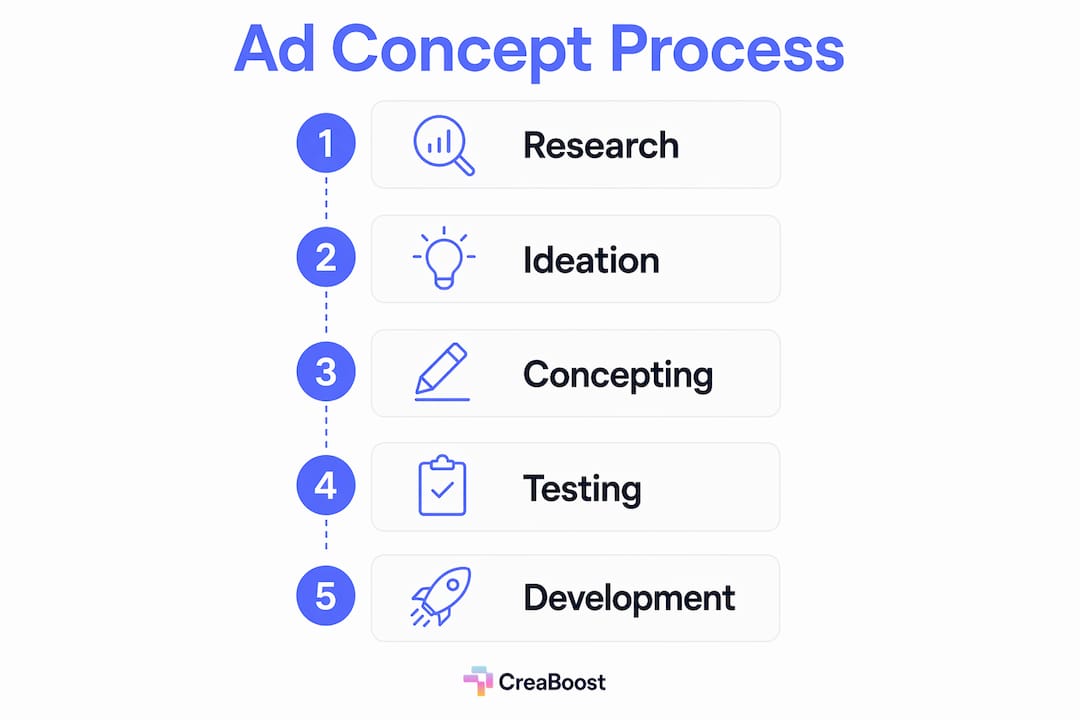
The concept generation pipeline follows a clear sequence that prevents premature production spending. Here is how the process runs in practice:
- Research — Mine audience reviews, competitor positioning, and customer interviews to surface the language, fears, and desires your audience actually uses.
- Angle selection — Choose 5 to 10 fundamentally different narrative directions, such as problem-solution, transformation, social proof, or objection inversion.
- Headline writing — Draft a primary hook for each angle that captures the core promise in one sentence.
- Visual direction — Specify the visual tone, setting, and format for each concept without producing full assets yet.
- Audience and CTA mapping — Assign each concept to a specific audience segment and pair it with a call to action that matches the funnel stage.
- Concept documentation — Package each angle into a brief that a designer or video editor can execute without a back-and-forth.
Pro Tip: Cover at least four to six structurally different angles per product before moving to production. Testing only surface variations of the same concept, like swapping a headline color, tells you nothing about whether your core messaging is right.
How does concept generation differ from concept testing and creative development?
These three terms describe sequential stages, not interchangeable activities. Mixing them up wastes both time and money.
Concept testing evaluates different ad ideas with audiences before production, filtering out weak angles upstream. It uses mockups, storyboards, or rough cuts to gauge whether a concept resonates before a dollar of production budget gets spent. This is fundamentally different from A/B testing, which compares live variations of assets that are already in market. One happens before production. The other happens after.
Concept testing and element testing solve different problems entirely. Concept testing confirms the angle resonates. Element testing fine-tunes execution details like button color, headline phrasing, or thumbnail image inside a concept that has already proven its core message works. Skipping concept testing and jumping straight to element testing is the equivalent of optimizing the font on a billboard that nobody reads.
The table below maps out how these three stages relate to each other:
| Stage | What it produces | When it happens | Primary question answered |
|---|---|---|---|
| Ad concept generation | Testable advertising angles and briefs | Before production | What story should we tell? |
| Ad concept testing | Validated concepts worth producing | Before production | Does this story resonate? |
| Ad creative development | Finished assets ready to run | After validation | How do we execute this story well? |
The sequencing matters as much as the definitions. Confusing concepting with production inflates costs and sends creative teams down directions that fail for strategic reasons, not executional ones. Validate the angle first. Then produce.
What frameworks drive effective ad concept ideation in eCommerce?
The most reliable frameworks for advertising idea generation share one characteristic: they start with the audience, not the product. Audience-first ideation outperforms product-focused starting points because cold audiences do not care about your product features. They care about their own problems, identities, and desires. Your product is only relevant insofar as it connects to those things.
The MHI Growth Engine identifies five frameworks that consistently produce strong concept variety for DTC and eCommerce brands:
- Voice of Customer Mining — Pull exact language from Amazon reviews, Reddit threads, and customer support tickets. The phrases your customers use to describe their problem are often your best headlines.
- Problem Tree — Map every downstream consequence of the core problem your product solves. Each branch is a potential concept angle targeting a different emotional trigger.
- Competitor Gap Analysis — Identify what your competitors are not saying. Unclaimed positioning territory is often where the most differentiated concepts live.
- Benefit Ladder — Move from functional benefit ("saves 20 minutes") up through emotional benefit ("feels like you have your life together") to identity benefit ("you're the kind of person who has a system"). Each rung is a distinct concept.
- Objection Inversion — Take the most common reason someone would not buy and make it the opening hook. "You've probably tried three supplements that didn't work. Here's why this one is different."
Concept variety functions as a sampling problem. Diverse narrative angles are required to learn what truly resonates. Running five variations of the same problem-solution angle does not tell you whether a transformation angle or a social proof angle would outperform it. You need directionally different concepts to generate real learning.
Pro Tip: When you look at your current ad account and see one angle dominating spend, that is not proof the angle is your best performer. It may simply be the only angle you tested. Sampling across multiple frameworks before drawing conclusions is how you avoid building a strategy on a false signal.
You can see how these angles translate into actual executions by reviewing eCommerce ad examples across Meta and TikTok. The pattern is consistent: the ads that scale are almost always built on a specific, audience-rooted insight, not a generic product claim.
How are AI tools changing the ad concept generation process?
AI is reshaping how fast and how thoroughly marketing teams can move through the concept generation pipeline. Amazon Ads' agentic AI creative tool researches products and audiences, brainstorms ideas, generates storyboard concepts, and produces ads with multiple concept options in a single workflow. Announced in 2025, it represents a shift from AI as an execution tool to AI as a strategic collaborator that explains its reasoning and offers concept alternatives.
The practical benefits for eCommerce creative teams are significant:
- Speed — Concept generation that previously took a strategist two to three days of research and briefing can be compressed into hours.
- Scale — AI can generate 5 to 10 ready ad concepts per product across multiple angles simultaneously, a volume that would require a full creative team to match manually.
- Strategic input — Agentic AI tools provide storyboard explanations alongside concepts, making it easier for creative directors to evaluate and iterate rather than starting from scratch.
- Pattern recognition — AI trained on large creative datasets can surface angle combinations that human teams might not consider, particularly for new product categories.
The critical limitation is input quality. High-quality AI-generated concepts require feeding the system rich brand guidelines, specific product differentiation, and explicit audience data. Generic inputs produce plausible-sounding but strategically irrelevant concepts. The AI is only as good as the brief you give it. Teams that treat AI as a replacement for audience research consistently get worse output than teams that use it as an accelerator on top of solid research.
The end-to-end creative workflow for eCommerce brands now increasingly looks like this: human-led audience research feeds AI-assisted concept generation, which produces briefs that go into production. The human judgment layer moves upstream into research and angle selection, while AI handles the volume and variation work.
Key takeaways
Effective ad concept generation requires separating the strategic angle from the creative execution, validating concepts before production, and sampling across fundamentally different narrative frameworks.
| Point | Details |
|---|---|
| Concept precedes creative | Define and validate your advertising angle before spending production budget on assets. |
| Audience-first always wins | Start with customer language, fears, and desires rather than product features to build resonance with cold audiences. |
| Sequence your testing | Run concept testing upstream to confirm angle resonance, then use element testing to optimize execution inside proven winners. |
| Diversity is the point | Generate at least four to six structurally different angles per product to avoid building strategy on a single misleading signal. |
| AI accelerates, not replaces | AI tools like Amazon Ads' agentic AI produce better concepts when fed rich brand, product, and audience inputs. |
Why most eCommerce teams are solving the wrong creative problem
The teams I see struggling most with creative performance are not short on designers or budget. They are short on concept variety. They brief the same five angles every quarter because those are the ones that worked six months ago, and nobody has had the time to go back to first principles and ask whether the audience has moved on.
The deeper issue is that most eCommerce teams treat concept generation as a creative task when it is actually a research task. The best concepts I have seen come from someone spending two hours in Amazon reviews and Reddit threads, not from a brainstorm session in a conference room. The language is already there. Your job is to find it and turn it into a hook.
The other pattern worth naming: teams that skip concept testing because it feels slow end up slower. They produce six assets, run them, get inconclusive data because the concepts were too similar, and then brief six more. Generating directionally different concepts first and then constraining execution testing inside winners is the operating principle that separates teams with repeatable creative engines from teams that are always starting over.
AI tools genuinely help here, but only if you resist the temptation to use them as a shortcut around the research step. Feed them garbage inputs and you get polished garbage back. Feed them a real audience brief with specific language, real objections, and a clear product differentiator, and you get concepts worth testing.
The teams winning on Meta in 2026 are not the ones with the biggest budgets. They are the ones who identify top-performing concepts fast, kill losers early, and have a system for generating the next round of angles before fatigue sets in.
— Bythewise
How Creaboost closes the gap between concept and performance
If your team is generating concepts but losing track of which ones are actually driving ROAS, the problem is not your creative quality. It is your infrastructure.
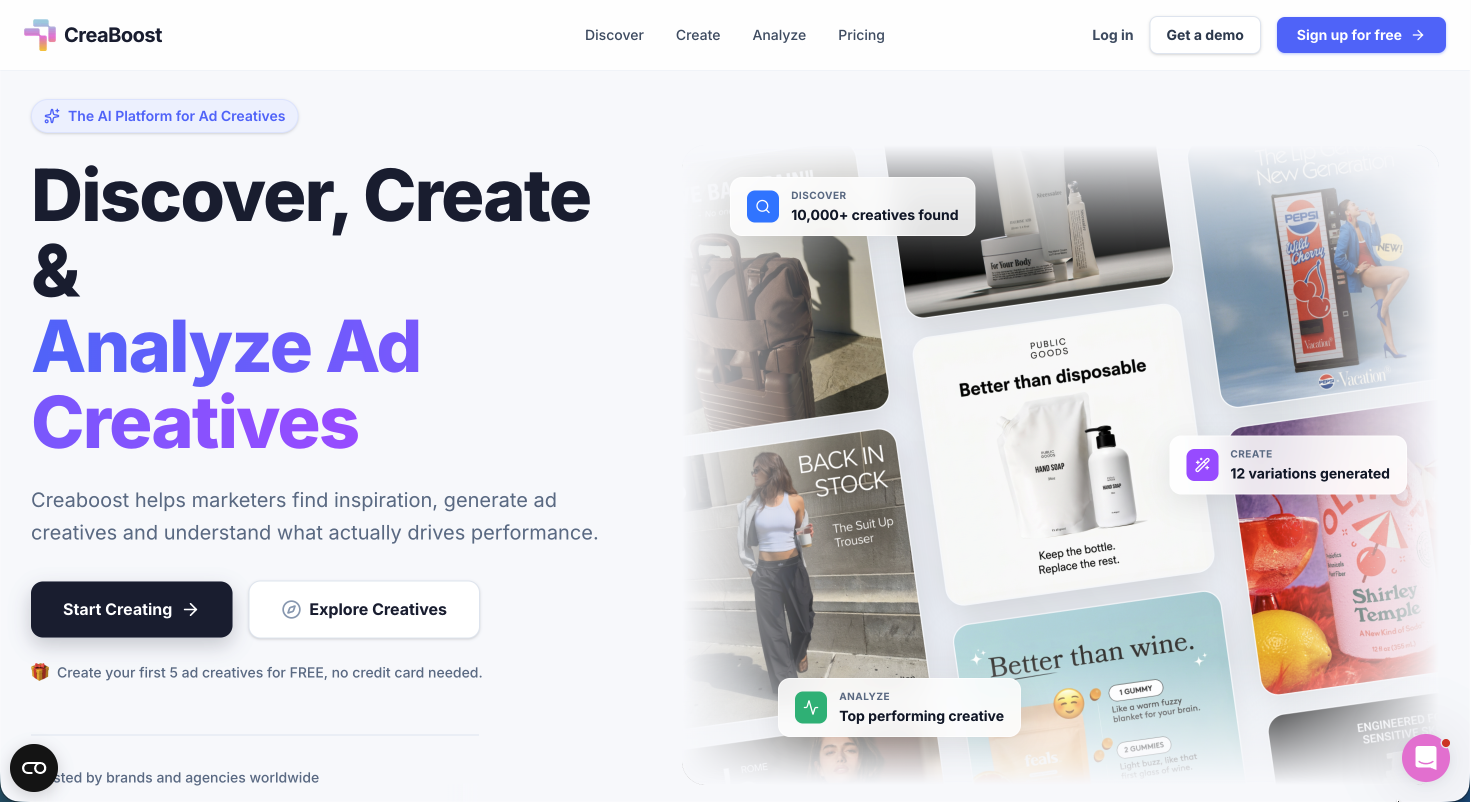
Creaboost covers the entire creative loop in one platform. The Discover feature anchors every brief in real performance patterns from your vertical, so you stop briefing from a blank page. The Create feature turns a product URL into dozens of platform-ready ad variations in minutes, not days. And Analyze auto-tags every creative by concept, angle, and format, then connects directly to your ad accounts so you can see which concepts are driving results at the cohort level, not just which ones got the most impressions. If your creative pipeline feels like it is always one step behind your spend, Creaboost is built specifically to fix that.
FAQ
What is ad concept generation in simple terms?
Ad concept generation is the process of creating distinct, testable advertising angles before any creative assets are produced. Each concept represents a different story or message approach that can be validated with audiences before production begins.
How does ad concept generation differ from ad creative development?
Concept generation produces the strategic angle and brief. Ad creative development executes that angle into finished assets like videos, static images, or carousels. Concept generation always comes first to avoid wasting production budget on unvalidated ideas.
What is ad concept testing and when should it happen?
Ad concept testing evaluates different advertising angles with audiences before production, using mockups or storyboards to filter weak ideas. It happens upstream of production, unlike A/B testing which compares live assets already in market.
How many concepts should an eCommerce brand generate per product?
Most structured frameworks recommend generating 5 to 10 concepts per product, covering at least four to six fundamentally different narrative angles. This range provides enough variety to identify what truly resonates rather than optimizing within a single approach.
Can AI tools replace human judgment in concept generation?
AI tools like Amazon Ads' agentic AI accelerate research and ideation but require rich brand, product, and audience inputs to produce relevant concepts. Human judgment remains critical for audience research, angle selection, and evaluating which concepts align with brand strategy.