
Most ecommerce brands treat creative like a production line. They brief, they design, they launch, and they wonder why performance plateaus after week three. The problem isn't effort. It's the absence of a real ecommerce ad creative process. Without a structured workflow connecting research to production to testing to optimization, you're just burning budget on gut instinct. Brands that scale three times faster do so with disciplined creative systems. This article breaks down exactly what that system looks like.
Table of Contents
- Key takeaways
- The ecommerce ad creative process starts with preparation
- Creative production: designing ads that feed the algorithm
- Testing frameworks: evaluate concepts, not just ads
- Optimization and scaling: making winners last
- My honest take on creative process discipline
- How Creaboost fits into your creative workflow
- FAQ
Key takeaways
| Point | Details |
|---|---|
| Research before you design | Winning concepts come from competitive intelligence, not guesswork or blank-page briefs. |
| Test concepts, not just ads | Meta's algorithm treats near-identical ads as duplicates, so differentiated concepts are your real unit of testing. |
| Use the signal stack to evaluate | Hook rate, hold rate, CTR, and ROAS together tell a more honest story than any single metric alone. |
| Scale winners gradually | Budget increases over 20% in 24 hours trigger algorithm relearning and spike your CPM. |
| Archive everything you test | A searchable winners library compounds your learning and stops your team from repeating the same failed angles. |
The ecommerce ad creative process starts with preparation
Most teams skip this phase entirely. They get a brief that says "we need ads for the new SKU" and jump straight to design. That's how you produce volume without learning anything.
Competitive intelligence first
Before you write a single line of copy, you need to know what's already working in your vertical. Mining active competitor ads through the Meta Ad Library and third-party creative intelligence tools tells you which hooks, angles, and formats have been running for 30 or 60 or 90 days. Long-running ads almost always mean they're profitable. That's your signal.
The goal isn't to copy. It's to identify the concept categories that your market already responds to, so you can build differentiated versions grounded in reality. Think of concept categories as the core argument the ad makes. Social proof ("10,000 customers can't be wrong"), problem-agitation ("Why does your skin still break out after washing twice a day?"), and aspiration ("This is what your mornings could feel like") are three distinct categories with very different psychological mechanisms. Knowing which ones dominate your vertical before you start briefing saves weeks of wasted production.
Resource planning and goal-setting
Briefing AI with research-based angles consistently outperforms vague prompts, which means the research phase pays dividends in the production phase too. Allocating 10 to 20 percent of ad spend to creative testing from the start gives you the budget to actually learn. Teams that don't carve this out explicitly tend to test nothing, because every dollar gets absorbed by what's already running.
Pro Tip: Set your measurable goals before production begins, not after. Know whether you're optimizing for hook rate in the first test, cost per acquisition in the second, or ROAS at scale. A goal defined after the fact is just a rationalization.
Here's a research and preparation checklist worth keeping in your ecommerce ad strategy workflow:
| Task | What it unlocks |
|---|---|
| Audit 10 to 20 competitor ads currently running | Identifies proven concept categories and hook archetypes |
| Define 3 to 5 concept categories to test | Structures your brief before design work begins |
| Set testing budget as percentage of total spend | Prevents budget cannibalization by existing campaigns |
| Identify AI and production tools needed | Reduces friction during the production phase |
| Establish success metrics per test phase | Gives your team a shared definition of "winning" |
Creative production: designing ads that feed the algorithm
Once your concepts are validated by competitive data, production becomes a much more deliberate process. You're not generating options. You're executing specific hypotheses.
The brief is the most undervalued document in any advertising design process. A strong brief specifies the concept category, the core claim, the emotional tone, the target audience segment, the hook format (talking head, text on screen, product demo), and the platform format. Briefs that lack this specificity produce assets that look fine and test terribly.

Balancing UGC and studio content
UGC-style content outperforms polished studio content in ad testing phases on Meta and TikTok. That's not a permanent rule. It's a testing phase reality. The perceived authenticity of UGC reduces psychological resistance, which improves early engagement signals. Once you've identified a winning concept with UGC, you can produce higher-production versions of the same concept for scaling. Treating UGC as your testing format and studio content as your scaling format is a practical way to allocate production resources. For more on what high-performing ad structures actually look like, the ecommerce ad examples on Meta and TikTok from Creaboost's blog are worth reviewing before your next production cycle.
Effective ecommerce ads combine high-quality visuals, clear CTAs, and social proof regardless of production style. The format changes. Those three elements don't.
Produce multiple executions per concept. If you're testing the social-proof concept, you want at least three different executions: different hooks, different visual treatments, different lengths. This gives the algorithm variation to learn from while keeping your testing unit (the concept itself) consistent.
Pro Tip: For restricted product categories such as supplements, health claims, and financial products, review Meta's advertising policies before production begins. An entire creative batch can be rejected after launch if policy violations are caught post-upload. Build a compliance check into your brief review process.
Testing frameworks: evaluate concepts, not just ads
This is where most performance marketers lose money without realizing it. They A/B test two ads that are 80 percent identical. Meta's Andromeda algorithm treats overly similar ads as duplicates, causing reach to flatten and CPMs to climb. You don't learn anything except that running the same ad twice doesn't work.
The fix is concept-first testing. Each ad in your test represents a genuinely different concept category or angle. You're not testing whether the red button or the blue button converts better. You're testing whether social proof or problem-agitation resonates more with your audience at this moment.
The 60/30/10 budget framework
Structure your spend around a clear budget split to keep the ecommerce ad testing process honest:
- 60 to 70 percent of budget goes to proven winners that have already cleared your ROAS threshold.
- 20 to 30 percent goes to variations of those winners, which are fresh executions of the same concept to prevent fatigue.
- 10 percent goes to new concept tests, which is where your next winners come from.
This budget split for scaling prevents the common mistake of spending development budget on what's already working or starving new concepts before they have a chance to prove themselves. For smaller accounts that can't run all three tiers simultaneously, rotate monthly. One month tests new concepts; the next month scales what worked.
Reading the signal stack
Don't evaluate creative performance with a single metric. The signal stack works as a hierarchy:
- Hook rate (percentage of viewers who watch past three seconds) tells you whether your opening works.
- Thumb stop ratio tells you whether the visual stopped the scroll.
- Hold rate tells you whether the body of the ad holds attention.
- CTR tells you whether the offer and CTA are compelling enough to act on.
- CVR and ROAS tell you whether the traffic you sent was qualified.
A high hook rate with low CTR means the creative is entertaining but not persuasive. A low thumb stop with decent CVR means your ad only reaches the most motivated buyers who stopped despite everything. Reading the stack together tells you exactly where to fix the ad, not just whether it's working.
At least 10 conversions or 50 events per week are required before any testing decision should be treated as statistically reliable. Pulling an ad at 4 conversions in three days isn't a testing decision. It's noise management.
Pro Tip: Watch for engagement traps. An ad with 15% hook rate and 50 comments but 0.4% CTR isn't a winner. It's entertainment. Optimize for conversion signals, not vanity metrics. The algorithm will spend your money finding people who engage, not necessarily people who buy.
Optimization and scaling: making winners last
Identifying a winner is only half the job. The other half is scaling it without destroying it.
The 20% scaling rule on Meta is not a suggestion. Increasing budget by more than 20 percent in a 24-hour window resets the learning phase, spikes CPM, and often tanks CPA for days while the algorithm recalibrates. If you need to make a significant budget jump, duplicate the campaign at the new budget and let the original run. You get increased spend without the relearning penalty.
Here's how to manage the optimization layer without losing control:
- Identify winners by ROAS at the cohort level, not by impression volume.
- Create three to five varied executions of each winning concept immediately after it clears your threshold, so you have replacements ready when fatigue sets in.
- Track creative refresh cycles every four to six weeks. When frequency climbs above 3.0, performance decay is coming regardless of how strong the concept is. Plan the refresh before the numbers force your hand.
- AI monitoring tools can flag underperforming creatives before the decline shows up in weekly reporting. That's budget saved, not budget lost.
The piece most teams skip entirely is archival. A searchable winners library indexed by hook archetype, concept category, and decay rate tells your next creative strategist exactly what has worked and what has failed. Without it, every new hire or contractor starts from zero. With it, your creative knowledge compounds over time instead of walking out the door with whoever managed the account last quarter.
Pro Tip: Apply the same 60/30/10 logic to your scaling budget. Do not reallocate your entire testing budget to scaling a winner. Keep 10 percent running new concepts at all times. The winning concept you have today will fatigue. Your next winner needs to already be in the pipeline.
My honest take on creative process discipline
What I've seen across many teams building their ecommerce creative strategy is that the bottleneck is rarely creative talent. It's process discipline. The teams that win consistently are not the ones with the best designers. They're the ones who made the boring decisions early: what to track, how to tag, what threshold triggers a decision, and what gets archived when a campaign ends.
The concept-first testing shift sounds obvious once you hear it. But in practice, most brands are still debating thumbnail colors on two nearly identical ads and calling it a test. It's not. Testing concepts, not ads is the single change that made the biggest difference in how quickly teams find real leverage.
I've also learned to stop treating the winners library as a nice-to-have. It's the institutional memory of your entire ad campaign development effort. The knowledge compounding effect is real. Six months in, your briefs get faster, your hypotheses get sharper, and your creative directions stop cycling back through concepts that already failed 18 months ago.
The honest challenge with AI tools is that they solve the volume problem without solving the thinking problem. Volume without research is noise. The AI creative workflow that actually works puts human judgment at the front end of the brief and at the back end of the analysis. The AI handles the middle.
— Bythewise
How Creaboost fits into your creative workflow
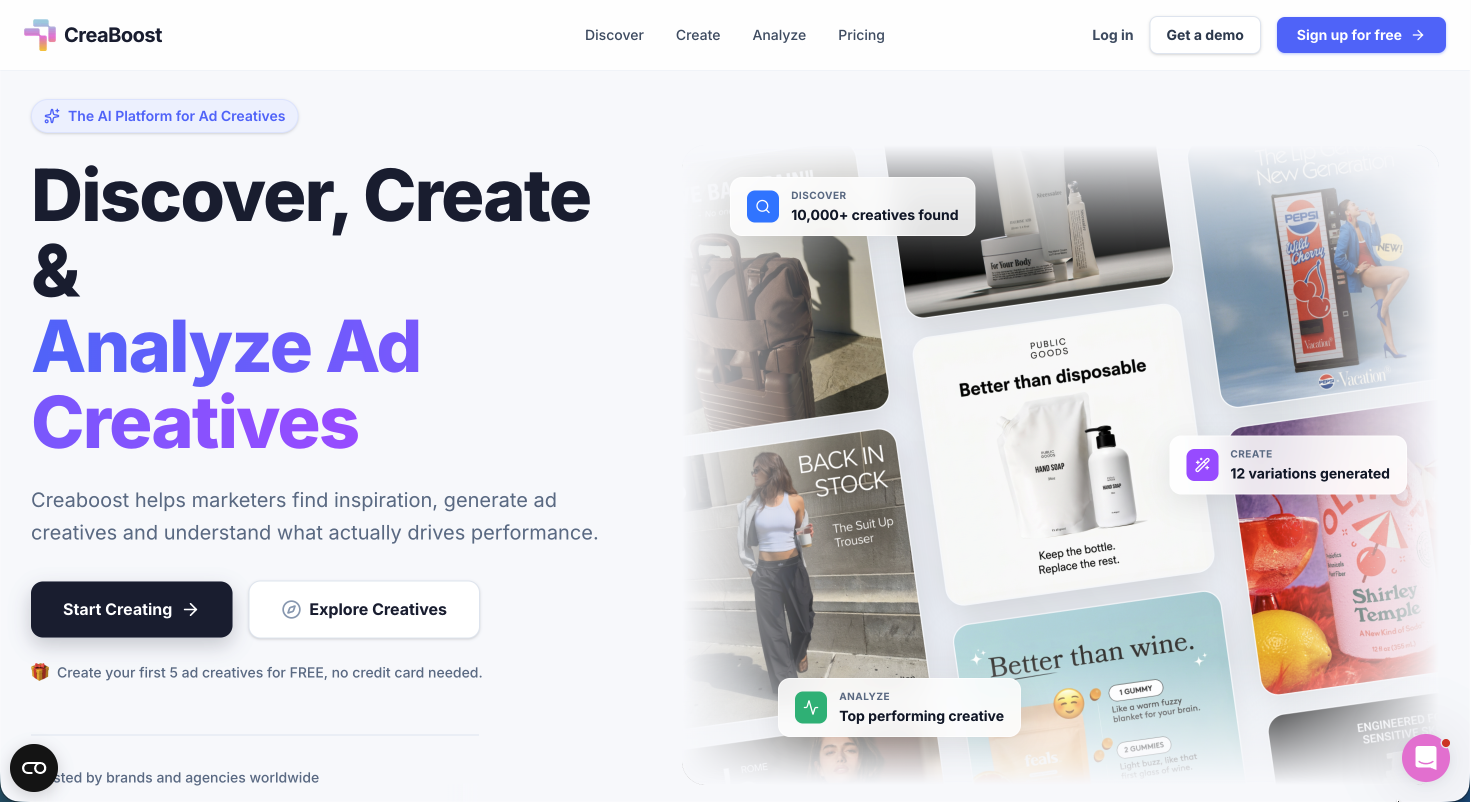
If reading through this process made you think "we're doing most of this in five different tools and a spreadsheet," you're not alone. Creaboost is built to run this entire loop in one place. The Discover feature anchors your briefs in real competitive data from your vertical. The AI creative generation tool turns a product URL into dozens of on-brand static and video ad variations in minutes. And Analyze auto-tags every creative by hook, format, and concept, so you stop losing your winners library to tab chaos and abandoned spreadsheets.
The teams using Creaboost don't replace their creative judgment. They apply it to the decisions that actually matter instead of wasting it on asset management and manual tagging. If your creative pipeline feels like it's always one week behind where it should be, that gap is exactly what Creaboost closes.
FAQ
What is the ecommerce ad creative process?
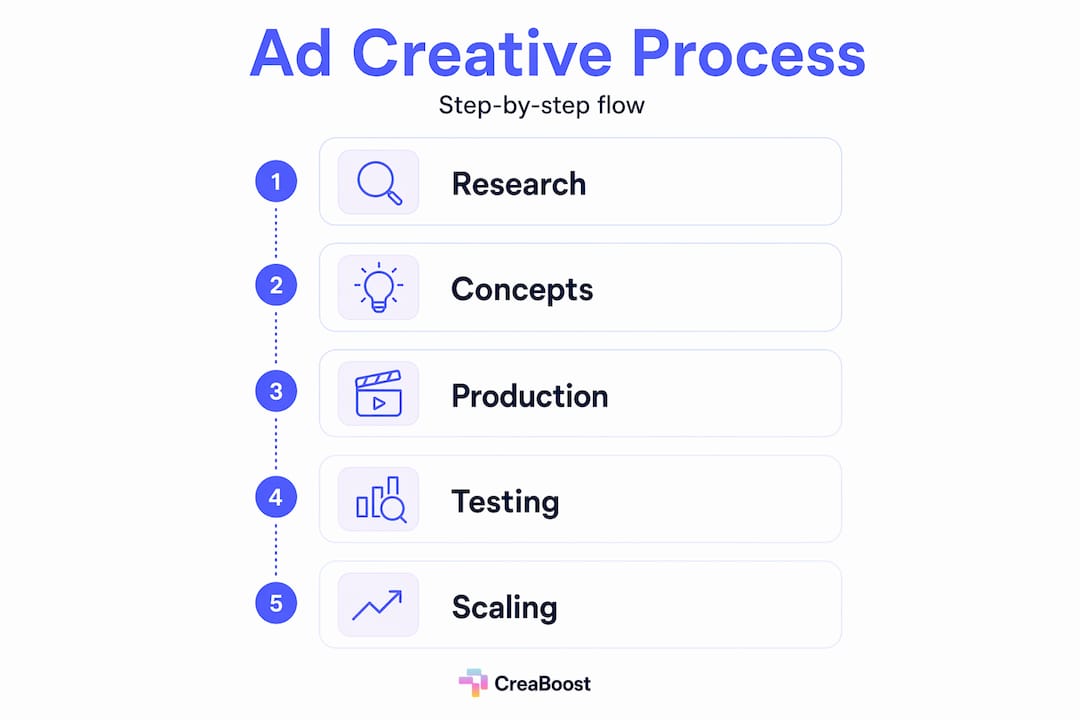
The ecommerce ad creative process is a structured workflow covering research, concept development, production, testing, and optimization of paid social ads. It connects competitive intelligence to creative output and performance analysis so every creative decision is grounded in data.
Why should I test concepts instead of individual ads?
Meta's algorithm treats near-identical ads as duplicates, which flattens reach and raises CPM without generating useful learning. Testing distinct concept categories gives you real signal about which marketing angles drive performance.
How often should I refresh ecommerce ad creatives?
Plan a creative refresh every four to six weeks. When frequency exceeds 3.0, performance decay is likely already underway. Monitoring frequency proactively keeps you ahead of fatigue rather than reacting to it after budget has been wasted.
What budget split works best for ecommerce creative testing?
The proven split is 60 to 70 percent on proven winners, 20 to 30 percent on winner variations, and 10 percent on new concept tests. This structure keeps scaling efficient while continuously feeding your next wave of winning creative.
How many creatives does a scaling ecommerce brand need monthly?
Brands producing 30 or more new creatives monthly scale three times faster than those producing fewer than 10. Consistent creative volume is what gives the algorithm enough variation to find and optimize toward your best-performing assets.