

Most ecommerce marketers treat ad platforms as interchangeable pipes that push traffic toward product pages. That framing costs real money. The role of ad platforms in ecommerce is far more layered than running bids and collecting clicks. Today's platforms are data engines, attribution systems, and AI optimization layers running simultaneously. Understanding how they actually work, and where each one fits in your growth strategy, is what separates teams with tightening margins from teams that keep compounding ROAS quarter over quarter.
Table of Contents
- Key Takeaways
- The role of ad platforms in ecommerce: types and ecosystem functions
- How ad platforms use AI and data to optimize performance
- Attribution and measurement models compared
- Practical strategies for using ad platforms effectively
- My honest take on where most teams get this wrong
- How Creaboost fits into your ad platform strategy
- FAQ
Key Takeaways
| Point | Details |
|---|---|
| Platform types serve different funnel stages | Retail media, social, search, and programmatic each reach shoppers at distinct moments of intent. |
| AI bidding requires clean data | Smart Bidding and similar tools fail when fed distorted or incomplete conversion signals. |
| Platform-reported ROAS misleads | Attribution windows and crediting rules inflate numbers; blended CAC gives a more honest picture. |
| Campaign structure prevents cannibalization | Separating prospecting, consideration, and conversion layers protects budget efficiency. |
| Creative testing speed compounds results | High-volume iteration accelerates the learning cycle and improves ROAS faster than bidding changes alone. |
The role of ad platforms in ecommerce: types and ecosystem functions
Not all ad platforms serve the same function in your ecommerce stack, and treating them as though they do is one of the most expensive mistakes you can make. The ecosystem breaks down into four distinct types, each with its own data signals, audience state, and conversion logic.
Retail media networks sit at the bottom of the funnel. Amazon Advertising, Walmart Connect, and similar platforms monetize shopper intent through sponsored placements tied directly to first-party purchase data. When a user searches "wireless headphones" on Amazon and sees sponsored results, that placement is powered by onsite behavioral signals that no third-party platform can match. The conversion window is short, intent is high, and attribution is cleaner than almost anywhere else.
Search platforms like Google Ads bridge intent and discovery. Someone searching "best protein powder for muscle gain" is in active research mode. Search captures them at the exact moment the problem is articulated. This is why Google remains foundational in ecommerce ad strategies despite rising costs.

Social media platforms like Meta, TikTok, and Pinterest operate at the awareness and consideration layers. They do not wait for users to express intent. Instead, they infer it from behavioral patterns, lookalike modeling, and purchase history signals. This makes them powerful for prospecting but harder to measure accurately using last-click models.
Programmatic platforms handle display and video inventory across the open web. They excel at retargeting and reach extension but tend to score the lowest on direct conversion attribution.
Here is why this matters practically:
- Retail media converts existing demand. It does not create it.
- Social platforms create demand by interrupting users with relevant creative at scale.
- Search captures demand that already exists.
- Programmatic extends reach and reinforces messaging across the broader funnel.
Beyond these distinctions, SKU-level insights from retail media let you see which individual products actually drive returns, not just which campaigns look good on a dashboard. That granularity transforms how you allocate budgets across a catalog.
How ad platforms use AI and data to optimize performance
The bidding and targeting decisions that used to require daily human intervention now happen in milliseconds inside platform algorithms. But here is the catch: the quality of AI output depends entirely on the quality of data you feed it.
Google's Smart Bidding relies on accurate conversion tracking to function correctly. When signals are missing or distorted, the algorithm optimizes toward the wrong target. Platforms like Google have responded with Enhanced Conversions, which uses hashed first-party customer data to recover 10 to 20% of lost conversions, improving bidding precision significantly. If you are not using Enhanced Conversions in 2026, you are starting every auction with a handicap.
The newest AI features push this further. Google's Smart Bidding Exploration can increase unique converting users by 27%, and demand-led pacing now adjusts spend dynamically based on real consumer behavior shifts rather than static schedule rules. These are not minor upgrades. They represent a fundamental shift in how platforms allocate budget across the day and week.
Here is where most teams go wrong on the data side:
- Duplicated conversion events caused by multiple tracking tags fire inflated signals that train the bidding model on phantom purchases.
- Mixed attribution windows across platforms create scenarios where the same sale gets counted by three separate systems simultaneously.
- Audience list contamination happens when converted customers stay in prospecting audiences, wasting spend on people who already bought.
Pro Tip: Audit your conversion events at least quarterly. Pull a raw event log from your tag manager and compare it to actual order volume in your ecommerce platform. A 15 to 20% discrepancy is common and quietly destroys Smart Bidding performance.
Meta's Advantage+ and similar automation layers face the same dependency. When tracking ecommerce conversions is incomplete, the algorithm cannot learn which creatives and audiences actually drive purchases. It optimizes for whatever signal it can find, and that signal is rarely the one you care about.
Attribution and measurement models compared
Platform-reported ROAS is the most seductive lie in ecommerce advertising. Every major platform has strong incentives to report numbers that favor its own contribution to your sales. The challenge is that attribution models vary significantly across platforms, making direct comparisons almost meaningless without a layer of independent measurement.
Here is how the major platforms differ:
| Platform | Default attribution window | Crediting method | Key measurement risk |
|---|---|---|---|
| Google Ads | 30-day click, 1-day view | Data-driven or last-click | Inflated ROAS from cross-device gaps |
| Meta Ads | 7-day click, 1-day view | View-through included by default | View-through credits inflate results |
| Amazon Ads | 14-day click | Last-click, purchase-based | Cannibalization of organic sales |
| Programmatic DSPs | 30-day view common | View-through often default | Overcrediting impression-based paths |
The practical implication is that when you add up attributed revenue across all four platforms, the total frequently exceeds your actual revenue. That math does not work, and yet teams build budgeting decisions on it every quarter.
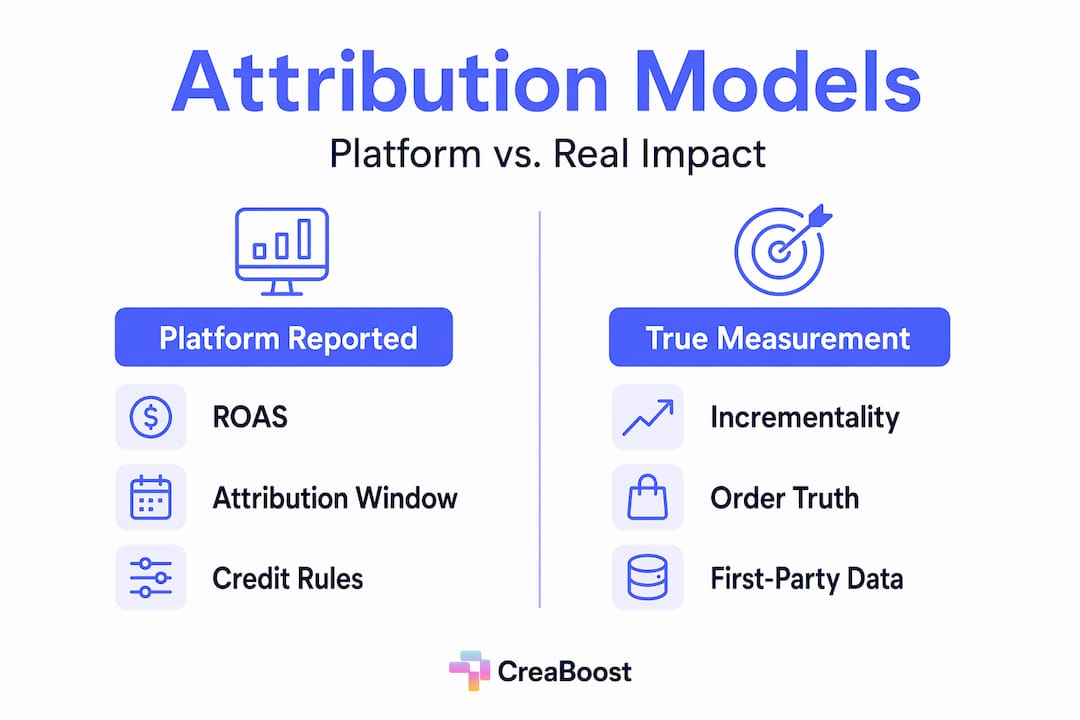
Closed-loop attribution directly links ad exposure to real sales data, bypassing the platform's self-reported numbers entirely. For retail media, this means connecting campaign data to POS records. Epsilon's in-store attribution capability goes further by connecting digital retail media activity to physical store purchases, which matters enormously for brands where the majority of volume still runs through physical retail.
The three methods that give you the most honest picture:
- Blended CAC divides total ad spend by total new customers acquired, regardless of platform attribution. It does not care which platform claims credit.
- Incrementality testing holds back a percentage of your audience from seeing ads and measures the revenue difference. True lift becomes visible.
- Data triangulation combines platform data, first-party order records, and survey responses to build a composite view of what actually drove the purchase.
Capturing true incrementality requires first-party data, ecommerce order truth, promo codes, and post-purchase surveys working together. It is operationally demanding, but it is the only way to know which channels actually earn their budget.
Pro Tip: Run a geo holdout test for your top-spending channel at least once per year. Pause spend in a matched set of geographic regions, measure the revenue difference, and compare against what the platform reported as attributed revenue. The gap is almost always instructive.
Practical strategies for using ad platforms effectively
Knowing how platforms work is half the equation. Putting that knowledge into a repeatable operating structure is the other half. Here is the framework that works at scale:
-
Separate campaign layers structurally. Mixing prospecting and conversion campaigns under a single ROAS target causes the algorithm to cannibalize upper funnel activity the moment lower funnel efficiency dips. Build distinct campaigns for prospecting, consideration, and conversion with bidding strategies and creative matched to each stage.
-
Prioritize creative volume and iteration speed. Optimization speed matters as much as algorithm choice in ecommerce advertising. The teams learning fastest from high-volume creative tests consistently outperform teams relying on a small set of polished assets. More tests mean more data points for the algorithm to learn from, which compounds over time.
-
Audit your conversion tracking before touching bids. Clean signal is the prerequisite for everything else. Check for duplicate events, verify that all purchase paths (mobile, desktop, in-app) fire correctly, and confirm your audience exclusion lists are updated at least weekly.
-
Combine Performance Max with Standard Shopping. Performance Max handles prospecting and automated placements well. Standard Shopping campaigns give you direct control over your best-converting product categories and cleaner data for analysis. Running both in parallel with appropriate budget splits lets you capture the benefits of automation without losing visibility.
-
Triangulate data monthly. Do not wait for a quarterly review to notice attribution drift. A monthly comparison of platform-reported revenue against actual order data in your ecommerce platform catches problems early enough to correct them without significant budget waste.
-
Measure offline impact when it applies. If your products sell through physical retail, connecting digital ad exposure to in-store sales gives you a materially different (and usually more favorable) picture of true ROAS. Ignoring offline impact systematically underfunds the channels driving the most total revenue.
Pro Tip: Use proven conversion rate tactics on your landing pages before scaling ad spend. Doubling conversion rate cuts your effective CPA in half without touching a single bid.
My honest take on where most teams get this wrong
I have watched teams with solid media budgets quietly destroy their own AI bidding by never auditing their tracking setup. The model trains on whatever signal it receives. If that signal is distorted by duplicate events or mixed attribution windows, the algorithm is not failing. It is succeeding at optimizing for the wrong target. That is a much harder problem to diagnose because the platform dashboard still shows green numbers.
The other pattern I keep seeing is an over-reliance on platform-native reporting without any independent sanity check. Every platform has an institutional bias toward showing you numbers that justify continued spend. That is not cynicism. It is business model reality. Closed-loop attribution sounds technical, but its practical function is simple: it tells you what actually happened in your business, not what the platform wants to take credit for. The teams that build that measurement layer are consistently the ones with the highest confidence in their budget allocations.
My contrarian position is this: most teams invest too much time arguing with platform automation and not enough time on the two things that actually move the needle, which are data hygiene and creative iteration speed. Fight the algorithm and you will lose. Feed it clean data and a constant supply of strong creative, and it will work for you. The ad platforms have genuinely gotten good at their jobs. The constraint is almost always on your side of the interface.
— Bythewise
How Creaboost fits into your ad platform strategy
Understanding the mechanics of ad platforms is one thing. Having the infrastructure to act on that understanding every week is another problem entirely.
Creaboost is built for the part of the workflow that most teams handle with spreadsheets and Slack threads. The platform covers the full creative loop: discover which concepts are driving performance in your vertical, generate variations at the volume your testing strategy actually requires, and analyze results with auto-tagging that does not fall apart after three months. With AI-powered creative generation, you turn a product URL into dozens of platform-ready ad variations across Meta and TikTok formats in minutes, not days. The Analyze feature connects directly to your ad accounts, tags every creative by hook, angle, and concept, and flags fatigue before it shows up in your CPAs. If your current process is holding back your learning speed, Creaboost closes that gap.
FAQ
What is the role of ad platforms in ecommerce?
Ad platforms drive traffic, create demand, and convert intent into sales by connecting brands with shoppers at different funnel stages. Retail media, search, social, and programmatic platforms each serve distinct roles and use different data signals to target buyers.
Why does platform-reported ROAS often mislead ecommerce marketers?
Each platform uses different attribution windows and crediting rules, which means the same sale frequently gets counted across multiple platforms simultaneously. Blended CAC and incrementality testing provide a more accurate picture of true performance.
How does AI bidding affect ecommerce ad performance?
AI bidding tools like Google's Smart Bidding optimize spend based on conversion signals, but their accuracy depends entirely on clean tracking data. Missing or duplicated conversion events cause the algorithm to optimize toward the wrong outcomes.
What is closed-loop attribution and why does it matter?
Closed-loop attribution directly links ad exposure to actual sales, including offline purchases, rather than relying on platform-reported clicks. It removes self-reported bias and gives brands a transparent view of true campaign effectiveness.
How should ecommerce marketers structure their ad campaigns?
Separating campaigns by funnel stage, prospecting, consideration, and conversion, with distinct bidding strategies and creative for each layer, prevents cannibalization and gives the algorithm cleaner signals to optimize against.