
The role of AI in advertising has never been louder as a topic, and yet the gap between what's being promised and what's actually working on the ground has never been wider. 77% of advertisers agree AI transforms ad buying, but 61% of them have not seen meaningful impact yet. That is not a technology problem. It's an expectations and implementation problem. This guide cuts through the noise and gives you a practical, clear-eyed look at where AI is genuinely changing advertising workflows, where it still falls short, and how to use it without losing what makes your creative work.
Table of Contents
- Key takeaways
- How AI is transforming advertising workflows
- Balancing AI automation with human creativity
- Overcoming operational challenges and integration
- Future trends in AI advertising strategies
- My take on AI and advertising
- How Creaboost closes the creative loop
- FAQ
Key takeaways
| Point | Details |
|---|---|
| AI saves real time | Senior marketers reclaim 8 to 10 hours per week, but only with disciplined implementation. |
| Automation does not replace strategy | AI handles production volume; human judgment still drives brand voice, positioning, and creative quality. |
| Integration is the real barrier | Only 27% of teams have fully implemented AI in campaigns, with 60% citing integration challenges. |
| Governance matters as much as tooling | Hybrid approval workflows and clear success criteria prevent brand-voice drift and wasted spend. |
| Future AI shifts the marketer's role | Autonomous agents and first-party data strategies are making strategic oversight the core competency. |
How AI is transforming advertising workflows
The practical benefits of AI in advertising are real, they just do not arrive automatically. What AI actually does well is remove the repetitive, high-volume work that slows down every team. Real-time bidding optimization, audience segmentation at scale, and creative variant generation are the three areas where the impact is most measurable today.
On the efficiency side, the numbers are hard to ignore. Marketers save an average of 6.1 hours per week using AI tools, with senior practitioners saving 8 to 10 hours. That is time that was previously spent on manual reporting, asset resizing, or bid adjustments. Beyond time, AI workflows improve time-to-market by up to 80% and can reduce customer acquisition costs by 30 to 40%.

In programmatic and social, machine learning in ads has made real-time bidding almost unrecognizable from what it was five years ago. Platforms now adjust bids at the impression level, factoring in user behavior, time of day, device type, and hundreds of contextual signals simultaneously. No human team can operate at that granularity. The AI impact on marketing here is not incremental. It is structural.
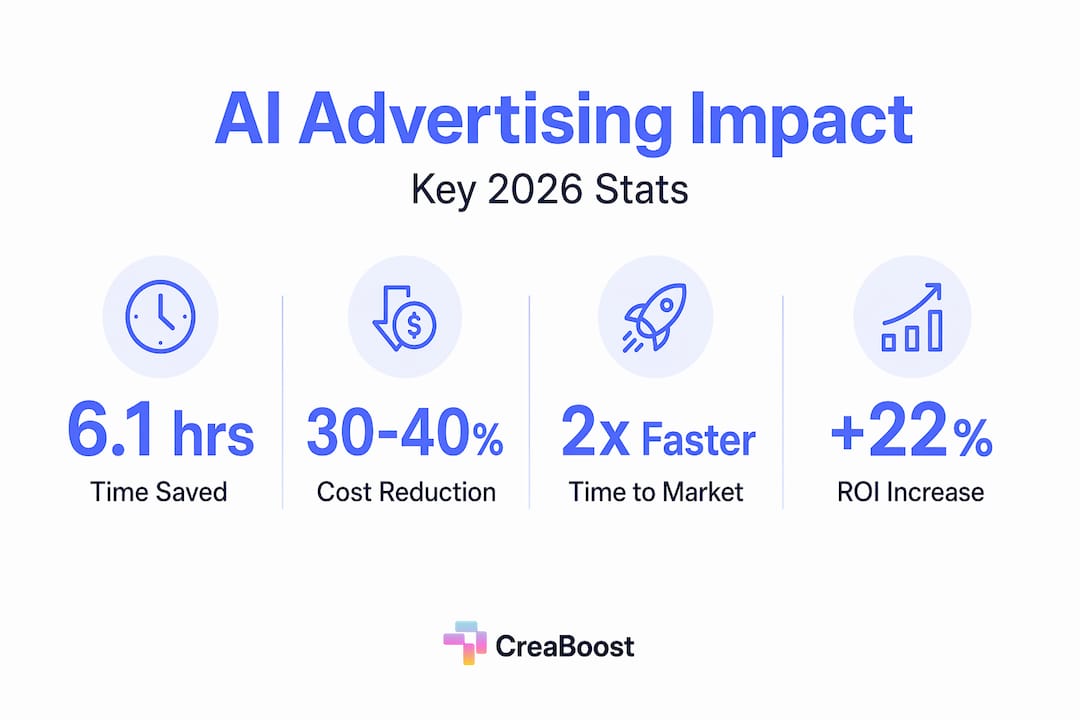
The role of AI in ad creation is also accelerating. Generative tools can now produce dozens of creative variants from a single brief, which matters enormously for ecommerce ads where volume and freshness directly affect performance. Autonomous AI agents in marketing have doubled in adoption in just six months, handling multi-step workflows from creative briefing to performance reporting without manual handoffs.
Pro Tip: When evaluating AI advertising strategies for your team, start with the workflow that burns the most hours before it touches revenue. Time savings compound fastest when you fix the bottleneck first.
- Real-time bidding: AI adjusts bids at the millisecond level across programmatic channels.
- Audience segmentation: Machine learning clusters behavioral and contextual signals to build segments no analyst could build manually.
- Creative variant generation: AI produces format-specific variations at a pace that lets teams test more hypotheses per cycle.
- Performance reporting: Automated tagging and attribution reduce the manual analysis load significantly.
- Cross-channel optimization: AI allocates budget across channels dynamically, shifting spend toward what is converting right now.
Balancing AI automation with human creativity
Here is the part most AI advertising articles skip. Handing your creative pipeline fully to AI is not a strategy. It is a fast way to produce high-volume mediocrity. AI handles roughly 80% of creative production in optimized workflows, but human oversight is what keeps brand voice and positioning from drifting into generic territory.
The concept of "asset engineering" describes this hybrid approach well. Successful AI ad production relies on mixing human creative structure with AI styling, where the human provides the compositional "bones" and the AI handles stylistic execution and variation. Without that structure, you get what practitioners call generation drift, where output gradually loses coherence and brand consistency across a campaign.
"AI should not simply scale mediocre ads but be used to infuse ads with culture, taste, and human judgment for better brand engagement." — AdExchanger
This is exactly the tension every performance marketing team has to navigate. The role of AI in ad creation is to accelerate production, not to replace the strategic thinking behind what gets made. A culturally off-key ad that generates impressions at scale costs you more than an unserved ad. The platform will spend your budget either way.
Here is a practical framework for keeping human judgment in the loop:
- Brief with specificity. AI generates better output when humans define the angle, the audience tension, and the single call to action before the prompt is written. Garbage in, garbage out applies more to creative AI than anywhere else.
- Lock the composition before styling. Use image-to-image workflows to fix your product placement and layout before applying stylistic variation. This prevents the visual inconsistency that erodes brand recognition.
- Build a governance layer. Establish who approves AI-generated creative before it goes live, and what criteria they use. Legal exposure from AI-generated content is real. So is reputational risk from off-brand output that slipped through a rushed review.
- Track concept performance, not just asset performance. If you only know which image performed best, you cannot brief smarter next time. Tracking by concept and angle is how you build compounding creative intelligence.
Pro Tip: The human element in ad creatives remains the clearest differentiator between brands that use AI to scale good work and brands that use AI to scale noise. Protect it deliberately.
Overcoming operational challenges and integration
The hardest part of AI adoption in advertising is not the technology. It is the organizational and systems layer underneath. Only 27% of marketing teams have fully implemented AI in their campaigns, and 60% report significant integration challenges. Those numbers tell you that most teams are somewhere in between, running experiments without a coherent system.
The reasons for that gap fall into a few recurring patterns. Tool fragmentation is the most common. Teams end up with a generation tool, a separate analytics platform, a spreadsheet for naming conventions, and a Slack thread substituting for creative briefing. Each tool works in isolation. None of them talk to each other. The result is that insights from one tool never make it into the workflow of another, and the compounding advantage of a connected system never materializes.
Data silos are the second major barrier. AI-powered optimization is only as good as the data feeding it. If your first-party data is scattered across a CRM, a pixel, and a handful of disconnected ad accounts, the AI cannot do what it is built to do. Fixing that data architecture is unglamorous work, but it is the prerequisite for almost every advanced AI advertising strategy.
Here is what phased adoption actually looks like in practice:
- Phase 1: Automate the obvious. Start with asset resizing, naming conventions, and performance reporting. These have zero creative risk and immediate time savings.
- Phase 2: Add AI to creative production. Use generative tools to expand your variant count, but keep human review in the loop for every asset before launch.
- Phase 3: Connect analytics to briefs. Build the feedback loop where performance data informs what gets briefed next. This is where the compounding advantage lives.
- Phase 4: Implement governance. Define who owns AI output, how it gets reviewed, and what happens when something goes wrong. Do this before you scale.
Pro Tip: Disciplined scoping and clear success criteria are the difference between AI workflows that deliver ROI and ones that get abandoned after three months. Define what winning looks like before you start.
Future trends in AI advertising strategies
The trajectory of AI in advertising is moving from task automation toward something more fundamental. The AI impact on marketing is shifting from channel management toward interaction design, where autonomous agents act as the primary interface between brands and customers. That is a different kind of work than most marketing teams are currently structured to do.
Several trends are worth watching closely:
- Always-on AI agents. Autonomous agents that run multi-step workflows, from monitoring performance to pausing underperformers to generating replacement creative, are already in use at scale. The adoption rate is doubling every few months.
- First-party data as infrastructure. As third-party cookies continue their exit, contextual alignment through AI can improve brand recall by over 38%. The brands building clean first-party data pipelines now will have a structural advantage in every AI-powered system they run.
- Conversational and immersive formats. Conversational AI ads and AR-integrated formats are moving from experimental to mainstream on the major platforms. These require entirely different creative thinking than static or video formats.
- The marketer's role shift. As AI absorbs more execution, the premium on strategic oversight, creative direction, and brand judgment increases. The marketers who thrive will be the ones who know how to brief AI well, not just how to use it.
- Privacy-compliant AI personalization. Regulatory pressure is accelerating the development of privacy-preserving personalization methods. Teams that explore AI's strategic role in marketing early will be better positioned when compliance requirements tighten.
The direction is clear. AI is not a campaign tactic. It is becoming the operating system of modern advertising. The teams building that system deliberately, with governance and human judgment built in, are the ones who will compound their advantage over the next three years.
My take on AI and advertising
I've watched a lot of marketing teams chase AI adoption because they felt left behind, not because they had a clear problem to solve. That's where most of the disappointment comes from. You grab a generation tool, run a few batches, see mediocre output, and conclude AI is overhyped. It's not. You just skipped the part where humans define what good looks like.
What I've seen work consistently is teams that treat AI as an amplifier of existing creative discipline, not a replacement for it. The best AI advertising strategies I've encountered were built by people who understood their creative winners deeply and used AI to produce more of what was already proven, faster. They did not use AI to figure out what worked. They used it to scale what they already knew.
The operational layer is also where I've seen the most waste. Teams invest in generation tools and completely ignore the analytics infrastructure that would tell them whether the AI output is performing. You end up with more creative, less clarity, and the same frustrating guessing game about what to brief next.
My honest view is that the advantages of AI in advertising only compound when you close the loop between what you create and what you learn. Without that feedback mechanism, you are just producing faster without getting smarter. The teams winning right now are not the ones with the best AI tools. They are the ones with the tightest loop.
— Bythewise
How Creaboost closes the creative loop
If the operational picture described in this article sounds familiar, you already know what it costs. Budget bleeding on burned-out creatives. Briefs sitting in queues. Performance data that never makes it back into the next brief.
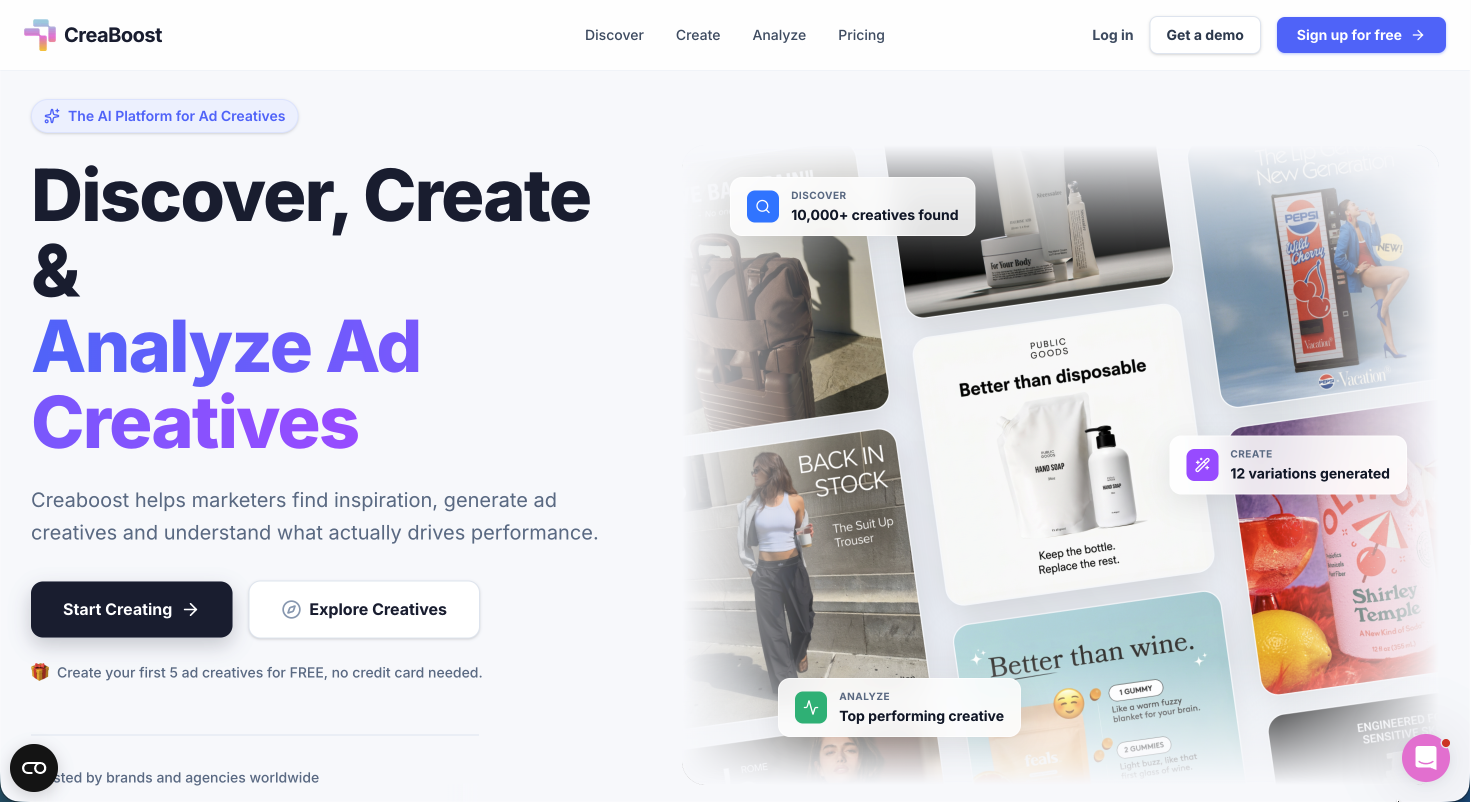
Creaboost is built specifically for teams running ads at scale who need production volume, creative intelligence, and operational control in one place. With AI ad creative generation, you turn a product URL into dozens of platform-ready variants in minutes, not days. With creative performance analytics, you auto-tag every asset and see which concepts are actually driving ROAS before fatigue shows up in your CPAs. From discovery to creation to analysis, everything connects. Start at creaboost.com and see what a tighter loop actually looks like.
FAQ
What is the role of AI in advertising today?
AI automates high-volume tasks like real-time bidding, audience segmentation, and creative variant generation, while increasingly supporting multi-step campaign workflows through autonomous agents. However, human oversight remains critical for brand voice and creative quality.
What are the main benefits of AI in marketing?
The core benefits include time savings averaging 6.1 hours per week, acquisition cost reductions of 30 to 40%, faster time-to-market, and the ability to test more creative hypotheses per campaign cycle.
Why use AI for ad creation if it risks generic output?
AI accelerates production volume, but the quality of output depends on how well humans structure the brief, composition, and governance process. Used with disciplined asset engineering, AI produces strong variation without sacrificing brand consistency.
How does AI impact ecommerce ads specifically?
AI is particularly effective for ecommerce ads because the volume of required variants, combined with the speed of audience signal changes, makes manual production impractical. AI handles format-specific resizing, background variation, and hook testing at a pace human teams cannot match.
What is the biggest barrier to AI adoption in advertising?
Integration and data architecture. Only 27% of teams have fully implemented AI in campaigns, with the majority citing tool fragmentation and data silos as the core obstacles to realizing meaningful performance gains.