
AI has changed what's possible in creative production, but it hasn't changed what actually moves people. The human element in ad creatives remains the single biggest lever most ecommerce teams are underusing, not because they don't believe in it, but because they haven't built a workflow that makes it repeatable at scale. This guide breaks down what the data says, why emotional and cultural authenticity outperform AI polish on both Meta and TikTok, and how to structure a hybrid creative process that captures both speed and genuine human resonance.
Table of Contents
- Why human elements matter more than you might expect
- Human vs AI creatives: distinctive strengths and real performance differences
- The cultural and emotional power of human-led creative in ecommerce ads
- How to integrate the human element effectively in your ad creative workflow
- Why embracing imperfection and humanity is your secret weapon in 2026
- Optimize your ad creatives with Creaboost's hybrid AI-human platform
- Frequently asked questions
Key Takeaways
| Point | Details |
|---|---|
| Human creativity builds trust | Ads involving human input connect emotionally, increasing audience trust and engagement. |
| Hybrid model outperforms | Combining human strategy with AI scaling delivers higher ROAS and lowers CPA. |
| Emotional ads drive growth | Ads that evoke emotion generate twice the long-term effectiveness and stronger brand power. |
| Creative longevity matters | Human-made ads last 50% longer before fatigue, maximizing campaign impact duration. |
| Refresh cadence is key | AI creatives require faster refresh cycles, but human concepts keep campaigns distinctive. |
Why human elements matter more than you might expect
Performance marketers spend a lot of time obsessing over targeting, bidding, and budget allocation. Creative is often treated as an afterthought, something the design team handles while media buyers focus on the "real" levers. That's a mistake that shows up directly in ROAS.
The evidence keeps pointing in one direction. 48% of consumers trust ads that were co-created by humans with AI support more than pure AI outputs. That's not a soft brand perception metric. That's a trust signal that affects click behavior, purchase intent, and how long someone stays in your funnel after they first encounter your ad.
Here's what the data on emotional impact tells us about the role of human elements in ads:
- Emotional advertising is twice as effective as purely rational advertising over the long term, delivering measurably higher profit ROI.
- Ads that include a recognizable human story build brand recall significantly faster than product-forward, feature-led creatives.
- Human-led storytelling creates associations that persist long after the campaign ends, reducing the cost of future acquisition.
- Audiences can detect AI-polished but emotionally hollow ads quickly. On TikTok especially, users scroll past anything that feels manufactured inside the first two seconds.
"The emotional connection in advertising is not a soft metric. It's the mechanism by which brands build pricing power, loyalty, and word-of-mouth that no media spend can replicate."
If you want to understand why ad creatives drive ROAS at a structural level, the answer almost always traces back to emotional resonance, and emotional resonance is something humans create far more reliably than machines.
Human vs AI creatives: distinctive strengths and real performance differences
Let's be precise about what each approach actually delivers, because the answer isn't "humans always win." It's more useful than that.
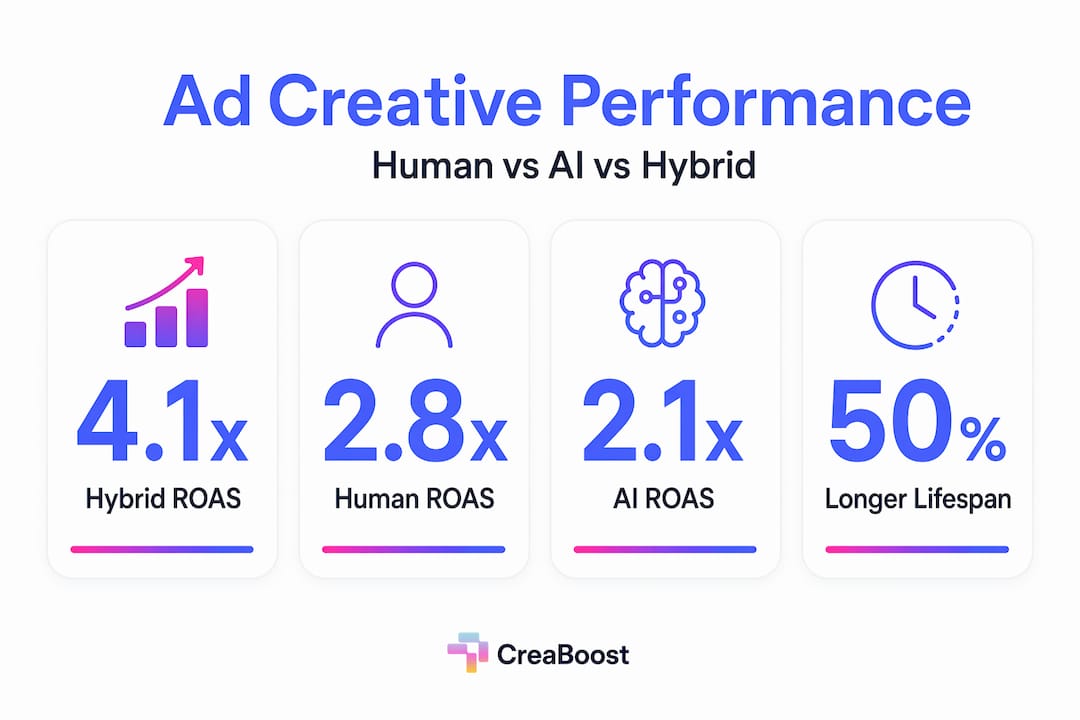
Hybrid AI-human ad creatives achieve 4.1x average ROAS, outperforming both AI-only and human-only campaigns. That number is drawn from 10,000 campaigns and it's not close. Neither pure approach wins on its own.
Here's how the two approaches stack up across key metrics:
| Metric | Human-created | AI-generated | Hybrid |
|---|---|---|---|
| Average ROAS | 2.8x | 2.1x | 4.1x |
| CTR | Higher | Lower | Highest |
| Creative lifespan | ~18 days | ~7-10 days | ~15-18 days |
| Production speed | Slow | Fast | Fast |
| Cost per variant | High | Low | Low |
| Cultural nuance | Strong | Weak | Strong |
| Emotional resonance | Strong | Moderate | Strong |
Human-created ads deliver higher CTR and last significantly longer before creative fatigue sets in. That matters enormously on Meta and TikTok, where fatigued creatives quietly drain budget for days before your metrics surface the problem.

What AI does well is speed and volume. You can generate more variants, test faster, and keep CPAs lower during early-stage testing. What it can't do is produce the kind of creative that makes someone stop mid-scroll because they felt something. That emotional interruption is almost always human in origin.
The key takeaways for your campaign planning:
- Use AI for volume, variation, and iteration at the format level.
- Use humans for the core concept, the hook, the emotional angle, and the cultural frame.
- Use creative performance analytics to understand which human-originated concepts are worth scaling into AI-generated variants.
- Never let AI dictate creative direction. That's where the return on human investment is highest.
Pro Tip: If you're seeing CTR decay within 7-10 days on your AI-generated variants, that's not a targeting issue. It's a signal that the underlying concept lacks the distinctiveness to hold attention. Go back to the human layer, not the production layer.
Building high-performing ad creatives in 2026 means treating AI as the production engine and humans as the creative director. When that relationship flips, performance follows.
The cultural and emotional power of human-led creative in ecommerce ads
There's a specific reason AI struggles in this area that goes beyond capability. AI has no lived experience. It can pattern-match on what has worked before, but it cannot identify the cultural moment that makes a concept feel timely, fresh, and genuinely resonant.
Only humans can identify cultural opportunities, adding authenticity that AI alone cannot replicate. A human creative director working in a specific category understands the unspoken anxieties, desires, and references that make a particular audience feel seen. That understanding doesn't live in a training dataset.
Where human creativity creates irreplaceable value:
- Emotional risk-taking: Humans are willing to put vulnerable, imperfect, or emotionally charged messages into ads because they understand why those messages land. AI defaults to safe.
- Cultural timing: Knowing when to lean into a cultural moment versus when to avoid it requires judgment, not pattern recognition.
- Authentic imperfection: A slightly shaky UGC-style clip, a real founder talking to camera, an unscripted customer reaction. These "flaws" signal proof of life and build trust faster than polished AI output.
- Storytelling that earns attention: The impact of storytelling in ads comes from narrative tension, not from following a template. Human writers understand pacing, surprise, and emotional payoff.
"Marketing must remain human-led to deliver the authenticity and cultural depth that audiences increasingly demand, especially as AI-generated content floods every platform."
The brands growing fastest on TikTok right now are the ones leaning into this. They're using creative agencies and AI together in 2026 as a complementary model: human insights drive the brief, AI handles the production lift.
Marketing authenticity in 2026 cannot be automated. The most distinctive ecommerce brands are betting on human imperfection as a feature, not a flaw. And the data on consumer engagement strategies backs that up: personalization in ad creatives that feels mechanical is worse than no personalization at all.
Pro Tip: If your creative brief doesn't include a clear emotional truth, a specific cultural reference, or a real customer insight, you're writing a brief that AI could have generated. That's the problem. Human strategy starts with human observation, not category conventions.
How to integrate the human element effectively in your ad creative workflow
Knowing that human elements matter is one thing. Building a repeatable workflow around that principle is where most teams fall short. Here's a practical framework.
-
Start with human insight, not AI generation. Your creative strategist should define the emotional hook, the cultural frame, and the core message before a single AI tool opens. This is the work that determines whether your campaign has a soul.
-
Brief with specificity. Generic briefs produce generic creative. Include a real customer quote, a specific pain point, a cultural observation. These details are what AI ad creative generation tools can then scale into platform-ready variants.
-
Generate AI variants from that human core. Once the concept is defined by a human, AI can produce dozens of format-specific variations fast. Different hooks, different aspect ratios, different visual treatments, all anchored to the same emotional truth.
-
Analyze performance at the concept level, not the asset level. Most teams look at individual ad performance. The smarter move is tagging by concept and angle, then identifying which human ideas are driving ROAS. Performance analytics for your creatives should tell you which emotional angles are winning, not just which file got the most impressions.
-
Plan refresh cycles before you need them. Refreshing creatives frequently lowers CPA, but only if the new creatives bring a fresh human concept, not just a resized version of what already fatigued. Build a 2-week creative review into your weekly cadence, not a monthly scramble.
-
Define roles explicitly. Hybrid workflows where humans lead strategy and AI handles scale and testing achieve superior ROAS and creative longevity. Ambiguity about who owns the creative direction is where quality erodes.
| Stage | Human responsibility | AI responsibility |
|---|---|---|
| Strategy | Emotional insight, cultural angle | None |
| Briefing | Core concept, target feeling | Format guidelines |
| Production | Hero asset or UGC direction | Variant generation |
| Testing | Hypothesis setting | Rapid A/B execution |
| Analysis | Identifying winning concepts | Tagging, reporting |
| Iteration | New concepts based on learnings | Scaling winners |
The step-by-step guide to boosting ad performance always leads back to this split. Human creativity defines what's worth building. AI determines how fast you can build it.
Why embracing imperfection and humanity is your secret weapon in 2026
Here's an opinion you don't hear enough in performance marketing circles: the obsession with production quality is actively hurting some brands. Polished, visually perfect AI-generated ads look like ads. And audiences on TikTok and Instagram have developed a finely tuned filter for anything that looks like an ad.
The most daring brands in 2026 are those that are unmistakably human and imperfect, proving that marketing authenticity cannot be automated. A founder talking directly to camera with shaky lighting, a customer stumbling over their words while describing why they love a product, a real behind-the-scenes moment that wasn't planned. These perform because they feel true.
Creative leaders routinely underestimate emotion's role in driving performance. It's easier to justify a budget for production quality than for "emotional bravery." But the brands winning on Meta and TikTok right now are the ones willing to take emotional risks in their messaging.
The role of empathy in marketing gets discussed abstractly. But in practice, it means your creative team needs to understand the exact anxiety, desire, or aspiration your audience is carrying before they ever see your ad. That understanding cannot come from a prompt. It comes from talking to customers, reading reviews, watching how real people describe their problems. AI accelerates what comes after that work. It doesn't replace the work itself.
What we've seen consistently is that teams using human and AI-native approaches together outperform teams that treat the two as competing choices. The question is never "human or AI." It's "where does human judgment create the most value, and where does AI create the most efficiency?" Answer that clearly for your team, protect the human layer fiercely, and use AI to do what it actually does well.
Optimize your ad creatives with Creaboost's hybrid AI-human platform
If the framework above describes where you want to be, but your current workflow doesn't support it, that's exactly the gap Creaboost is built to close.
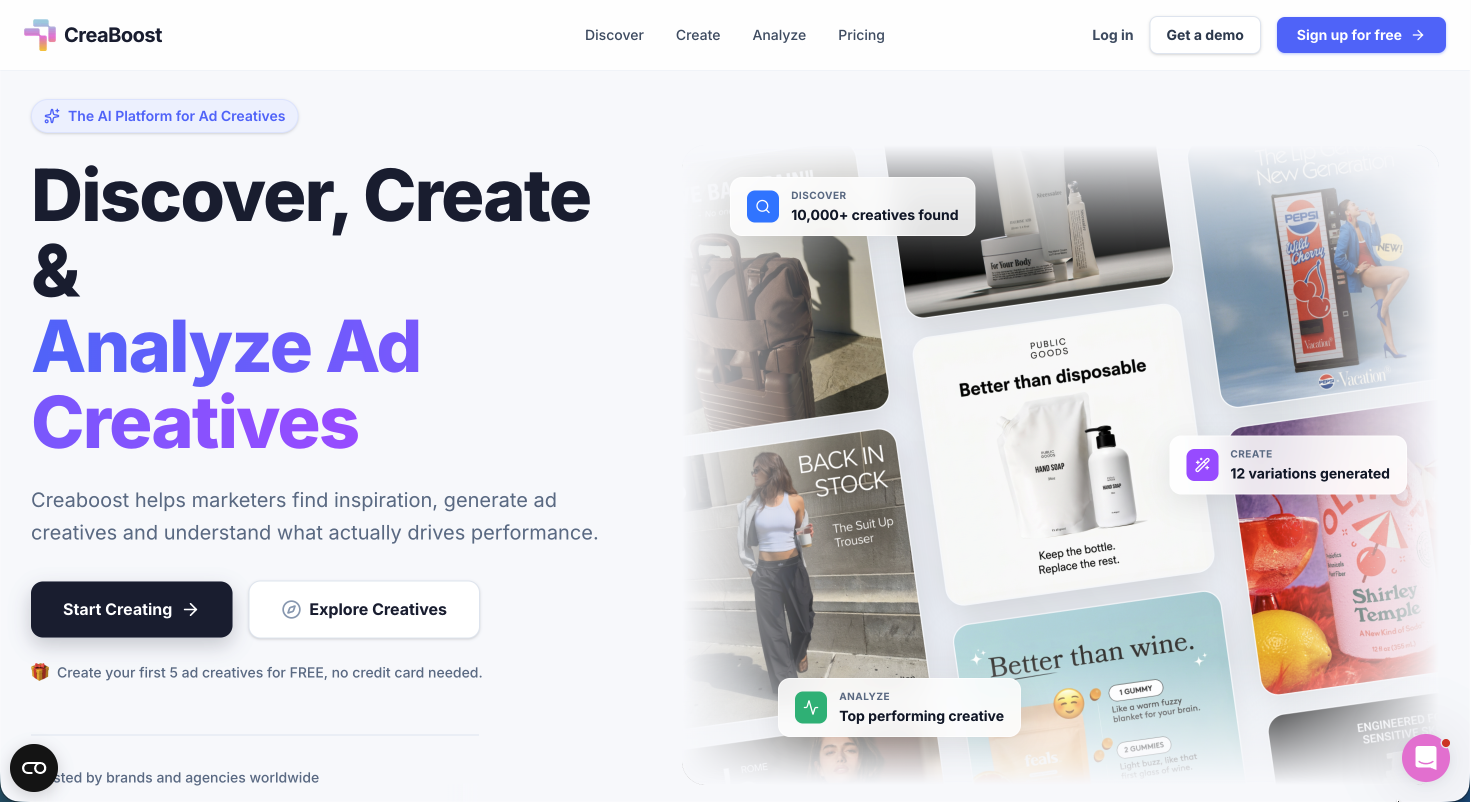
The Creaboost platform is designed around the hybrid model: human strategy sets the direction, and AI handles the production and scale. With AI-powered creative generation, your team turns human-defined concepts into dozens of Meta and TikTok-ready variants in minutes, not days. And with integrated creative analytics, you track performance at the concept level, catching fatigue early and scaling the emotional angles that are actually driving ROAS. You stop guessing which human ideas are working and start building a system around them.
Frequently asked questions
Why can't AI replace humans completely in ad creative?
AI lacks the ability to understand cultural nuances and deliver authentic emotional storytelling, both of which are critical to making ads memorable and trustworthy. Only humans can identify cultural opportunities and provide the creative soul that ads need to genuinely connect.
What benefits do hybrid human-AI ad creatives offer performance marketers?
Hybrid creatives combine human strategic direction and emotional insight with AI's speed and scale, resulting in stronger ROAS, lower CPA, and more durable creatives that resist fatigue. Hybrid AI-human creatives achieve 4.1x ROAS, outperforming both AI-only and human-only campaigns.
How often should I refresh my AI-generated ad creatives compared to human-made ones?
AI-generated creatives tend to fatigue 1.5 to 2 times faster than human-made ones. Human creatives last about 50% longer before fatigue, so plan to refresh AI variants every 5 to 7 days while human-led creatives typically hold for around 18 days.
Does using human elements in ads improve long-term brand performance?
Yes. Emotionally engaging, human-led ads build brand memory and pricing power over time, which reduces acquisition costs and supports sustained growth. Emotional advertising is twice as effective long term, delivering greater profit ROI and measurable brand strength.
What role should performance marketers play in hybrid ad creative workflows?
Performance marketers should own the strategic creative direction, configure AI tools for rapid testing, and use data to identify winning concepts. Creative strategists combining data fluency with human judgment consistently direct hybrid workflows toward the best results, because they understand both what the numbers say and what the audience actually feels.