
Most brand managers treat brand identity in ads as a visual checklist: logo present, brand colors applied, done. That framing is costing you. True advertising brand identity is the full system of signals, voice, personality, and values that make your brand recognizable before a customer even reads your headline. When that system is built deliberately and executed consistently, it compounds. When it is patched together campaign by campaign, it erodes. This guide gives you the frameworks, workflows, and measurement approaches to build brand identity into every ad you ship.
Table of Contents
- Key takeaways
- What brand identity in ads actually means
- How strong brand identity drives ad effectiveness
- Operationalizing brand identity in your ad workflow
- Measuring brand identity presence in your ads
- My take on where most teams get this wrong
- How Creaboost keeps your brand identity intact at scale
- FAQ
Key takeaways
| Point | Details |
|---|---|
| Brand identity is a system, not a logo | Visual, verbal, and experiential elements work together to shape how audiences perceive your brand. |
| Consistency drives revenue | Brand consistency across channels is linked to a 10–20% increase in revenue growth. |
| Fixed rules, flexible execution | Lock in structural identity elements and let creative styling vary so you can scale without going off-brand. |
| Measure brand, not just performance | Combine ad analytics, brand surveys, and social listening to track whether your identity is actually landing. |
| Ongoing advertising sustains identity | Stopping mass-reach advertising causes brand awareness to decline within 12 months without ongoing reinforcement. |
What brand identity in ads actually means
The phrase gets used loosely, so let's define it precisely. Brand identity in advertising is the deliberate, coordinated set of signals your brand deploys across every ad so that audiences recognize, trust, and remember you. It is not your logo in isolation. It is not a mood board. It is a system.
That system has several interconnected layers:
- Visual elements: logo, color palette, typography, photography style, and illustration approach. Color choice alone can increase brand recognition by up to 80%, which is why brands guard their specific shades aggressively.
- Verbal elements: brand voice, tone, taglines, messaging hierarchy, and the specific language patterns your copy uses across every format.
- Experiential elements: the emotional texture of your ads, the pacing of your video content, the personality that comes through in every customer touchpoint.
- Brand personality: the human characteristics your brand consistently expresses, whether that is wit, authority, warmth, or irreverence.
What brand identity is not is your brand image. Your brand identity is what you project. Your brand image is what audiences actually perceive. The gap between those two things is where advertising either builds trust or loses it. Per the American Marketing Association, branding shapes how audiences emotionally connect with a company, which means your ads must reflect both tangible signals and intangible meaning.
Internal alignment matters as much as the external output. If your creative team, media buyers, and copywriters are operating from different versions of your brand guidelines, every campaign you run widens the gap between your intended identity and what the market actually experiences. Clear, specific, enforced guidelines are not a creative constraint. They are the foundation that makes creative freedom possible.
How strong brand identity drives ad effectiveness
Here is the claim that should reframe your entire creative strategy: distinctive brand assets that can replace your brand name in advertising improve recognition and recall across crowded media environments. You are not just trying to be remembered. You are building a set of signals so recognizable that your audience knows it is you before they see your name.

The evidence for this is substantial. Campaigns with high use of distinctive brand assets show stronger long-term brand trust and differentiation, which translates directly into advertising effectiveness scores tracked by the IPA Effectiveness Databank. This is not a soft branding metric. It shows up in hard campaign outcomes.
Several mechanisms explain why:
- Recognition reduces cognitive load. When an audience immediately recognizes your brand, they spend less mental energy orienting themselves and more time absorbing your message.
- Consistency builds trust faster than any single ad. Consistent brand presentation reduces friction for customers and teams alike, leading to faster buying decisions and higher budget efficiency.
- Storytelling anchored in brand identity lands harder. An emotional narrative that connects to your brand's established personality creates recall in a way that a generic creative concept never will.
The most common pitfall brand managers fall into is confusing visual sameness with brand consistency. Identical layouts are not the goal. Recognizable identity signals are. Your Instagram Reels creative should not look like a scaled-down version of your display banner. It should feel unmistakably like your brand while being built for how that format actually gets consumed. Brand identity must flex intelligently by channel, not be stamped identically across every placement.
Operationalizing brand identity in your ad workflow
Knowing what brand identity means and actually building it into a repeatable production workflow are two very different problems. Here is how teams that get this right approach it.
1. Position brand identity as your creative filter, not your final approval step. Before any creative brief goes out, run it through your brand positioning. Ask: does this concept reinforce the specific personality and associations we are trying to build? Catching off-brand directions at the brief stage costs you nothing. Catching them after three rounds of revisions costs you a week.
2. Separate fixed identity elements from flexible creative variables. Brand teams succeed when they define locked structural rules (color priorities, logo placement zones, typography hierarchy) and then allow flexible creative styling within those rules. This separation is what makes high-volume ad production possible without losing brand coherence. Fixed means fixed. Flexible means anything within the guardrails.
3. Build channel-specific voice templates. Flexible voice templates with contextual guardrails allow your brand to sound appropriately authoritative in a LinkedIn ad, playful in an Instagram Story, and empathetic in a retargeting sequence, without sounding like three different brands. Document these templates. Make them usable by junior copywriters and contractors, not just senior strategists.
4. Create a feedback loop between testing and brand identity refinement. Brand identity and advertising strategy should be a unified workflow. When a creative concept tests well, ask why. Is it the offer, or is it the specific brand signal it used? When a concept underperforms, check whether it was off-brand, not just off-message. Real-world test data is one of the best inputs you have for refining your brand identity over time.
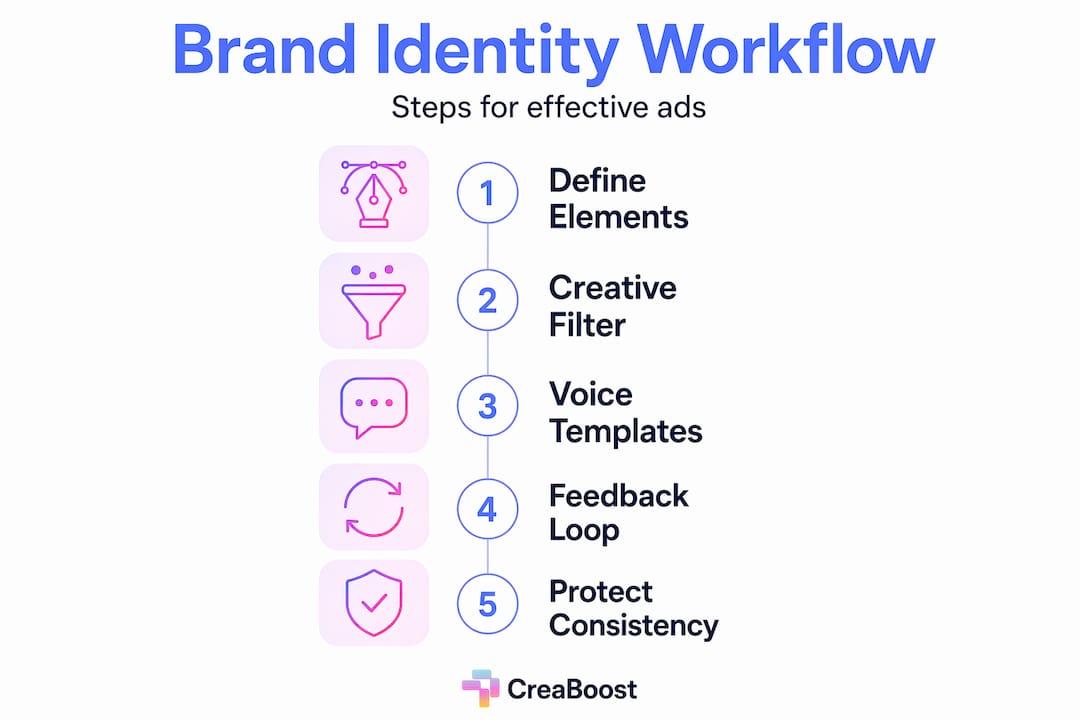
5. Protect against identity drift at scale. When creative volume increases, brand drift becomes a serious operational risk. Teams that lack locked-in structural identity elements produce off-brand ads at higher rates during high-volume production cycles. The solution is not more reviews. It is better systems upstream.
Pro Tip: Build a one-page brand identity reference card that any creative contributor can use without reading your full guidelines. Include your exact hex codes, approved font pairings, three voice examples across tones, and a list of five words that describe your personality alongside five words that never describe your brand. This single artifact eliminates most off-brand creative before it starts.
Measuring brand identity presence in your ads
Most performance teams measure ads by ROAS, CPA, and CTR. Those metrics tell you whether an ad worked. They do not tell you whether it built anything. Measuring brand identity effectiveness in advertising requires a parallel layer of tracking.
The table below outlines the measurement approaches that give you the most signal across different objectives:
| Measurement type | What it tells you | How often to run it |
|---|---|---|
| Brand recall surveys | Whether audiences remember your brand after ad exposure | Quarterly |
| Social listening analysis | How audiences describe your brand versus your intended identity | Monthly |
| Creative asset tagging and cohort analysis | Which brand signals (color, voice, format) correlate with ROAS | Ongoing |
| Brand health tracking | Long-term shifts in awareness, trust, and preference | Bi-annually |
| Ad testing with asset isolation | Which specific brand elements drive recognition and lift | Per campaign cycle |
Regular brand audits that combine surveys, focus groups, social media monitoring, and web analytics provide the continuous feedback needed to keep your brand identity and brand image aligned. Without this, you are running on assumptions.
The most underused tool in this stack is creative performance metrics broken down by brand element. When you tag your ads by hook type, visual style, and messaging angle, you can start answering questions like: "Does our brand color palette outperform neutral creatives in this vertical?" and "Does our brand voice lift conversion rates in retargeting?" That level of insight turns brand identity from a qualitative debate into a data-backed strategy.
Pro Tip: Run a creative quality audit every quarter by pulling your top 20 ads by spend and checking each one against your brand guidelines. You will find patterns in which elements get dropped under pressure, and those patterns will tell you exactly where your workflow needs stronger guardrails.
My take on where most teams get this wrong
I have watched a lot of brand identity projects fail in ways that had nothing to do with the quality of the strategy. The work was good. The guidelines were thorough. The decks were polished. And then nothing changed in the actual ads.
The problem, almost every time, is that brand identity gets treated as a document rather than a system. A team spends three months developing a beautiful brand guide, shares it once, and then watches it collect dust while creative production continues under deadline pressure and institutional habits. Within six months, the guidelines exist in theory and the ads exist in reality, and those two things have almost nothing to do with each other.
What actually works is building brand identity into the production workflow itself, not just into the reference materials. When your briefing templates force creative teams to state which brand signals they are using and why, identity enforcement stops being a policing function and starts being a creative habit. When your testing framework tracks brand element performance alongside conversion metrics, brand identity becomes a performance lever rather than a compliance exercise.
I also think the industry is too obsessed with visual consistency and not obsessed enough with voice consistency. Most teams will catch a wrong logo usage immediately. Far fewer will catch a headline that sounds like a completely different brand personality. And in an environment where text-heavy formats like search and social copy carry enormous weight, that gap in attention is costing brands real recognition and recall. Ad creative quality depends as much on verbal coherence as it does on visual execution.
The brands that get this right treat brand identity enforcement as a leadership function, not a design function. It requires someone with authority to say no when a campaign is off-brand, even when it is performing. Especially when it is performing. Because short-term performance gains built on off-brand creative erode the exact mental structures that make your next campaign cheaper to run.
— Bythewise
How Creaboost keeps your brand identity intact at scale
If you are running Meta Ads at serious volume, the operational reality is that brand identity breaks down not because teams do not care, but because the production loop is too slow and the analysis layer is too thin. You end up with off-brand variations in your account, no easy way to tell which concepts are actually driving results, and creative decisions made on gut rather than data.
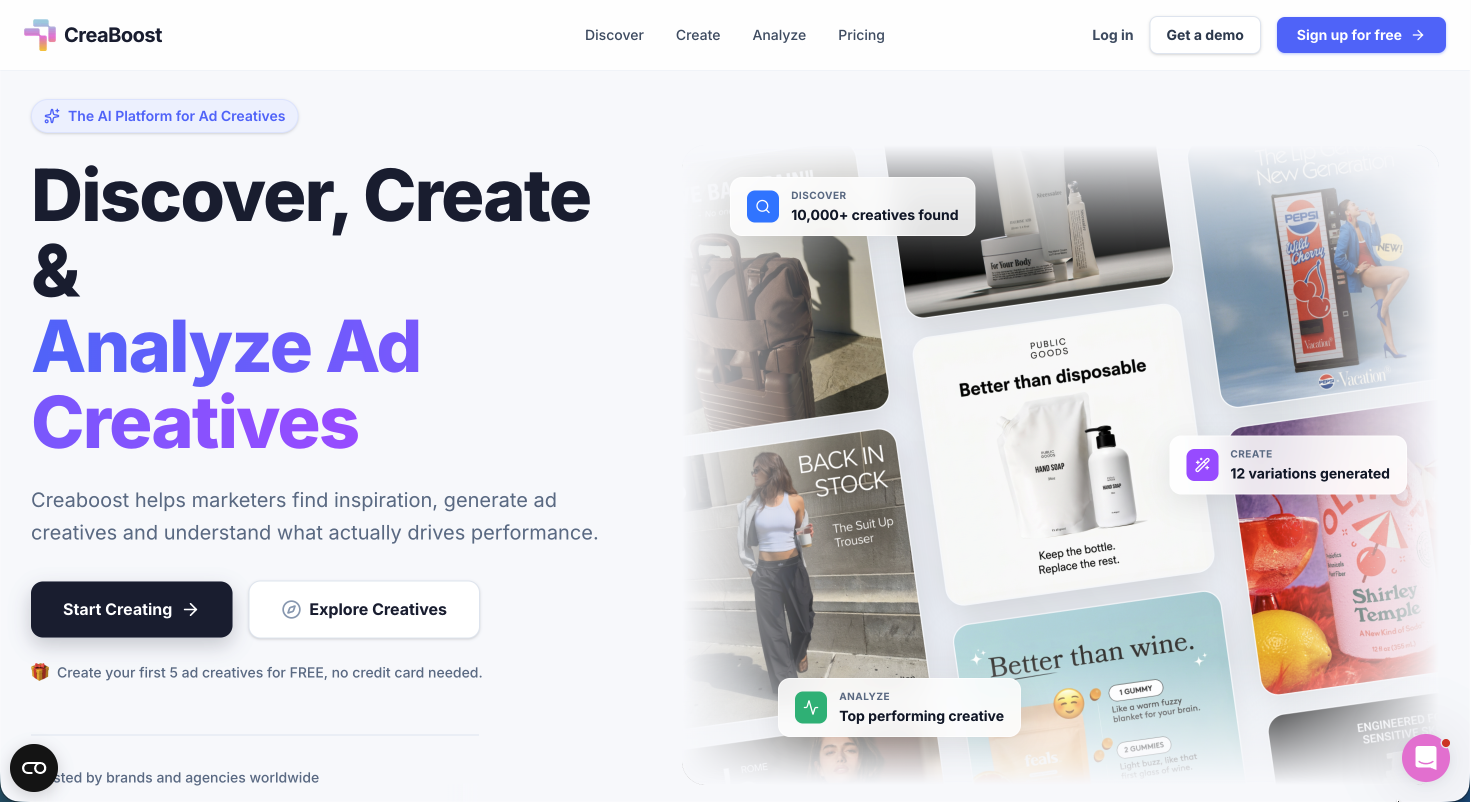
Creaboost is built around exactly this problem. The Create feature pulls your brand identity directly from your product URL and generates platform-ready static ads across every Meta and TikTok format you need, on-brand, batch-resized, and ready to upload. The Analyze feature auto-tags every creative by format, hook, angle, and concept, so you can see which brand signals are actually driving ROAS at the cohort level rather than guessing. You catch creative fatigue before it shows up in your headline metrics and scale your real winners with confidence. If your team is building high-performing ad creatives and needs a tighter loop between brand identity and performance data, Creaboost is where that loop lives.
FAQ
What is brand identity in ads?
Brand identity in ads is the coordinated system of visual, verbal, and experiential signals a brand consistently deploys across advertising to drive recognition, trust, and recall. It includes color, typography, voice, messaging, and personality working together as a unified system.
Why does brand consistency in advertising matter?
Brand consistency across channels is associated with a 10–20% increase in revenue growth. Consistent brand signals reduce cognitive load for audiences and build the trust that makes advertising more efficient over time.
How do I build brand identity into my ad workflow?
Separate fixed identity elements (logo placement, color rules, typography hierarchy) from flexible creative variables, and build these rules into your briefing templates and production process rather than relying on post-production review to catch off-brand creative.
What happens if I stop advertising consistently?
The Ehrenberg-Bass Institute finds that stopping mass-reach advertising causes brand loyalty and awareness to decline significantly within 12 months, as the distinctive assets that trigger brand recognition lose their mental availability without ongoing reinforcement.
How do I measure brand identity effectiveness in my ads?
Combine creative performance analytics broken down by brand element, quarterly brand recall surveys, and regular social listening to track whether your projected identity matches how audiences actually describe and remember your brand.