
Most marketing teams already run ads on multiple platforms. The problem is they run them like separate businesses. Each platform gets its own budget, its own creative, and its own reporting cadence. Nobody checks whether the audience on Google already converted from a Meta ad two days ago. Nobody notices when two campaigns from the same brand push conflicting offers to the same person on the same day. That fragmentation quietly bleeds budget, and most teams only notice once CPAs have already moved. This guide explains what cross-platform advertising actually is, how it works when done right, and what it takes to stop running isolated campaigns and start running a system.
Table of Contents
- Key Takeaways
- What cross-platform advertising actually means
- How cross-platform advertising works
- Benefits of cross-platform advertising
- Strategies for running effective cross-platform campaigns
- My take on where most teams go wrong
- How Creaboost fits into your cross-platform setup
- FAQ
Key Takeaways
| Point | Details |
|---|---|
| Coordination beats presence | Running ads on multiple platforms without a unified strategy creates waste, not reach. |
| Unified tracking is non-negotiable | Normalizing metrics across platforms improves marketing efficiency by 15 to 30 percent. |
| UTM discipline drives clean data | Inconsistent naming conventions make cross-platform analytics unreliable and optimization impossible. |
| GA4 as neutral source of truth | Platform-reported conversions are inflated; GA4 provides fair, single-model attribution across channels. |
| Creative alignment matters as much as budget | Consistent messaging across platforms builds brand trust and reduces conflicting consumer experiences. |
What cross-platform advertising actually means
What is cross-platform advertising? It is the practice of running coordinated ad campaigns across multiple channels like Google, Meta, TikTok, and LinkedIn simultaneously, under a unified strategy. The key word is coordinated. Simply buying ads on five different platforms is not cross-platform advertising. It is just fragmented spending with extra steps.
True cross-platform advertising means your budget decisions, creative strategy, messaging, and attribution framework all operate as one system. When the Meta campaign and the Google Search campaign know about each other, you stop paying premium CPM on one platform to reach audiences already converted at lower CPC on another.
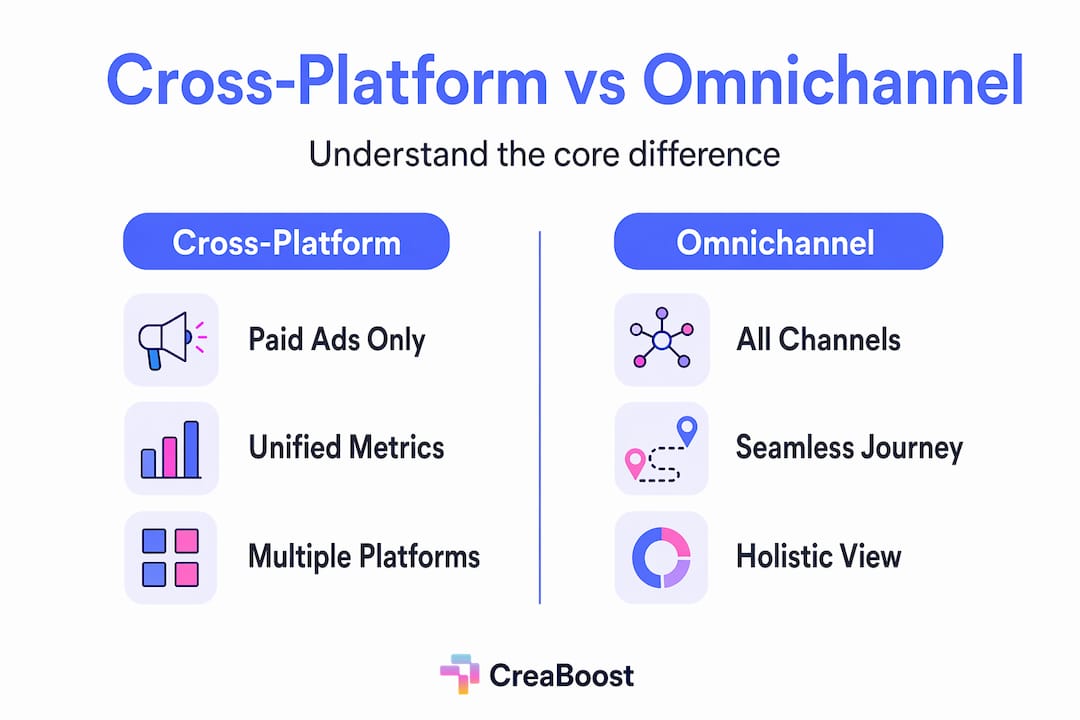
It helps to separate this concept from two adjacent terms that often get used interchangeably.
| Term | Scope | Focus |
|---|---|---|
| Cross-platform advertising | Paid channels only | Coordinated ad spend across platforms |
| Cross-channel marketing | Paid + organic + email + events | Consistent customer touchpoints across mediums |
| Omnichannel marketing | Full customer experience | Unified journey from awareness to retention |
Cross-platform advertising sits inside the broader cross-channel and omnichannel universe, but it is specifically about paid media coordination. That distinction matters when you are scoping a project or explaining to a CFO why this requires a different operational setup than what you are currently doing.
The platforms most commonly involved include Google Search and Display, Meta (Facebook and Instagram), TikTok, LinkedIn, YouTube, and programmatic networks. The right mix depends on your audience and offer. A B2B SaaS company will weight LinkedIn and Google heavily. A direct-to-consumer brand selling to Gen Z will skew toward TikTok and Meta. The principle of coordination applies regardless of which platforms you choose.
How cross-platform advertising works
The mechanics behind an effective cross-platform campaign come down to four interlocking systems: a unified brief, consistent tracking, dynamic budget allocation, and creative alignment.
The unified campaign brief
Everything starts with a single brief that defines the target audience, core message, offer, and success metrics across all platforms at once. This sounds obvious, but most teams brief each channel separately and then wonder why the customer experience feels disjointed. A unified strategy brief forces your team to decide upfront what the campaign is about before anyone touches a platform.
Cross-platform tracking and attribution
This is where most campaigns fall apart technically. Each platform measures conversions using its own model, attribution window, and counting logic. Meta's 7-day click and 1-day view window will show completely different numbers than Google's last-click model for the same purchase. Neither is lying. They are just measuring differently.
The solution is GA4 as your neutral attribution source that applies a single model across all channels. You use platform dashboards to manage bids and creatives, but you evaluate performance in GA4. That discipline alone prevents the classic trap of counting the same conversion three times across three platforms.
Equally critical: UTM naming conventions applied consistently across every campaign, ad set, and ad. Without that standardization, your cross-platform analytics are just noise. You cannot compare what you cannot consistently label.
Pro Tip: Build your UTM taxonomy before you launch a single ad. Define the exact values for source, medium, campaign, content, and term. Then put them in a shared document every channel manager must use. Retrofitting this discipline after six months of inconsistent tagging is significantly harder than doing it right from day one.
Dynamic budget allocation
Static budget splits across platforms are one of the most common sources of waste in multi-platform campaigns. A well-run cross-platform setup shifts budget dynamically toward the channels delivering the best results at any given point in a campaign. That requires normalized metrics across platforms so you are comparing actual performance rather than platform-native vanity numbers.

AI-driven campaign platforms now handle campaigns across 8 to 10 networks simultaneously, consolidating data into single interfaces and enabling faster reallocation decisions. That does not eliminate the need for human judgment, but it removes the manual data aggregation that used to consume entire mornings.
Here is what a functional cross-platform workflow looks like operationally:
- A single creative brief drives ad production across all formats and platforms
- Every asset gets tagged with a consistent naming convention tied to concept, hook, and format
- All paid traffic flows through UTM-tagged URLs and is measured in a neutral attribution tool
- Platform dashboards handle bid management and delivery optimization
- Weekly performance reviews compare channels on normalized metrics
- Budget shifts follow performance signals, not guesswork or platform rep recommendations
Benefits of cross-platform advertising
The case for coordinated cross-platform campaigns is not philosophical. The numbers are concrete. Unified cross-platform tracking improves marketing efficiency by 15 to 30 percent, primarily because you stop optimizing against inflated platform-reported numbers and start optimizing against real ROAS.
The reach argument is also compelling. Cross-platform advertising gives you access to 4.76 billion active social media users across global platforms. No single platform comes close to that. But raw reach is not the point. The point is reaching the right people at the right stage of consideration, on whichever platform they happen to be using that day.
Here is where the measurable value actually shows up:
- Reduced redundant impressions. When your campaigns know about each other, you stop paying to show ads to people who already converted. That CPM was wasted. Coordination recovers it.
- Better creative learning. Testing a hook on TikTok and seeing it win there is useful. Knowing that same hook underperforms on Meta tells you something specific about how the audience differs across those platforms. You only get that insight when your tracking is unified.
- Consistent brand experience. Organizational silos create conflicting messages across platforms, from mismatched promotional offers to contradictory product claims. Cross-platform coordination prevents that, which has a measurable impact on consumer trust.
- Faster fatigue detection. When you track creative performance holistically rather than per platform, you catch fatigue signals earlier. An asset that is burning out on Meta might still be getting served aggressively because the platform algorithm has not caught up yet. Unified tracking shows you the trend line before it shows up in your headline CPAs.
The efficiency gains compound. Every week you run a coordinated system instead of fragmented campaigns is a week you learn faster, waste less, and build a richer data set for the next campaign.
Strategies for running effective cross-platform campaigns
Knowing the theory is one thing. Implementing it across a real marketing team with real budget pressure is another. These are the practices that separate teams doing this well from teams that adopted the vocabulary without changing their operations.
-
Break the channel silo first. Inconsistent customer experiences almost always trace back to organizational structure, not technology. If your paid social team and your paid search team report to different managers and share no common brief or reporting cadence, coordination is structurally impossible. Fix the org chart before you fix the tech stack.
-
Choose one attribution source and commit to it. Platform-reported conversion data is inherently inflated because every platform claims credit for every conversion it touched. GA4 as a single source of truth solves the double-counting problem. Set it up, align your team on it, and resist the urge to use platform-native numbers when they look better.
-
Standardize your naming conventions before launch. Fragmented UTM parameters make cross-platform reporting impossible. Define your taxonomy upfront, document it, and build in a review step that catches non-compliant assets before they go live.
-
Adapt creative for each platform while keeping the message consistent. The offer and the core argument should be identical across platforms. The format, hook, and visual treatment should fit each platform's native experience. A 15-second TikTok and a Google Display ad can carry the same message in formats that feel native rather than repurposed.
-
Test placement types deliberately. Explore placement performance differences across Meta and TikTok specifically. Reels, Stories, Feed, and TikTok In-Feed placements each attract different engagement patterns. Treating them as interchangeable inflates your reported reach without improving actual performance.
-
Use AI tools to handle the operational load, not the strategic decisions. AI-powered platforms accelerate creative generation, automate budget reallocation, and normalize data across channels. But audience behavior differs significantly per platform, and those differences require human interpretation. Automate the repetitive layer. Keep humans on the judgment layer.
Pro Tip: Run a two-week audit before restructuring your cross-platform setup. Pull every active campaign's UTM data, compare it against GA4 attribution, and calculate what percentage of reported conversions are being counted more than once. Most teams find the number is higher than they expected. That audit alone tends to realign the team on why the operational changes are worth the effort.
My take on where most teams go wrong
I have spent years watching well-resourced marketing teams underperform simply because they never solved the coordination problem. The symptoms are always the same: separate channel leads briefing separately, manual aggregation of campaign metrics that consumes six-plus hours every week, and performance reviews that compare incompatible numbers as if they mean the same thing.
The technology to fix this has existed for a while. What has been slower to change is the belief that running more platforms automatically means better results. It does not. More platforms without coordination just means more places to waste money faster.
What I have found is that the teams who crack this are not necessarily the ones with the best tools. They are the ones who decided to treat their paid media as a single system and then built the operations to match. That decision changes everything from how briefs are written to how results are reviewed. AI tools genuinely help with the automation layer, and I have seen them significantly reduce the manual drag of cross-platform campaign management. But I would caution against treating AI allocation as a substitute for understanding how your specific audiences behave differently across platforms. The data tells you what happened. You still have to decide what to do next.
The teams that will win over the next few years are not the ones with the biggest budgets. They are the ones with the tightest feedback loops, and cross-platform coordination is the foundation of that loop.
— Bythewise
How Creaboost fits into your cross-platform setup
If your cross-platform advertising effort keeps hitting the same wall, chances are the friction is in your creative pipeline and your analytics layer, not your strategy document.
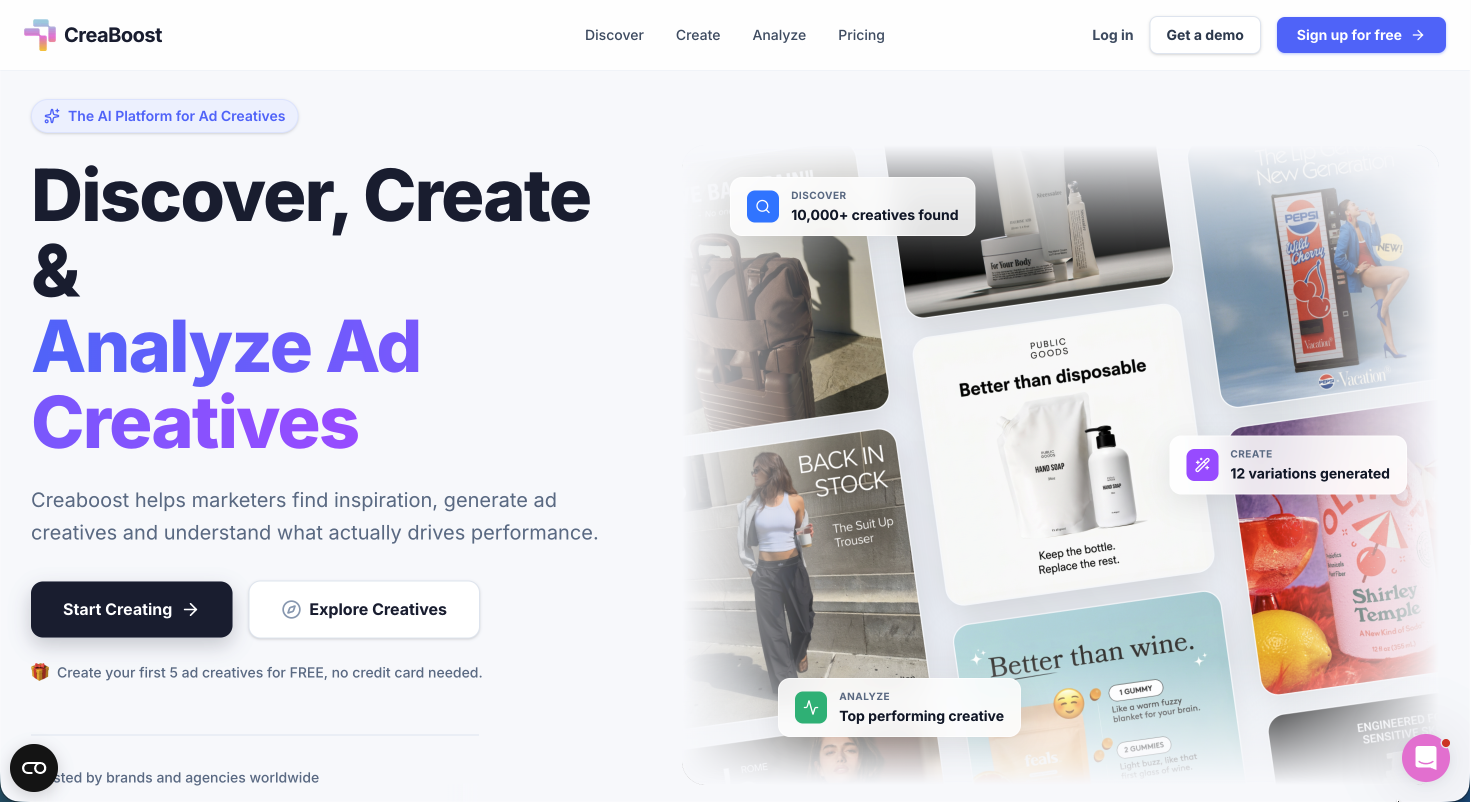
Creaboost is built for performance teams managing Meta and TikTok at scale. The Analyze feature auto-tags every creative by hook, format, angle, and concept, then connects directly to your ad accounts so you can see which concepts drive ROAS at the cohort level rather than just which assets got the most impressions. With the Create feature, you generate platform-ready variations in minutes from a single product URL. Explore what multi-platform ads at scale can look like with Creaboost, or check the pricing plans to find the right fit for your team size and volume.
FAQ
What is cross-platform advertising in simple terms?
Cross-platform advertising means running paid ad campaigns across multiple platforms like Google, Meta, and TikTok under a single coordinated strategy, shared creative framework, and unified tracking system. It is distinct from simply buying ads on multiple platforms without coordination.
How does cross-platform advertising work technically?
It relies on a unified campaign brief, consistent UTM parameters across all platforms, a neutral attribution tool like GA4, and normalized performance metrics that allow valid comparisons across channels. Dynamic budget allocation shifts spend toward the highest-performing channels based on that shared data.
What are the main benefits of cross-platform advertising?
The primary benefits include reduced wasted ad spend from redundant impressions, improved marketing efficiency of 15 to 30 percent through unified tracking, broader audience reach, and more consistent brand messaging across every platform where your audience spends time.
What is cross-platform ad analysis?
Cross-platform ad analysis is the practice of measuring and comparing ad performance across all channels using normalized metrics and a single attribution model. It prevents the double-counting that occurs when each platform reports conversions independently and enables accurate ROAS comparison across your full media mix.
How is cross-platform advertising different from omnichannel marketing?
Cross-platform advertising specifically covers paid media coordination across ad platforms. Omnichannel marketing is broader and encompasses the full customer experience across paid, organic, email, in-store, and every other touchpoint a customer encounters from awareness through retention.