

Producing high-volume ad creatives for cross-channel campaigns slows down marketing teams when manual resizing and analytics live in separate tools. Most current creative automation platforms gate advanced analytics, batch generation, or feed integrations behind high enterprise pricing or lengthy onboarding. This comparison covers AI-driven ad creative tools with automation, analytics, and integration features so you can pick the right platform to meet your campaign volume and budget.
Table of Contents
CreaBoost

At a Glance
The vendor reports being trusted by over 10,000 brands and agencies worldwide, a claim that underlines its orientation at scale rather than solo use.
CreaBoost pairs AI creative generation with platform-ready resizing and a visual-first analytics layer that flags creative fatigue and cohort performance.
Core Features
- Discover trending ads and build inspiration boards for rapid brief generation.
- Generate ad creatives from product pages using AI and batch-resize for multiple platform formats.
- Produce studio-style product packshots from casual photos to raise creative quality without a photo shoot.
- Analyze creative performance with visual dashboards that detect fatigue signals and tag concepts.
Key Differentiator
CreaBoost combines AI-powered generation, automated resizing, and analysis inside a single workflow tailored for high-speed advertising cycles. That integration reduces the friction between idea, execution, and measurement so teams can iterate faster without stitching together three separate tools.
Pros
- Rapid output. Teams report a big reduction in time to launch thanks to AI-driven generation and automated resizing that turn a single product page into many ad variants.
- Fewer manual handoffs. Creative and performance signals live in one place so brief-to-test cycles shorten and fewer assets get lost across drives and chats.
- Diversity at scale. The platform creates many creative variations automatically, which helps avoid early fatigue from repeating the same concepts.
- Visual-first analysis. Dashboards surface which concepts and hooks are moving ROAS rather than just showing impression counts.
- Enterprise-ready orientation. The vendor positions the product for brands and agencies running sustained performance campaigns rather than one-off creatives.
Cons
- The monthly cost and add-on credit model can be pricey for one-person teams or micro agencies that need occasional creative bursts.
Who It's For
Performance marketers, ecommerce brands, advertising agencies, and in-house creative teams that run high-volume testing and want to convert URLs and existing assets into platform-ready ads quickly.
Unique Value Proposition
Turn a product page into dozens of platform-ready static ads in minutes. That concrete capability shifts creative bottlenecks away from designers and toward hypothesis-driven testing, so media teams can identify winners faster and reallocate spend based on cohorts rather than impressions.
Real World Use Case
A performance marketing team at an ecommerce brand uses CreaBoost to generate hundreds of ad variations from product pages, runs split tests across channels, and uses the visual analytics to pause fatigued concepts before CPAs drift higher. The result is more confident scaling and fewer wasted ad dollars.
Pricing
Base plan listed at $127 per month with optional add-ons for extra credits or additional data sources. The pricing model favors teams that produce at scale; small teams should model monthly creative volume against credit costs before committing.
Website: https://creaboost.com
CreativeX
At a Glance
According to the vendor's marketing materials, Nestlé increased ROAS by 74% on Meta after applying CreativeX's measurements to optimize creative content. That single, vendor-cited example is the most concrete claim the company uses to demonstrate measured creative impact.
Core Features
CreativeX links pre-testing, creative, and media datasets so creative decisions trace to performance outcomes.
- Content scoring to surface stronger assets before launch
- Impartial measurement of creative effectiveness across campaigns
- End-to-end visibility connecting creative and media datasets
- Platform connectors that pull real campaign data from ad accounts
Key Differentiator
CreativeX emphasizes impartial measurement and compliance at scale. The platform is built to let global teams apply one consistent rubric for creative quality, representation, and brand rules across regions and channels.
Pros
- Automates creative best-practice evaluation so reviewers get benchmarked scores rather than only subjective feedback.
- Supports brand consistency and compliance workflows, which reduces back-and-forth with legal and regional teams.
- Tracks inclusive and diverse representation in assets, giving stakeholders measurable signals for DEI reporting.
- Integrates with major ad platforms so media planners can map creative variants directly to spend and outcomes.
- Produces insights that inform both creative iteration and media allocation, shortening the loop between test and scale.
Cons
- No free version or trial exists, so pilots require a sales engagement and budget commitment.
- Independent, detailed user reviews are limited on major review sites, which makes outside validation harder to find.
- Integration can be technically involved for teams without engineering support and may require vendor or partner assistance.
When It May Not Fit
If your team needs a ready-to-use, low-cost experiment before committing to a vendor partnership, CreativeX will likely feel heavyweight. Smaller teams that prefer DIY tooling or a free entry point will find the procurement path long.
If you lack engineering resources for account-level integration, setup and data plumbing could delay results and increase initial project cost.
Notable Integrations
CreativeX connects to the ad platforms most media teams run campaigns on:
- Meta
- TikTok
- YouTube
- Amazon
Who It's For
Marketing teams at global consumer brands focused on creative optimization, governance, and measurable representation. Best for organizations that can budget for integration and want a single measurement standard across markets.
Real World Use Case
That 74% figure above illustrates the intended workflow: a brand used CreativeX scores to rework underperforming Meta creatives, then shifted media toward higher-scoring variants and reported improved ROAS in subsequent campaign cycles.
Pricing
The vendor does not publish standard pricing; the product data lists pricing as informational only. Expect an enterprise sales process and line items for integration, onboarding, and ongoing platform access.
Website: https://creativex.com
Hunch Insights

At a Glance
Hunch's marketing materials claim Academy Sports doubled ROAS using AI templates, Carwow increased revenue tenfold, and Kiwi reduced CPA by 77% — treat those figures as vendor-reported case studies.
This platform combines feed enrichment, creative generation, and campaign automation across Meta, Snapchat, TikTok, and Google Ads to push more creative variations into live tests fast.
Core Features
Hunch connects data sources like Google Sheets and Shopify to enrich catalogs for ads. It unifies reporting across major social channels and Google Analytics so you can compare cohorts rather than impression counts.
The platform automates generation of dynamic creatives, supports bulk launches of hyper-localized campaigns, and provides AI templates that parameterize headlines, imagery zones, and offers.
Key Differentiator
Hunch positions itself as an AI-powered unified cross-channel creative automation engine that links directly to ad channels and feed sources. That focus skews toward teams who need to scale catalog-driven creative and automate launches across multiple networks rather than teams that prioritize deep creative analytics inside a single ad account.
Pros
- Simplifies production: Automates hundreds of creative variants from a catalog so design time drops and test velocity rises.
- Cross-channel automation: One workflow can push variants to Meta, Snapchat, TikTok, and Google Ads without manual resizing or repetitive uploads.
- Catalog management works well for retail and e-commerce where inventory changes often and creatives must reflect live prices and offers.
- Media and creative alignment: Unifying signals from ad accounts and analytics helps buyers spot which creative cohorts actually drive ROAS rather than just impressions.
- Agency scale: Bulk launch and template libraries let agencies spin up localized campaigns for many clients quickly.
Cons
- High starting price point may put Hunch out of reach for small businesses and early-stage brands.
- Public user feedback is limited, so independent verification of performance claims is sparse.
- The product trades granularity for automation; teams that need very hands-on creative iteration may find the templated approach constraining.
When It May Not Fit
If your team is a small solo marketing shop or a startup with a tight media budget, the cost and onboarding overhead will likely outweigh the gains. If you need deep creative analytics tied to a single ad account with a heavy human review loop, Hunch's automation-first model may feel like the wrong lever.
Notable Integrations
- Meta
- Snapchat
- TikTok
- Google Analytics
- AppsFlyer
- Adjust
- Gmail and Outlook connectors for workflow notifications
These integrations support direct publishing, measurement consolidation, and feed enrichment from common sources.
Who It's For
Performance marketing teams, creative strategists, and agencies running cross-channel social campaigns that depend on catalog feeds and high-velocity testing. Best when you have a media budget large enough to justify automation and templates.
Real World Use Case
A retailer with thousands of SKUs uses Hunch to auto-generate hundreds of localized creative variants from a product catalog, then launches segmented campaigns across three channels in one go. According to the vendor case set above, that approach drove meaningful ROAS improvements for several clients.
Pricing
Pricing is not published publicly; the product data lists pricing as informational only. Expect an enterprise or agency-level starting point given the platform’s automation and multi-channel scope.
Website: https://hunchads.com
Comparative Analysis of the Reviewed Platforms
In evaluating creative advertising solutions for performance-driven campaigns, it's crucial to distinguish the standout features and limitations of each platform against specific needs. Below, we'll assess the three eligible options considering their operational impact and alignment with user requirements.
Workflow Integration and Automation
CreaBoost provides an intuitive and unified workflow that combines AI-driven creative generation, resizing, and analytics into a single platform. This integration allows teams to reduce operational friction significantly, as demonstrated by its strength in high-speed campaign iteration—transforming product URLs into a plethora of ad variants effectively. Alternatively, Hunch Insights thrives in automating cross-channel campaigns with dynamic creative generation and catalog-driven advertising strategies. While Hunch's automation excels in scaling multi-channel campaigns, it might trade off depth for breadth, potentially limiting granular control over creative iterations compared to CreaBoost.
Compliance and Quality Governance
A clear dimension where CreativeX surpasses its peers is its focus on creative compliance and qualitative governance metrics. For global teams aiming to ensure brand consistency and apply diversity and inclusion (DEI) objectives comprehensively across campaigns, CreativeX offers structured scoring mechanisms and impartial benchmarking capabilities. These features go beyond creative generation, supporting governance objectives that align with wider organizational standards—a point relevant for teams prioritizing legislative or brand guidelines alongside performance advertising.
Best Fit Scenarios
- CreaBoost: For teams requiring a streamlined tool that combines AI-powered creative generation, resizing, and analytics to minimize manual handover and accelerate high-volume testing.
- Hunch Insights: Ideal for agencies or retailers leveraging catalog-driven campaigns across diverse channels, seeking automation to quickly deliver variations with integrated measurement capabilities.
- CreativeX: Suitable for enterprise teams focused on maintaining rigorous compliance across international markets while optimizing creative clarity and representation at scale.
Our Pick: CreaBoost
CreaBoost excels by uniting its capabilities—generating market-ready ads directly from product assets, batch resizing them for various platforms with performance analytics—to produce a rapid cycle of hypothesis-driven execution suitable for data-informed scale. However, when strict compliance governance or catalog-heavy localized campaigns are the priority, the other platforms may offer better alternatives.
Advertising Workflow Platforms Comparison
Evaluate these platforms based on their ability to streamline advertising workflows and meet various team needs effectively.
| Platform | Key Differentiator | Best For | Pricing | Notable Limitation |
|---|---|---|---|---|
| CreaBoost | AI-powered generation, resizing, and analysis | Performance marketers and high-volume testing | $127 per month base | Costs may be high for small-scale occasional use |
| CreativeX | Impartial measurement of creative compliance | Global consumer brand marketing teams | Not disclosed | No free trial and detailed reviews lacking |
| Hunch Insights | AI-powered cross-channel creative automation | Catalog-driven creative production agencies | Not disclosed | High initial cost and limited granularity for manual iteration |
Solve Your Creative Bottlenecks with Creaboost
Running Meta Ads at scale means the real challenge lies in managing and optimizing your creative pipeline. You need more ad variations than your design team can produce manually. Tracking which concepts actually drive Return on Ad Spend versus those that only rack impressions can feel impossible. Creative fatigue can increase CPAs before you even notice, draining budget and slowing your growth. Creaboost addresses these exact pain points by combining creative discovery, automated generation, and advanced performance analysis in one platform.
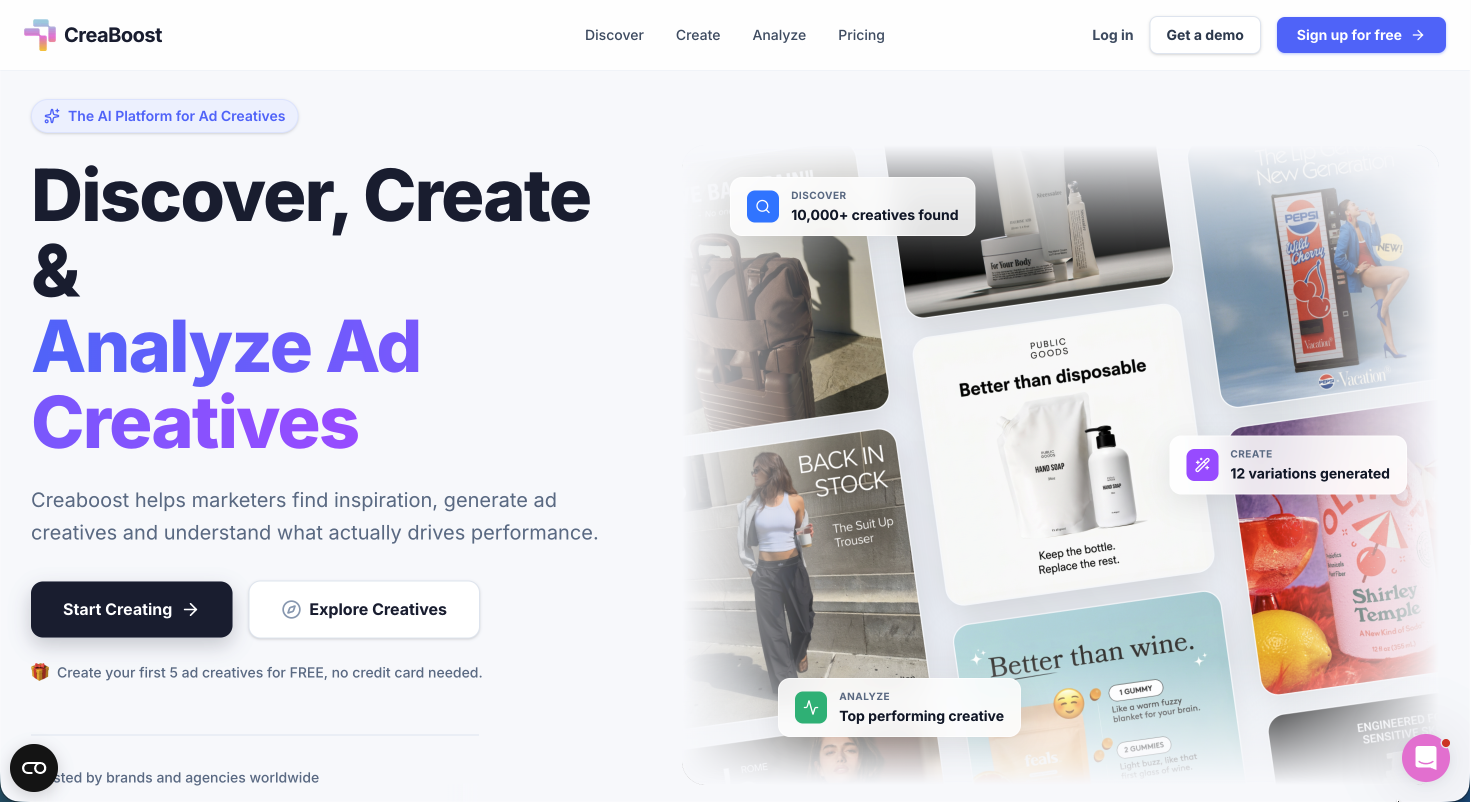
Stop wasting time juggling multiple tools and lost assets. With Creaboost, instantly turn product URLs into dozens of platform-ready ads, tag and measure creative cohorts precisely, and catch fatigue before it inflates your costs. Get faster briefs, ship more variations, and gain confidence in what you scale. Visit Creaboost to see how you can reduce creative friction and improve Meta campaign ROAS this week.
Frequently Asked Questions
How does CreaBoost reduce time to launch ad campaigns?
CreaBoost significantly cuts down the time teams need to launch campaigns. Its AI-driven generation and automated resizing can turn a single product page into many ad variants rapidly. Users can expect to launch ads faster and with less manual effort.
What is the difference between CreaBoost and CreativeX?
CreativeX provides impartial measurement of creative effectiveness across campaigns, which allows for consistent evaluations across global teams. In contrast, CreaBoost focuses on rapidly generating multiple ad variations and offers streamlined testing for high-volume campaigns. Teams looking for a high-speed testing solution may find CreaBoost better suited to their needs.
Which platform allows for easy analysis of creative performance?
CreaBoost features visual dashboards that analyze creative performance, detecting fatigue signals and tagging concepts effectively. This capability helps teams understand which ads are performing well and informs their future creative efforts. Users will benefit from more informed decision-making regarding their ad spend and creative strategies.
Can I use CreaBoost if my team is small?
While CreaBoost is designed for larger teams running high-volume advertising campaigns, small teams can still leverage its features, though they should consider the monthly costs associated with its plans. Smaller teams should evaluate their monthly creative volume to ensure it aligns with the credit costs before committing.
How does CreaBoost support creativity at scale?
CreaBoost enables users to create numerous creative variations automatically, which helps alleviate the risk of creative fatigue. The platform's focus on diversity allows teams to test different concepts efficiently, ensuring continuous performance optimization. This feature enables marketing teams to experiment without the bottlenecks typically associated with traditional creative processes.