

Scaling ad creative production while connecting inspiration, analytics, and fast iteration often gets bottlenecked by disconnected tools and manual workflows. Many ad creative management platforms either gate critical features behind agency-priced tiers or lack integrated discovery and performance analysis, leaving teams to juggle assets across scattered drives and dashboards. This guide compares CreaBoost, Foreplay, and GetHookd on workflow automation, analytics depth, and production speed so you can choose an ad creative management solution that fits your budget and growth targets.
Table of Contents
CreaBoost

At a Glance
The vendor advertises that CreaBoost can convert a single product URL into dozens of platform-ready static ads in minutes rather than days. The platform positions itself as a single workspace for discovering, creating, analyzing, and managing ad creative across Meta, TikTok, Google, and LinkedIn.
CreaBoost targets ecommerce brands, agencies, and marketing teams that need high-volume creative production paired with actionable performance signals.
Core Features
- Discover: Search ad inspiration and creator archetypes across platforms so briefs start from patterns that have trended in your vertical.
- Create: Auto-generate and batch-resize creatives from product pages or uploaded assets into multiple social formats, including studio-style packshots created with AI.
- Analyze: Connects to your ad accounts and auto-tags creatives by format, hook, angle, and concept to reveal which cohorts drive ROAS and which are burning out.
- Manage operational tasks with bulk uploads, a Naming Convention Engine, automation rules that pause underperformers, and quota-based alerts that ping the right person when spend or ROAS thresholds are crossed.
Key Differentiator
CreaBoost’s main claim is that it bundles generation, discovery, and analytics in one product so creative output and performance measurement live in the same system. The platform’s auto-tagging and fatigue detection aim to separate impression volume from true ROAS drivers, letting teams identify winners and underperformers without manual tagging.
Pros
- Allows rapid generation and variation of ad creatives so you can run more tests without adding headcount.
- Centralizes discovery, production, and analysis in one workspace, cutting context switching between generator tabs, analytics dashboards, and shared drives.
- Supports collaboration with unlimited team members, which simplifies multi-stakeholder workflows across creative and media teams.
- Provides AI-driven insights for CTR and ROAS optimization, including pattern tagging that surfaces concepts worth scaling.
- Tracks performance across multiple ad platforms for consistent cohort-level analysis rather than siloed platform reports.
Cons
- Third-party reviews note a learning curve for some users; teams without onboarding resources may take time to use the full feature set effectively.
Who It's For
Marketing teams, creative agencies, and ecommerce brands that must scale creative output and want performance signals tied directly to assets. CreaBoost fits teams that publish frequent tests and need a disciplined naming and tagging system to keep accounts readable.
Unique Value Proposition
Turning a product page into dozens of upload-ready creatives removes the designer round trip as the gating factor in creative testing. That workflow change lets media buyers and creative strategists iterate on concepts faster while designers spend time on higher-fidelity work.
Real World Use Case
A digital agency uses CreaBoost to generate hundreds of variants across Facebook, Instagram, and TikTok from client product feeds. Creative and media teams tag concepts automatically, spot a fatigued hook a week or two earlier than platform signals, and reallocate budget to winning cohorts in near real time.
Pricing
Plans start at $127/month for the Pro plan. The vendor offers add-ons for extra credits and additional data sources so teams can scale generation and analytics as spend and volume increase.
Website: https://creaboost.com
Foreplay

At a Glance
Foreplay's marketing materials state a Discovery index of over 100 million ads, a scale that makes ad inspiration genuinely searchable rather than anecdotal. The platform pairs that library with creative analytics and workflow tools so teams move from idea to brief without switching tabs.
Core Features
Foreplay combines a Swipe File for saving inspiration, a Discovery search engine, and Spyder for ongoing competitor tracking. Lens offers creative analytics and reporting while Briefs accelerates concept handoffs to production.
Each tool links to the next so research, tagging, testing, and reporting live in one place rather than scattered across drives and spreadsheets.
Key Differentiator
The single thing that separates Foreplay is the integrated loop between inspiration and analytics. You can surface a competitor idea in Discovery, pin it to a board in Swipe File, run performance analysis in Lens, and then produce a brief without recreating context. That continuity reduces handoff friction between strategists and creatives.
Pros
- Saves research time. The massive ad index above shortens the hunt for high-potential concepts and examples you can reuse.
- Clean, visual UI. Teams describe the interface as easy to scan and curate which helps nontechnical stakeholders contribute ad examples.
- Strong organizational tools. Boards and briefs keep creative ideas actionable instead of buried in a folder.
- Responsive support. The vendor claims attentive customer service which speeds onboarding and troubleshooting.
- Built for iterative testing. Lens centralizes test results so you see which hooks work at the cohort level rather than guessing from impressions.
Cons
- Cost can escalate. Pricing starts at a modest tier but higher plans for agencies and enterprises are significantly more expensive which may limit long term adoption by small teams.
- Feature limits on lower tiers. Some useful functionality is gated behind higher plans which creates pressure to upgrade as needs grow.
- Sparse official integrations. The product data lists no integrations which means extra work wiring data into some ad operations stacks.
When It May Not Fit
If your team runs on a shoestring budget and needs every workflow feature at the entry level Foreplay will feel constrained. Also, teams that rely on deep native integrations to a bespoke tech stack may find the platform adds manual steps rather than removing them.
Who It's For
Performance marketing teams at e-commerce brands, digital agencies, and growth teams will gain the most. Foreplay reports over 10,000 growth teams and agencies using the platform which suggests product-market fit with teams that run frequent paid social tests.
Real World Use Case
A digital agency uses Foreplay daily to pull top-performing Facebook and TikTok ads into client boards. Creative directors tag winners, analysts run Lens reports, and account managers send data-backed briefs to designers which cuts research time and sharpens hypotheses for A B tests.
Pricing
Free trial is available. Paid plans start at $49 per month for basic features. Agency and enterprise tiers carry higher fees and customization options which can include additional seats and advanced reporting.
Website: https://foreplay.co
GetHookd

At a Glance
Starting at $19/month, GetHookd combines competitor ad research, AI-generated ad scripts, and instant visual variations in one interface — a low entry price for teams that need rapid creative throughput. The platform emphasizes fast ad variation generation and advanced filtering.
Core Features
- AI-powered competitor ad research with filters for niche, ROAS benchmarks, and visual style to surface relevant creative patterns quickly.
- AI-generated ad scripts tailored to campaign objectives and platform formats so copy and hooks match the creative direction.
- Instant AI-created ad visuals and variations that produce multiple platform-ready assets from a single brief.
- A searchable library of high-performing ads across Facebook, TikTok, and Google plus in-platform tools for research, production, and analysis.
Key Differentiator
GetHookd pairs very fast ad variation generation with deep discovery filters in a single workspace. That combination lets teams move from spotting a winning competitor creative to testing dozens of tailored variants in hours rather than days.
This tight loop between discovery and production is the product’s real edge for teams running many parallel tests and needing repeatable outputs.
Pros
-
Fast creative throughput reduces designer round-trips; you can push dozens of visual and copy variants from one product URL.
-
Advanced filtering surfaces examples that match specific ROAS bands and stylistic cues, shortening hypothesis formation for buyers and creatives.
-
Trend-spotting tools help you spot rising formats early, which matters when platform windows close quickly.
-
Flexible subscription plans and a credits model let smaller teams start cheap while larger accounts scale credit volumes and seats.
-
Clean interface and per-brand ad limits prevent accidental cross-client asset leakage during heavy testing.
Cons
-
Limited independent review volume makes it harder to read broad user sentiment outside vendor materials.
-
The credits system and tiered plans add billing complexity that some teams need time to decode.
-
The feature set can be more than a solo marketer needs; very small advertisers may not use enough volume to justify certain tiers.
When It May Not Fit
If your main requirement is enterprise-grade social proof from independent review sites, GetHookd’s limited outside review footprint may be a blocker. Also, teams uncomfortable with credit-based billing will prefer straightforward per-seat or flat-fee models.
For single-person shops running one or two ads a month, the platform’s production scale may be unnecessary and more costly than manual design plus ad copy services.
Who It's For
Growth-oriented eCommerce teams, performance marketers, and agencies running multiple client accounts who need to accelerate hypothesis-to-test cycles. It works best when you have recurring test volume and want to reduce creative lead time.
Real World Use Case
A three-person agency uses GetHookd to replicate top competitor hooks, generate fifty visual variants across TikTok and Facebook, and run early-cohort A/B tests. The team stabilizes ROAS by spotting winners faster and rotating underperformers before spend balloons.
Pricing
Plans start at $19/month with annual discounts around 35 percent. Pricing scales by credits and seats up to enterprise packages that include higher credit allocations and multi-seat management.
Website: https://gethookd.ai
Comparative Analysis
When selecting an ad creative management platform, understanding the tradeoffs between workflow integration, pricing dynamics, and feature availability is essential for making an informed decision.
Workflow Integration and Usability
CreaBoost excels in providing a unified workspace where creative discovery, generation, and performance tracking operate within a single interface. It offers auto-tagging capabilities that distinguish fatigue markers in ads, enabling earlier identification of underperforming cohorts. However, Foreplay introduces a concept-to-production loop, where its interconnected tools—from ad inspiration discovery to analytical brief creation—streamline collaboration between strategists and creatives effectively. This fosters a smooth transition from ideation to implementation. Meanwhile, GetHookd facilitates rapid creative iteration by pairing template-based visual and text generation with filtering options for targeting specific niches.
Pricing Scale and Value
Foreplay begins at an accessible tier but rapidly scales to higher fees for enterprise-level usage, a consideration for budget-conscious teams. GetHookd offers one of the lowest entry prices, allowing smaller advertisers to access AI-powered tools without substantial upfront investment. Conversely, CreaBoost's pricing at $127/month complements its extensive features, making it a cost-effective solution for teams handling high ad volumes across multiple platforms.
Best Fit
- CreaBoost works best for teams requiring end-to-end automation from ad concept generation to real-time performance analysis, especially those focused on scaling creative output across diverse platforms.
- Foreplay is ideal for agencies prioritizing integrated workflows where creative ideation and analytical feedback feed into production briefs.
- GetHookd suits small teams looking for economical tools to expedite visual and textual ad creation while leveraging niche-specific filters for research.
Our Pick
Choose CreaBoost if your priority is combining creative analytics with automated generation in a single platform. Its ability to link ad performance signals directly to creative archetypes enables insights into scaling strategies. However, smaller teams or agencies emphasizing collaborative workflows might find Foreplay or GetHookd to be better fits, depending on their operational and budgetary needs.
Ad Creative Management Platforms Compared
When selecting an ad creative management platform, it is important to consider which tool provides the most comprehensive set of features for rapid creative generation and actionable analytics.
| Product | Core Feature | Key Differentiator | Best For | Pricing | Notable Limitation |
|---|---|---|---|---|---|
| CreaBoost | Ad creation, analytics, and multi-platform management | Unified creation and analytics workspace | Teams scaling ad volume with tied performance insights | $127/month | Learning curve for full feature utilization |
| Foreplay | Ad discovery with creative analytics and briefing | Integrated loop from inspiration to analytics | Agencies finding ad inspiration and organizing briefs | $49/month | Limited integrations add manual data handling steps |
| GetHookd | AI-powered ad creation and competitor research | Discovery and variant generation in one tool | Smaller teams scaling creative throughput quickly | $19/month | Limited independent review availability |
Simplify Your Creative Pipeline Beyond Tryatria.com Alternatives
Managing high volumes of ad creatives while pinpointing what truly drives return on ad spend can be overwhelming. If you find yourself struggling with lost variations, delayed fatigue detection, and manual tagging, Creaboost offers a unified platform to solve these challenges. It empowers marketing teams to discover winning concepts, create dozens of ready-to-use ads from a single product URL, and analyze real performance with auto-tagging—all without juggling multiple tools.
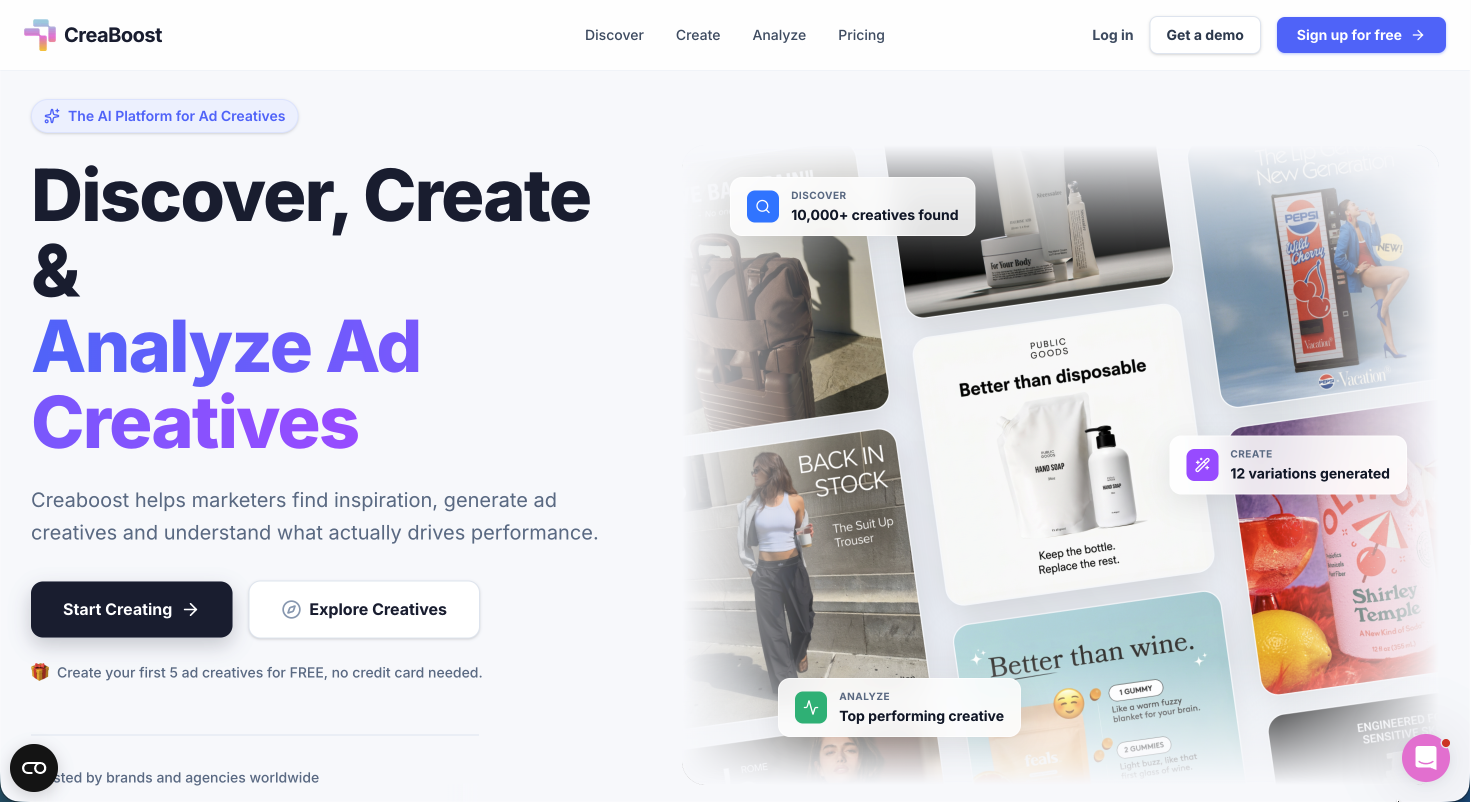
Ready to stop wasting budget on underperforming assets and accelerate your testing cycles? Visit Creaboost today to connect your ad accounts and start generating actionable performance insights in minutes. With streamlined creative management, you can confidently scale winners and optimize your ads faster than ever.
Frequently Asked Questions
What is the pricing plan for Creaboost?
Creaboost's plans start at $127 per month for the Pro plan. This tier allows users to generate multiple creatives rapidly, making it cost-effective for teams focused on volume. Be prepared for additional costs if your team requires extra credits as your advertising needs grow.
How does Creaboost compare to Foreplay in terms of usability?
Foreplay features a strong organizational toolset that helps streamline the research and tagging process, making it known for an easy-to-scan interface. For users needing a more integrated solution that centralizes discovery, production, and analytics, Creaboost allows teams to cut context switching, enhancing overall workflow efficiency.
How does Creaboost handle performance analysis of ad creatives?
Creaboost automatically connects to ad accounts and categorizes creatives by format, hook, angle, and concept. This enables teams to identify which creatives improve Return on Ad Spend (ROAS) easily and makes it straightforward to scale successful campaigns accordingly.
Can I use Creaboost if my team is small and has limited onboarding resources?
Creaboost has a learning curve, especially for teams without onboarding resources, but it can significantly enhance creative output over time. Starting with the Pro plan may help your small team adapt and leverage its full potential without requiring extensive initial support.
What advantages does Creaboost have over GetHookd when it comes to creative variations?
GetHookd excels in fast ad variation generation with deep discovery filters, making it ideal for teams needing quick testing cycles. Creaboost stands out by allowing for rapid iterations on creative concepts while connecting performance measurement directly to the ad creatives, providing a holistic view necessary for streamlined testing.