
Most marketing teams spend months optimizing bids, audiences, and budget allocation, then wonder why their numbers still disappoint. The real culprit is usually sitting right in front of them. Common ad creative mistakes drain budgets faster than almost any targeting error, and they are far less visible until the damage is done. This article breaks down the specific visual, messaging, tracking, and testing errors that cost e-commerce brands the most money, with concrete fixes for each. If your CPAs are climbing and your creatives feel stale, you are in the right place.
Table of Contents
- Key takeaways
- 1. Common ad creative mistakes with visuals and technical specs
- 2. Overlay text errors that quietly suppress performance
- 3. Messaging and copy mistakes that reduce clarity
- 4. Targeting and landing page misalignment
- 5. Running campaigns without proper tracking
- 6. Testing too many variables at once
- 7. Refreshing creatives on a fixed schedule instead of signals
- 8. Treating creative as a deliverable instead of a system
- My take on why most ad creative problems are process problems
- Stop leaving ROAS on the table with better creative tooling
- FAQ
Key takeaways
| Point | Details |
|---|---|
| Brief the claim first | Start every creative with the core offer or proof point, not a decorative visual, to produce more effective ads. |
| Track before you spend | Without conversion pixels and UTM-tagged links, you cannot attribute sales to specific creatives and will waste budget. |
| Refresh on signals, not schedules | Monitor CTR and CPM trends to detect fatigue and refresh only when performance data tells you to. |
| Isolate one test variable | Testing multiple creative elements simultaneously produces unreadable results and blocks meaningful learning. |
| Align ad and landing page | A mismatch between the ad promise and the landing page headline will crater your conversion rate. |
1. Common ad creative mistakes with visuals and technical specs
Low-quality visuals are a fast way to lose a sale before you even make an argument. Blurry, pixelated images signal to the viewer that the brand behind the ad is either careless or unprofessional. Trust dissolves in about 1.7 seconds of first contact, and a poor visual is the most common reason that happens.

The technical side is just as unforgiving. Facebook ads can be rejected over a single pixel difference from platform specifications. An image submitted at 1200x627 pixels instead of the required 1200x628 gets flagged and pulled before a single impression runs. These are not obscure edge cases. They happen to experienced teams who are moving fast and not checking specs on every upload.
Aspect ratios are another frequent culprit. Running a 16:9 horizontal asset in a Stories or Reels placement means you are serving a letterboxed visual to a full-screen vertical environment. Your ad shrinks to a fraction of the available space while competitors fill the frame.
- Use only assets at or above the minimum resolution required per placement
- Match aspect ratios to the specific placement, not just the campaign objective
- Keep logo placement and critical text within the safe zone, away from UI overlays on vertical formats, to prevent obscuring by platform interface elements (Meta ad specs define these zones precisely)
- Avoid static image overlays that are decorative rather than functional
Pro Tip: In video ads, place your logo in the first three seconds and keep it clear of the lower-center zone on vertical placements. Platform UI buttons often sit there and will cover branding that you assume is visible.
2. Overlay text errors that quietly suppress performance
Text overlays on images and videos are not inherently bad. They become a problem when used incorrectly. Image overlay text generally lowers conversions by 13% unless the text creates urgency, such as a sale deadline or a clear call to action. Generic descriptive text sitting on top of a lifestyle image does not help. It competes with the visual and often violates platform policy when it covers too much of the image.
Video is a different story. Captioning videos increases conversion rates by an average of 8.2% compared to uncaptioned video, according to a Reddit study analyzing 150,000 ads. The majority of social video is watched without sound. If your ad relies entirely on audio to deliver its message, you are invisible to that audience segment.
Policy issues also arise from text errors that many teams overlook. Improper punctuation, all-caps text, and branding placement that violates platform style guidelines all trigger policy flags on platforms. These are not creative problems. They are process problems, and they are entirely preventable.
3. Messaging and copy mistakes that reduce clarity
The most expensive copy mistake is writing your creative in the wrong order. Most teams start with a visual concept, then write copy around it. This produces decorative ads, not persuasive ones. Briefing the claim before the visuals produces more proof-driven, effective creative. The sequence should be claim, then proof, then format. When you flip that order, the visual becomes the hero and the argument becomes an afterthought.
Mixing too many messages in a single ad is another common advertising blunder. One ad should make one argument. When you try to communicate a discount, a product feature, a social proof element, and a brand story simultaneously, none of them land with force.
- Write copy that starts with the core offer or strongest proof point
- Limit each creative to one primary message
- Use captions on all video ads by default, not as an afterthought
- Match your tone to the platform community. Reddit, TikTok, and Meta each have distinct norms. Copy that feels authentic on Instagram can feel promotional and off-putting on Reddit
Pro Tip: Structure copy modularly at the sentence level so each line stands alone. When dynamic creative systems recombine your text with different visuals, a sentence that depends on context from the previous line will read as nonsense.
4. Targeting and landing page misalignment
An ad that works technically and creatively can still fail at the last step. A mismatch between the ad promise and the landing page headline causes a severe conversion rate drop. If your ad headline says "Get 40% off your first order" and the landing page leads with a brand story, the user feels deceived. They arrived expecting a specific thing and found something else. They leave.
This is one of the most overlooked advertising design mistakes because it sits outside the ad account. Teams optimize the creative, test the copy, refine the audience, and never check whether the page their ad sends people to actually matches what was promised.
The fix is mechanical: every ad variant should have a corresponding landing page or at minimum a landing page section that mirrors the specific claim in the creative. This is particularly important for promotional offers and time-sensitive messaging.
Pro Tip: Align your creative messaging with your pixel event setup. If your ad promotes a specific product category, the pixel should fire on the corresponding page with the correct parameters. Misaligned tracking means your algorithm is optimizing for the wrong signal from the start.
5. Running campaigns without proper tracking
Flying blind without conversion tracking pixels and UTM-tagged links makes it impossible to know which creatives are actually driving revenue. Many marketers optimize by feel instead, and that is a documented budget drain. You end up scaling assets based on impressions or CTR when neither of those metrics reliably predicts purchase behavior.
The operational fix is straightforward but easy to skip when moving fast. Before any campaign goes live, verify that the pixel is firing on the confirmation page, UTM parameters are appended to every ad URL, and the events you are bidding toward are actually being recorded in the platform.
Boosting posts for vanity metrics compounds this problem. Boosted posts optimize for likes, shares, and comments, not purchases. If your measurement system is counting engagement as success while your actual goal is conversion, you will see a dashboard full of green numbers and a flat revenue line.
6. Testing too many variables at once
Creative testing is where most teams develop bad habits without realizing it. The instinct is to test everything: the hook, the headline, the proof element, the call to action, and the format, all at once. The result is a multivariate mess where you have no idea what caused the performance difference between variants.
Testing multiple creative variables simultaneously produces unreadable results and makes it impossible to build on learnings. When variant A outperforms variant B, you need to know why. If you changed five things between them, you know nothing actionable.
The more effective approach is to separate concept-level testing from execution-level testing. First, test different angles or claims against each other. Once you know which concept wins, test executional variables within that winning concept. Separating concept from execution testing can produce up to 8x the difference in performance insights compared to undifferentiated multivariate testing.
7. Refreshing creatives on a fixed schedule instead of signals
Calendar-based creative rotation is one of the most common advertising blunders at scale. The logic sounds sensible: refresh every two weeks to prevent fatigue. The problem is that ad fatigue is not linear. Some creatives burn out in five days. Others run strong for six weeks. Refreshing on a schedule means you are either pulling winners too early or letting losers spend too long.
Refreshing based on performance signals like CTR and CPM is the smarter approach. When you see your CTR starting to decline and your CPM starting to climb on the same asset, that is the fatigue signal. That is when you rotate. Not before, and not on a predetermined date.
Slow creative iteration cycles make this worse. When your design process takes three to five days from brief to upload, you are already behind the fatigue curve by the time new creative goes live. The gap between when you should have refreshed and when you actually can refresh is where budget bleeds. Speed of iteration is as important as quality of creative.
Pro Tip: Track creative performance metrics like frequency and CTR trend together. Frequency alone is misleading. A high-frequency ad with stable CTR is not fatigued. A moderate-frequency ad with a declining CTR is.
8. Treating creative as a deliverable instead of a system
Creative failures most often stem from treating ads as static deliverables rather than components of a measurement and learning system. When the goal is "ship the ad," the work stops at upload. When the goal is "learn what works and build on it," the work never really stops, and neither does performance improvement. Teams with consistently strong ROAS build high-performing workflows around creative iteration rather than one-off production.
My take on why most ad creative problems are process problems
I've looked at hundreds of ad accounts across brands and agencies, and the pattern is always the same. The creative itself is rarely the actual problem. The process around the creative is.
Teams brief visuals before they brief claims. They test five things at once and call it structured experimentation. They refresh ads every two weeks because that is what someone told them to do three years ago. They send traffic to landing pages that haven't been touched since the ad creative was written.
What I've found is that the brands with the best creative performance are almost never the ones with the best designers. They're the ones with the tightest feedback loops. They know within 48 hours whether a new concept is working. They have a briefing process that starts with the claim and works backward to the format. They monitor CPM and CTR daily and respond when the curves bend, not when the CPA eventually spikes.
The uncomfortable truth is that most ad creative mistakes are not creative problems. They're organizational ones. The fix is not better taste or better talent. It's a tighter system.
— Bythewise
Stop leaving ROAS on the table with better creative tooling
If any of these mistakes sound familiar, the good news is that most of them are fixable at the system level, not the individual ad level.
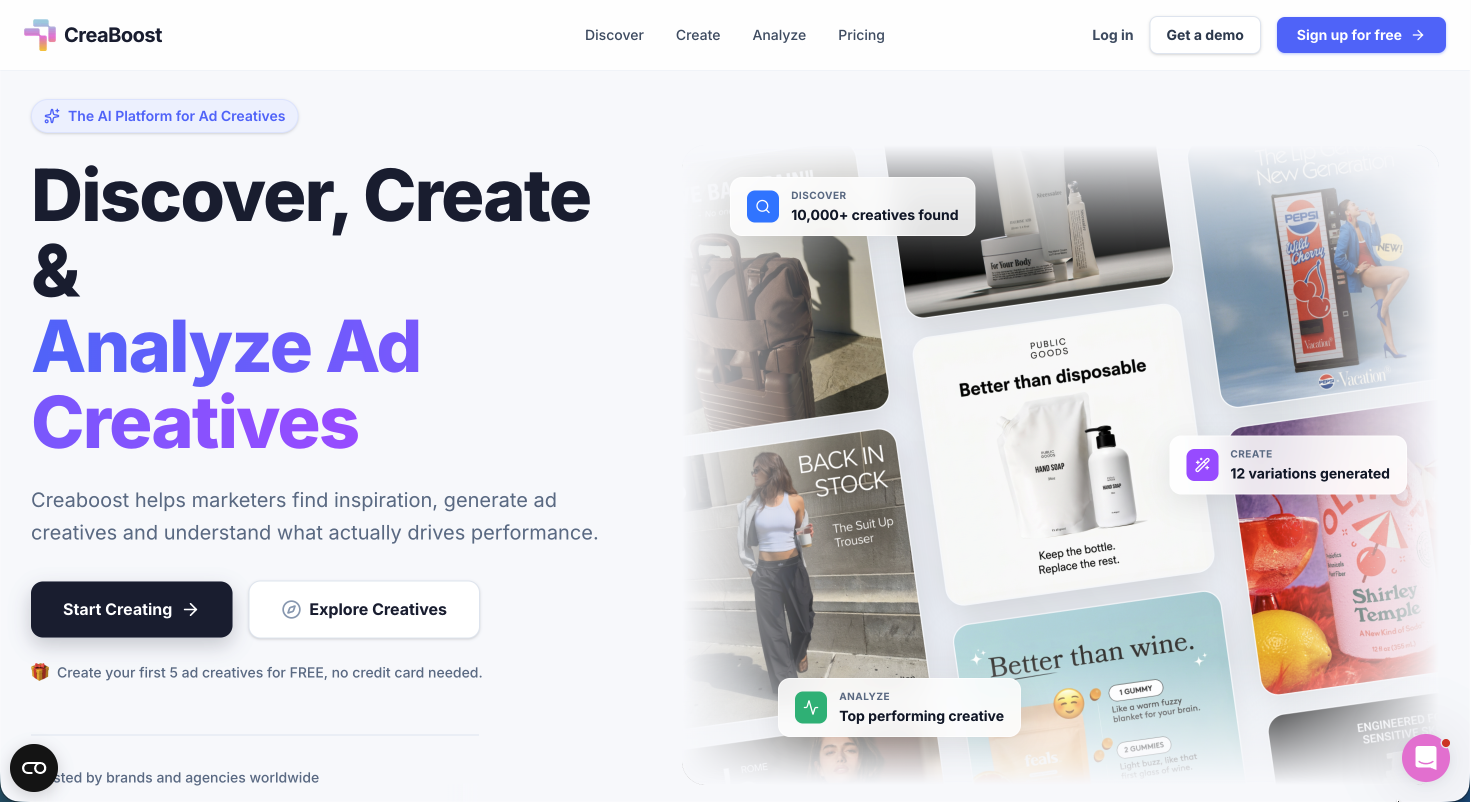
Creaboost is built specifically for teams running Meta Ads at scale who need to ship more creative, learn from it faster, and stop bleeding budget on assets that have already burned out. The Analyze feature auto-tags every creative by concept, hook, and format the moment it connects to your ad account, so you stop confusing impression volume with real performance. You spot fatigue before it hits your CPA. You scale winners before they stop winning. And with the AI creative generation tool, your team ships dozens of on-brand variations in minutes. Explore Creaboost's full platform and start closing the gap between what you're producing and what's actually possible.
FAQ
What are the most common ad creative mistakes?
The most frequent ad creative errors include using low-quality visuals, briefing visuals before the core claim, running ads without conversion tracking, misaligning the ad promise with the landing page, and refreshing creatives on a fixed schedule rather than performance signals.
How do I know when to refresh my ad creative?
Refresh when performance data shows CTR declining alongside rising CPM on the same asset, not on a fixed calendar schedule. Ad fatigue is nonlinear, so signal-based rotation prevents both premature pulls and prolonged spend on burned-out assets.
Why does landing page alignment matter for ad performance?
A mismatch between your ad headline and landing page content causes users to feel misled and leave immediately, severely dropping your conversion rate. Every ad variant should point to a page that mirrors the specific offer or claim made in the creative.
How many variables should I test in a single creative test?
Test one variable at a time. Changing multiple elements between variants makes it impossible to identify what caused the performance difference, which blocks you from building on learnings in future iterations.
Does adding text overlay to ad images hurt performance?
It depends on the content. Generic descriptive overlays lower conversions by around 13%, while urgency-focused text like sale deadlines can lift performance. For video, adding captions consistently increases conversion rates by an average of 8.2%.