
Managing creative pipelines for digital ad campaigns becomes a bottleneck when platforms force manual asset generation and fragmented reporting across channels. Many existing ad creative management tools either limit integrations to core ad platforms or require extra steps for unified analytics and scalable AI production, which slows testing and inflates labor costs. This comparison includes pricing, asset generation speed, and channel coverage across four ad creative management software options so you can choose one that eliminates workflow handoffs and fits your campaign volume.
Table of Contents
- CreaBoost
- Uplifted
- Wider
- Benly AI
- Comparing Ad Creative Platforms: CreaBoost, Uplifted, Wider, and Benly AI
CreaBoost

At a Glance
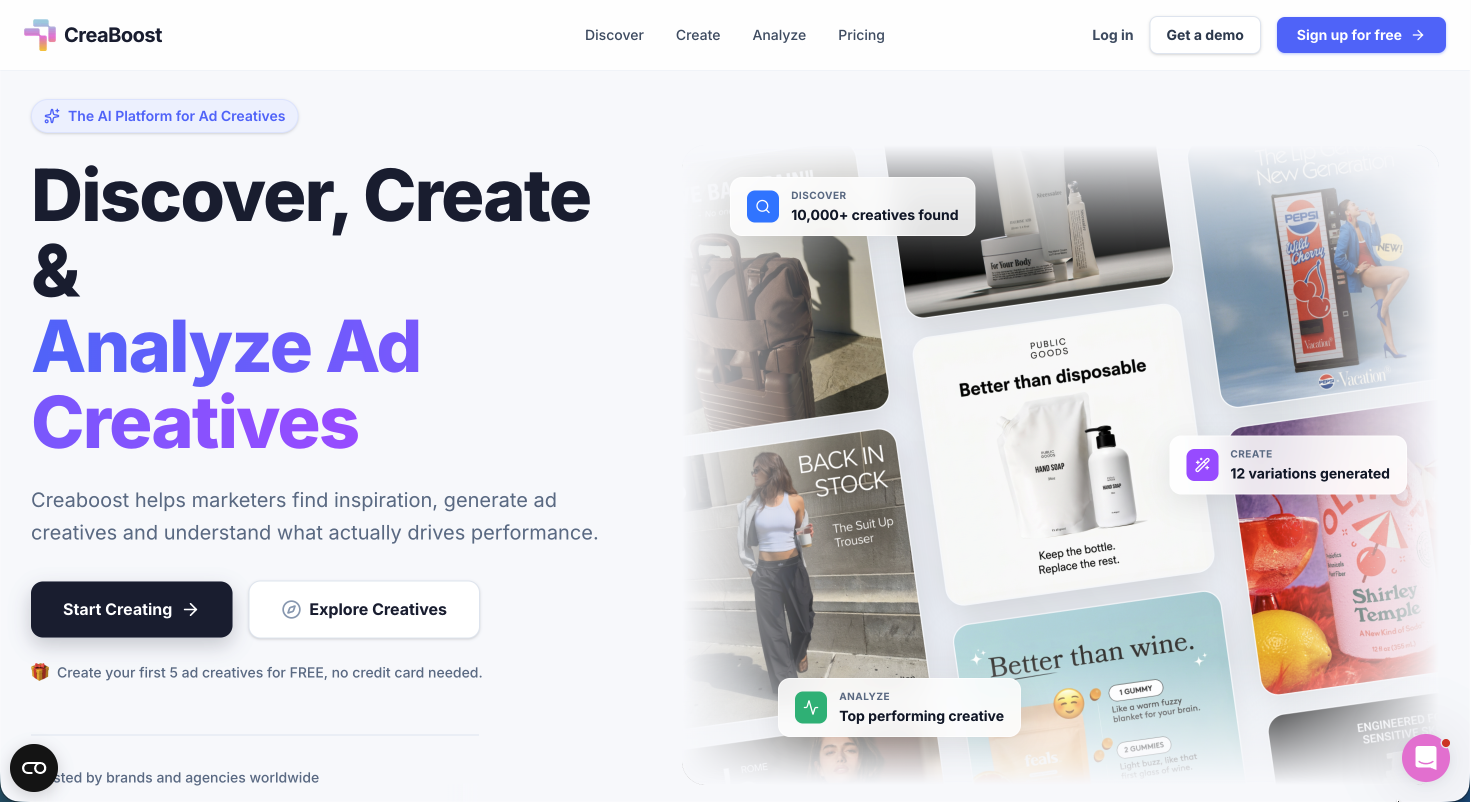
The vendor reports CreaBoost is used by more than 10,000 brands and agencies worldwide. It combines trend discovery, AI creative generation, and centralized campaign analytics to help teams reduce wasted ad spend and find winning concepts faster.
CreaBoost positions itself against the specific pain in Meta Ads: bidding and targeting are automated, but creative pipelines break down. The product aims to close that gap across discovery, production, analysis, and operations.
Core Features
- Discover trending ad concepts and benchmark competitors to start briefs from real patterns rather than a blank page.
- Create AI-generated creatives from product URLs with automated resizing and platform-ready outputs for Meta and TikTok formats.
- Analyze campaign performance across channels and auto-tag creatives by format, hook, angle, and concept for cohort-level ROAS signals.
- Automate variation batches and edits so designers aren’t the throughput bottleneck.
- Centralized dashboard that pulls performance and creative metadata into one place for faster decision cycles.
Key Differentiator
The single workflow from discovery through production to analytics and operations is what separates CreaBoost. Rather than stitching separate tools together, it keeps inspiration, creative generation, and performance tagging inside one system so teams can move from hypothesis to scaled testing without manual handoffs.
Pros
- Rapid production: turning product pages into multiple platform-ready creatives cuts designer round-trips and increases test velocity.
- Measurement-first tagging: the auto-tagging by hook and concept prevents impression volume from masquerading as performance; you see cohort-level ROAS quickly.
- Operational tooling: bulk upload, a Naming Convention Engine, and automation rules reduce the weekly manual grind for optimizers.
- Trial availability: there is a free trial with no credit card required, which lowers the barrier to try workflows before committing.
Cons
- Requires live connections to your ad platforms for full functionality; without those integrations the analytics and automation features are limited.
Who It's For
Marketing teams, performance advertisers, and agencies that run high-volume social campaigns and need to scale creative testing. If your media strategy depends on rapid hypothesis cycles and you have ad accounts to connect, CreaBoost fits the operational profile.
Unique Value Proposition
The vendor advertises that the Create flow can turn a product URL into dozens of platform-ready static ads in minutes. That speed changes how you staff creative cycles: fewer designer handoffs, more rapid A/B tests, and faster identification of winners you can scale before fatigue sets in.
Real World Use Case
A mid-size agency uses CreaBoost to generate hundreds of ad variations from client product pages, auto-tag creatives by angle, and surface the top cohorts in the dashboard. The team pauses low-performing concepts automatically and reassigns spend to cohorts driving the best ROAS.
Pricing
Pro Plan starts at $127 per month when billed annually ($1,524). Additional capacity and enterprise add-ons are available for teams that need higher volume processing and account automation. A free trial is offered without a credit card.
Website: https://creaboost.com
Uplifted

At a Glance
Uplifted converts raw footage into scene level clips and then ties those moments directly to ROAS and CTR so you can find which second of a creative actually moves the needle. The platform links ad accounts, cloud storage, and performance data into one searchable hub.
Core Features
- Connected asset library that pulls from ad accounts, drives, and raw footage for a single source of truth.
- Automatic segmentation that slices video into scenes and tags each moment for fast reuse.
- Performance linking which attaches ROAS, CTR, and other metrics to creative elements for cohort analysis.
- AI-powered briefs and brainstorming tools that generate direction grounded in past performance.
- Searchable, performance-aware creative library for rapid iteration across markets.
Key Differentiator
What stands out is the combination of scene level segmentation with direct performance tagging. Uplifted does not just store assets; it transforms a library into an actionable dataset so your creative hypotheses start from measurable patterns rather than gut feeling.
Pros
- Integrates DAM, analytics, and briefing into a single workflow which reduces handoffs between teams and speeds iteration cycles.
- AI-driven organization cuts manual tagging time and surfaces clips you would otherwise miss when combing folders.
- Multi-language support helps global teams keep creative consistent while testing localized variations across markets.
- Performance-aware search lets media buyers pull assets that have demonstrable ROAS history rather than guessing from view counts.
- Tiered pricing covers teams from solo producers to established agencies so you can scale seats without surprises.
Cons
- Third-party buyer feedback is sparse; independent reviews and case studies are limited which makes vendor claims harder to validate.
- The breadth of features and AI tooling brings a learning curve; teams will need to invest time in governance and naming conventions.
- Pricing details require digging or contacting sales for precise enterprise quotes which slows procurement for some buyers.
Who It's For
Marketing teams and creative agencies that produce large volumes of ad content and want to tie creative elements directly to performance metrics. Best for groups that can dedicate a few weeks to onboarding and taxonomy setup to get the most from the AI features.
Real World Use Case
A multinational brand connects its ad accounts and cloud footage to Uplifted. The tool automatically segments product videos into key moments, links those moments to campaign ROAS, and generates briefs that instruct local teams which hooks to test next — reducing guesswork across five markets.
Pricing
Free tier available for basic use. Paid plans are Starter at $99 per month, Core at $299 per month, and Growth at $499 per month. The vendor offers multiple tiers to match team size and feature needs.
Website: https://uplifted.ai
Wider
At a Glance
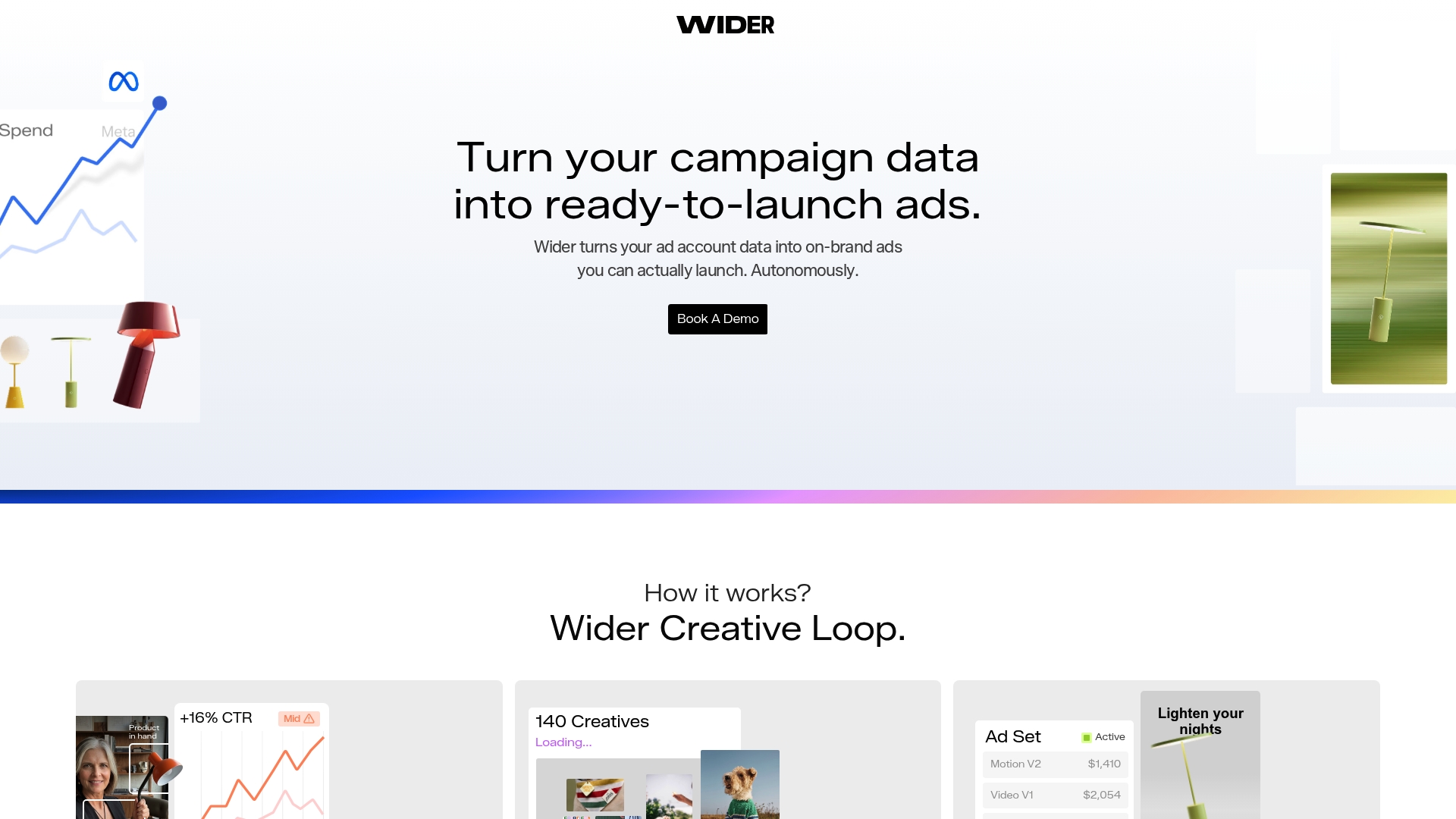
Wider's marketing materials state it can generate over 140 ad variations automatically from an account's historical data, a claim that frames its volume-first approach. The platform reads past campaigns to produce and launch new creatives with the stated goal of improving ROAS and lowering CPA.
Core Features
- Analyzes ad account history to surface winning creatives, audiences, and formats.
- Generates new creatives from proven patterns rather than blank‑slate templates.
- Automates launch, A/B testing, and continuous optimization across campaigns.
- Scales creative output — the vendor advertises the ability to create over 140 variations — and runs real‑time learning loops to iterate performance.
Key Differentiator
Wider builds new ads using actual ad account performance data rather than generic creative templates. That approach aims to reduce guesswork by turning historical signals into hypothesis-ready variations you can test and scale quickly.
Pros
- Data-rooted generation reduces speculative briefs and speeds iteration. Teams get variations that follow prior winners rather than starting from a mood board.
- Automation of launch and optimization cuts manual management time for high-volume campaigns and keeps tests running continuously.
- Integrates directly with ad accounts, so creative variants can be produced and deployed without a separate asset pipeline.
- Continuous learning means the system reweights creative sets as performance shifts, which helps catch fatigue earlier than manual checks.
- Designed to support multiple industries, including e-commerce, gaming, fintech, mobile apps, and SaaS, per the vendor.
Cons
- Limited third-party validation; the platform has few public user reviews and case studies available beyond vendor materials.
- Teams that require highly bespoke creative treatments or agency-style art direction may find the automation constraining.
- The automation model requires correct account setup and an initial learning period for the system to read useful signals.
When It May Not Fit
If your team relies on handcrafted, campaign-specific creative where designer control is nonnegotiable, Wider's automated generation will feel off. Also avoid it if you need broad community-verified vendor reviews before buying or if your ad accounts lack sufficient historical data for reliable pattern extraction.
Who It's For
Marketing teams running scaled paid social or programmatic campaigns who want to trade manual creative churn for automated variation and testing. Best for brands with established account histories and budgets big enough to benefit from continuous multivariate testing.
Real World Use Case
A fast-growing e-commerce brand connects its ad account, lets Wider analyze past winners, and receives hundreds of on‑brand variants to test. Over time the brand reduces manual design cycles and focuses creative hypotheses on concepts the system surfaces from historical wins.
Pricing
Pricing is not specified in public materials; the vendor positions the product like an enterprise or subscription offering. Expect bespoke quotes rather than a self-service per-seat SKU; plan to request a demo and custom pricing during procurement.
Website: https://wider.io
Benly AI
At a Glance
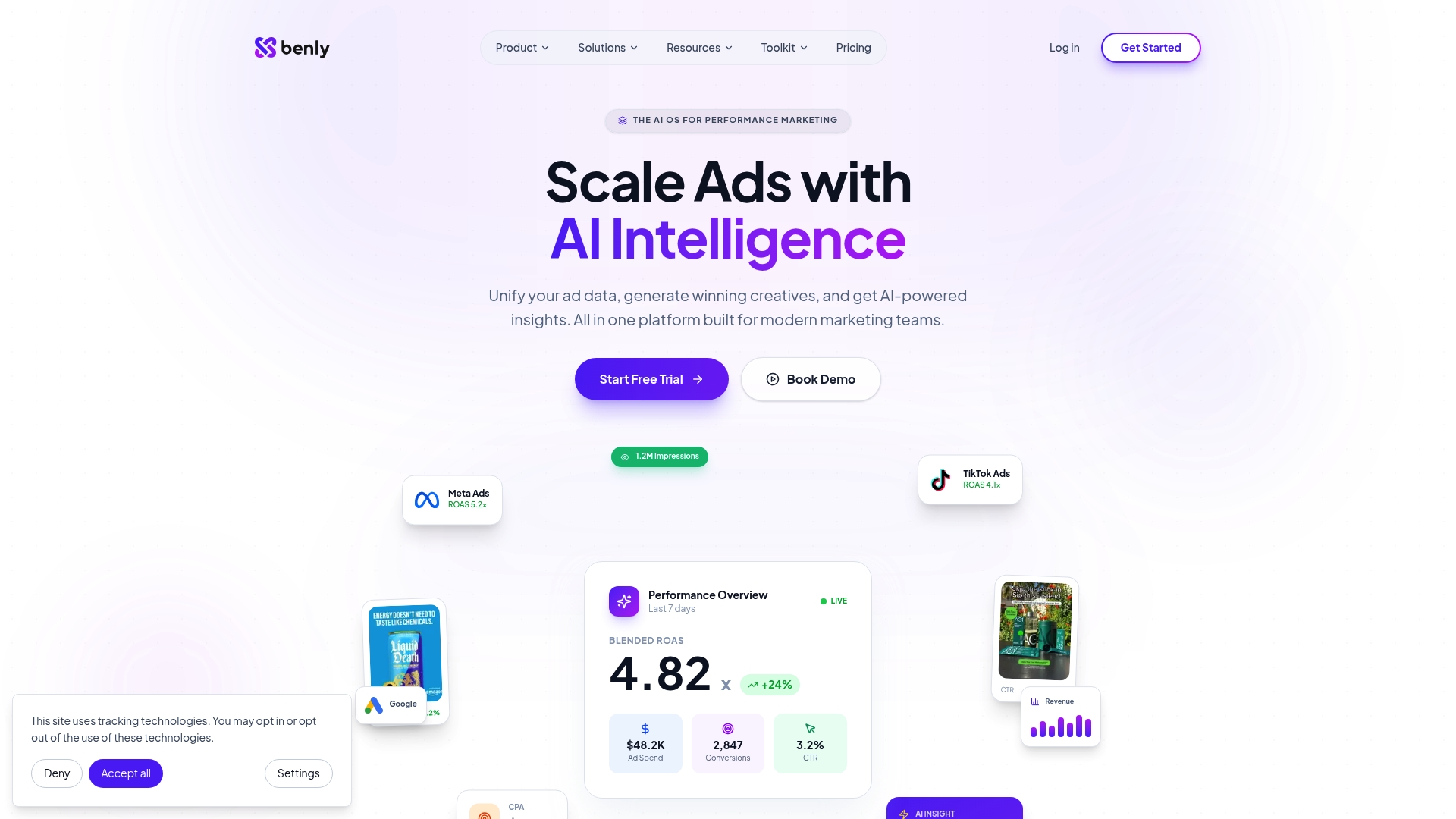
Plans start at $99 per month for freelancers and small teams, with a 7-day free trial and no credit card required to begin. Benly combines unified ad data, AI-driven creative generation, and cross-channel reporting into a single workspace aimed at performance marketers.
Core Features
-
Unified ad data management across Meta, TikTok, and Google to centralize reporting and reduce manual joins.
-
AI Copilot that surfaces performance signals, trend analysis, and suggested optimization steps for ad sets and creatives.
-
Creative Vision for visual element analysis that tags hooks, pacing, and objects inside creative assets.
-
Ad Spy and a competitive library for discovering and collecting peer ads, plus automated creative scaling, budget recommendations, and anomaly detection.
Key Differentiator
Benly's pitch is the all-in-one stack: data unification, AI creative production, and cross-channel analytics under a single pricing model tied to ad spend rather than opaque percentage fees. That positioning serves teams that want fewer tools and an AI layer to generate variations quickly, though it targets operational consolidation more than the deep workflow automation some platforms emphasize.
Pros
-
Centralized reporting reduces the time analysts spend stitching CSVs. Having all three major ad platforms in one dataset speeds up cross-channel comparisons.
-
The creative generation pipeline lets teams produce many variations without constant designer handoffs, which helps keep test velocity high.
-
Ad Spy and the creative library make competitive benchmarking and inspiration collection a single-click activity rather than a scattered research task.
-
Transparent, spend-based pricing can simplify procurement conversations for agencies handling multiple clients and campaigns.
Cons
-
External feedback is scarce; there is limited third-party review data to validate long-term reliability or customer satisfaction.
-
The product data shows no listed integrations beyond the core ad platforms. If you rely on a broader martech stack, you may need custom exports or engineering work.
-
Documentation and user stories are thin in public materials, which raises onboarding risk for teams that need detailed playbooks or managed services.
Who It's For
Digital marketing teams, performance agencies, and in-house advertisers running multi-platform campaigns who want to reduce tool sprawl and generate creative variations with less design overhead. Best for groups willing to trust a single vendor for data, creative, and reporting.
Real World Use Case
An agency connects Facebook, TikTok, and Google accounts, uses Benly to detect creative fatigue early, and auto-generates ten new variations from a top-performing ad. The team applies the platform’s budget recommendations and sees clearer cohort-level ROAS signals in a single dashboard.
Pricing
Benly advertises plans starting at $99 per month for freelancers and small teams, with custom enterprise options available for larger accounts. A 7-day free trial is offered and no credit card is required to start.
Website: https://benly.ai
Comparing Ad Creative Platforms: CreaBoost, Uplifted, Wider, and Benly AI
Making high-quality advertising creatives efficiently is vital for marketing teams. This section compares several platforms to evaluate their strengths and fit for varying needs.
Integration and Workflow Efficiency
CreaBoost excels by providing a unified workflow from creative inspiration to execution and analytics. This system minimizes many manual handoffs. Uplifted, while in asset organization, requires significant setup for its taxonomy to be fully effective, making it better for teams with dedicated resources. Wider focuses on automated variation generation informed by historical data, suitable for high-volume campaigns lacking intensive creative customization. Benly AI promotes streamlined data management across platforms with a centralized, budget-aware model, although it lacks integrations beyond core advertising systems.
Performance-Driven Insights
A well-rounded analysis is critical for measuring effectiveness. CreaBoost integrates context-driven tagging and cohort analysis, ensuring ROAS insights. Uplifted ties scene-level creative details directly to performance metrics like CTR improvements. Benly AI consolidates performance data across platforms within a single dashboard, simplifying comparisons. In contrast, Wider specializes in learning from campaign history to fine-tune future efforts automatically and swiftly, provided sufficient historical data is available.
Best Fit Recommendation
- CreaBoost is highly applicable for teams requiring streamlined workflows, offering effective trend discovery, AI creative generation, and performance analytics in one system.
- Uplifted is an excellent option for multinational teams seeking scene-level performance insights and optimized multilingual creative consistency.
- Wider best serves high-scale advertisers who intend to automate their ad variation processes using data-driven patterns from historical successes.
- Benly AI offers value for smaller teams seeking centralized reporting and cross-channel creative generation under a transparent pricing structure.
Our Pick: CreaBoost
For marketing teams and agencies engaging in high-volume social ad campaigns, CreaBoost proves to be a strong choice, combining creative discovery, expedited production, and analytics in one platform. However, clients requiring highly granular control over aspects like taxonomy may find Uplifted a better fit. This makes CreaBoost is suitable for use cases demanding an integrated, efficient, and rapid creative process.
Ad Creative Management Software Comparison
Explore software solutions for managing ad creative workflows, focusing on platforms that streamline production, analysis, and optimization.
| Product | Core Feature | Key Differentiator | Best For | Pricing | Notable Limitation |
|---|---|---|---|---|---|
| CreaBoost | AI-generated creatives and analytics | Workflow combining discovery, creation, analytics | High-volume social campaign marketing teams | Starting at $127/month | Requires connection to ad platforms for full functionality |
| Uplifted | Scene-level video creative segmentation | Scene-based tagging with direct performance links | Agencies producing extensive video content | Starting at $99/month | Needs dedicated time for taxonomy setup and onboarding processes |
| Wider | Automated generation of ad variations | Uses historical ad data for creating new ads | Large campaigns with established account data | Not disclosed | Limited third-party validation |
| Benly AI | Cross-channel creative and data unification | Unified ad data with AI-driven creative generation | Small to medium performance advertising teams | Starting at $99/month | Few integrations beyond core platforms |
Solve Creative Bottlenecks with Creaboost for aazarshad.com Alternatives
If you are exploring aazarshad.com alternatives, the biggest challenge you face could be managing your creative pipeline for Meta Ads at scale. Common issues include too few creative variations, difficulty spotting top-performing concepts, and wasted budget on fatigued ads. Creaboost addresses these pain points by unifying discovery, creation, analysis, and operational controls into one platform. This cuts down manual handoffs and lets your team ship more ad variations faster while clearly seeing which concepts drive real ROAS.
Take control of your creative workflows today by visiting Creaboost. Plug in your accounts and start turning product URLs into hundreds of platform-ready ads. Then analyze auto-tagged creatives to identify winners early and pause underperformers automatically. Experience the difference of a tighter creative loop and make your next ad campaign more cost-effective and focused.
Frequently Asked Questions
What features does Creaboost offer for rapid creative production?
Creaboost enables fast creative production by turning product URLs into multiple platform-ready ads within minutes. Its ability to generate AI-generated creatives with automated resizing for platforms like Meta and TikTok helps marketing teams test concepts quickly. Consider using Creaboost to streamline your creative workflow and enhance testing speed.
How does Creaboost compare to Uplifted in terms of performance linking?
Uplifted excels at linking creative performance metrics like ROAS and CTR directly to individual scenes in videos. This feature helps teams identify which parts of a creative truly resonate with audiences, yet Creaboost offers a single workflow that simplifies the overall creative process, combining discovery, creation, and analysis. Choose Creaboost if you need a more centralized approach to manage creative tasks efficiently.
Which platform automates tagging in campaign analysis?
Creaboost automates the tagging of creatives by format, hook, and concept, allowing for faster cohort-level ROAS analysis. This automated tagging system helps avoid the confusion of manual labeling, improving overall efficiency in performance tracking. If quick insights and streamlined operations are priorities for your team, consider adopting Creaboost.
Does Creaboost require live connections for full functionality?
Creaboost does require live connections to your ad platforms to access its full suite of analytics and automation features. Without these integrations, the product's capabilities can be somewhat limited, making it important to ensure compatibility with your existing ad accounts before getting started. Think about setting up your ad connections first to unlock the full potential of Creaboost.
What is Creaboost's pricing model for the Pro Plan?
Creaboost's Pro Plan starts at $127 per month when billed annually, totaling $1,524 per year. This pricing structure provides access to advanced features for teams looking to conduct high-volume tests in social campaigns. If you want to experience its capabilities, you can take advantage of the free trial, which does not require a credit card.