
Ad testing is the practice of systematically evaluating different creative strategies, messaging approaches, and ad elements to identify what drives the highest return on paid media spend. The complete list of ad testing methods for Meta and TikTok performance marketers includes concept testing, A/B testing, multivariate testing, holdout and incrementality testing, geo-based testing, and pre-launch survey research. Each method serves a distinct purpose in your optimization cycle. The most effective campaigns use all of them in sequence, not interchangeably. Tools like Meta's Conversion Lift, TikTok's built-in split test feature, and SurveyMonkey give you the infrastructure to run each type with statistical confidence.
1. The primary list of ad testing methods for Meta and TikTok
Performance marketers use six core categories of ad testing techniques. Understanding where each fits in your workflow determines whether you get clean data or expensive noise.
Concept testing evaluates fundamentally different messaging approaches against each other. You are not tweaking a headline. You are asking whether a social proof angle outperforms a problem-solution angle at the story level. This is the highest-leverage test you can run because it shapes every execution decision that follows.

A/B testing isolates a single variable between two ad variants delivered simultaneously to randomized audience splits. On TikTok, the platform's native split test tool manages equal budget allocation and simultaneous delivery, which removes the timing bias that kills sequential tests. Testing one variable at a time is the only way to know what actually moved the needle.
Multivariate testing runs multiple element variations simultaneously to identify winning combinations faster. It requires larger audiences and budgets to reach significance, but it compresses your learning timeline when you have enough volume.
Holdout and incrementality testing measures the true lift your ads generate, not just attributed conversions. Meta's Conversion Lift study is the platform-native tool for this. It randomly splits your audience into exposed and holdout groups, then compares conversion rates between them.
Geo-based incrementality testing compares matched geographic markets where ads run against markets where they are held out. This isolates ad impact at the market level rather than the user level, which is useful when cookie-based attribution is unreliable.
Pre-launch survey testing validates messaging and emotional resonance before you spend a dollar in-market. SurveyMonkey and similar tools let you test ad concepts with panels before committing budget. Combining survey testing with in-market A/B tests reduces the risk of scaling an underperforming ad by validating messaging early and confirming performance live.
Pro Tip: Build your testing calendar so concept tests always precede element tests. Running element tests on a losing concept is the most common way performance teams waste their monthly testing budget.
2. How concept testing differs from element testing
Concept testing evaluates fundamentally different messaging approaches, while element testing optimizes variations within a proven concept. Treating them as the same thing is what causes most teams to iterate endlessly without improving results.
The sequence matters more than the individual tests. Run concept tests first to find the story that resonates, then run element tests to sharpen the execution. Reversing that order means you are polishing an ad that was never going to work.
Here is how to structure the two phases in practice:
- Concept phase: Test three to five distinct messaging angles simultaneously. On TikTok, hook archetypes like problem-agitation, social proof, and pattern-interrupts are the standard starting points. On Meta, test benefit-led versus fear-of-missing-out versus authority-based angles. Run each for at least seven days with equal budget splits before reading results.
- Element phase: Once a concept wins, test the variables within it. On TikTok, move through format, CTA, audio, and audience targeting in sequence. On Meta, test static versus video, headline copy, and primary text variations one at a time.
- Scaling phase: Promote the winning element combination to your main campaign. Keep one or two challenger variants running at low budget to catch fatigue early.
The recommended duration for concept tests on Meta is two weeks minimum with enough budget to generate at least 50 conversions per variant. On TikTok, 50 conversions per variation is the threshold for declaring a winner at 90% confidence. Calling a winner before hitting that threshold is the single most common cause of bad scaling decisions.
Pro Tip: On TikTok, a phased three-week calendar works well: week one for hook testing, week two for format and CTA testing, week three for scaling the winner. This structure keeps your learning compounding rather than starting over each cycle.
3. Operational rules and thresholds for ad testing
Platform-specific guardrails determine whether your test results are trustworthy. Ignoring them produces data that feels conclusive but leads you in the wrong direction.
For Meta incrementality testing, the operational requirements are specific. Meta's Conversion Lift study runs two to four weeks and requires approximately $50,000 in spend and 300 or more conversions for statistical significance. That threshold exists because smaller tests produce confidence intervals too wide to act on. If your campaign does not meet those minimums, your lift measurement is noise, not signal.
For TikTok split tests, the rules are equally firm:
- Run tests for a minimum of seven days. TikTok's delivery algorithm needs time to exit the learning phase before results stabilize.
- Reach at least 50 conversions per ad variation before declaring a winner. Calling it at 20 conversions feels efficient but produces wrong conclusions more than half the time.
- Never make optimization decisions during the learning phase. Budget changes, bid adjustments, or creative swaps during this window reset the algorithm and corrupt your data.
- Control for one variable per test. TikTok's native split test tool enforces this by design, but custom tests in Ads Manager do not. You have to enforce it yourself.
Meta's incrementality tests also require careful sizing based on expected conversion volume, not just budget. Holdout groups can convert from non-ad factors like organic search or direct traffic, which compresses your measured lift. Sizing your test based on conversion rate rather than spend alone gives you a more accurate picture of true incremental impact.
Creative fatigue is the hidden variable that corrupts long-running tests. An ad that was winning in week one may be losing in week three not because the concept is wrong, but because the audience has seen it too many times. Build fatigue checkpoints into every test plan.
4. How geotargeting and media mix modeling complement ad testing
A/B tests and incrementality studies tell you what works within a platform. Geo-based testing and media mix modeling tell you what works across your entire marketing system. Both belong in a mature ad performance evaluation framework.
| Method | What it measures | Best use case | Key tools |
|---|---|---|---|
| Geo holdout testing | Ad impact in matched markets | Cross-channel or offline attribution | Meta GeoLift, Google CausalImpact |
| Media mix modeling | Channel contribution from historical data | Budget allocation across channels | Meta Robyn, Google Meridian |
| Platform A/B testing | Single variable impact within one platform | Creative and audience optimization | Meta Experiments, TikTok Split Test |
| Incrementality testing | True lift versus counterfactual | Measuring real conversion impact | Meta Conversion Lift |
Geo-based incrementality testing compares matched geographic markets with ads running against markets where ads are held out. Meta GeoLift and Google's CausalImpact provide the statistical framework to analyze those comparisons. The practical advantage is that geo tests work even when user-level tracking is limited by privacy restrictions or iOS changes.
Media mix modeling uses regression analysis of historical spend and revenue data to estimate each channel's contribution. Meta's open-source Robyn framework and Google's Meridian use Bayesian methods and automated tuning to make MMM more accessible to performance teams without data science resources. MMM is not a replacement for in-platform testing. It is the layer above it that tells you how much of your total revenue growth is attributable to paid social versus other channels.
The practical integration looks like this: run platform A/B tests to optimize creative execution, use incrementality tests to validate that your Meta or TikTok campaigns are generating real lift, and use MMM quarterly to confirm that your channel mix is allocated correctly. Each method answers a different question. Using only one of them leaves significant blind spots.
5. Practical steps to implement effective ad testing
Effective ad testing strategies require a structured workflow, not just a list of methods. Here is how to build one that compounds learning over time.
- Write a hypothesis before every test. "We believe a social proof hook will outperform a problem-agitation hook because our audience responds to peer validation" is a testable hypothesis. "Let's try a different hook" is not. Hypotheses force clarity and make post-test analysis faster.
- Allocate budget intentionally between testing and scaling. A common practice among performance teams is reserving 20% of campaign budget for active tests and 80% for scaling proven winners. Adjust that ratio based on how saturated your current creative pool is.
- Use pre-launch survey data to filter concepts before spending in-market. Surveying a panel on emotional resonance and message clarity before running a paid test eliminates concepts that were never going to work, which saves both budget and time.
- Tag every creative by concept, hook type, format, and CTA at launch. Tagging discipline is what separates teams that learn from tests from teams that just run them. Without consistent tagging, you cannot aggregate results across campaigns or identify patterns at the concept level.
- Set a decision date before the test starts. Checking results daily and making early calls is how confirmation bias corrupts your data. Commit to a review date that aligns with your platform's minimum thresholds, then stick to it.
- Iterate winners, do not just repeat them. A winning concept should generate three to five element variations before you move to a new concept. Milking a winner through systematic element testing is more efficient than constantly testing new concepts from scratch.
Pro Tip: Check out the ad creative best practices that consistently lift ROAS on Meta and TikTok. The most durable insight is that creative fatigue is almost always the cause when a previously strong ad starts underperforming, not audience saturation.
Key takeaways
The most effective ad testing strategy sequences concept tests before element tests, enforces platform-specific thresholds, and integrates geo-based and MMM methods for full-funnel measurement.
| Point | Details |
|---|---|
| Sequence your tests | Run concept tests first to find the winning story, then use element tests to refine execution. |
| Respect platform thresholds | Meta needs 300+ conversions and $50k spend; TikTok needs 50 conversions per variant over 7 days. |
| Combine survey and in-market testing | Pre-launch surveys filter weak concepts before you spend budget on live tests. |
| Use geo and MMM for full-funnel view | Platform A/B tests optimize creative; geo holdouts and MMM measure true cross-channel impact. |
| Tag everything at launch | Consistent creative tagging is what turns individual test results into compounding strategic knowledge. |
Why most ad testing frameworks break down before they scale
The teams I see struggle most with ad testing are not the ones running too few tests. They are the ones running tests without a clear distinction between what they are testing and why. Concept tests and element tests get merged into a single "creative testing" bucket, which means neither produces clean data. A team runs five ads simultaneously, calls the winner after three days, scales it, and wonders why performance collapses in week two.
The other pattern I see constantly is over-reliance on platform attribution without any incrementality layer. Meta's reported ROAS and TikTok's conversion numbers are not the same as true incremental lift. They include conversions that would have happened anyway. Until you run a proper holdout test, you do not actually know how much of your reported performance is real.
The emerging shift in 2026 is toward tighter creative fatigue management as a first-class testing discipline. Most teams treat fatigue as something they notice after the fact. The better approach is to build fatigue detection into your testing cadence from the start, monitoring frequency and engagement rate decay as leading indicators rather than waiting for CPA to drift visibly.
Blending survey-based pre-testing with structured in-market experimentation is the framework that holds up at scale. Neither method alone is sufficient. Together, they give you both directional confidence before you spend and empirical confirmation after you do. That combination is what separates teams that consistently find winners from teams that occasionally stumble onto them.
— Bythewise
How Creaboost closes the gap between testing and scaling
Running a disciplined ad testing program generates a lot of data. The problem most performance teams face is not a shortage of test results. It is the inability to act on them fast enough before creative fatigue sets in or a winner gets missed.
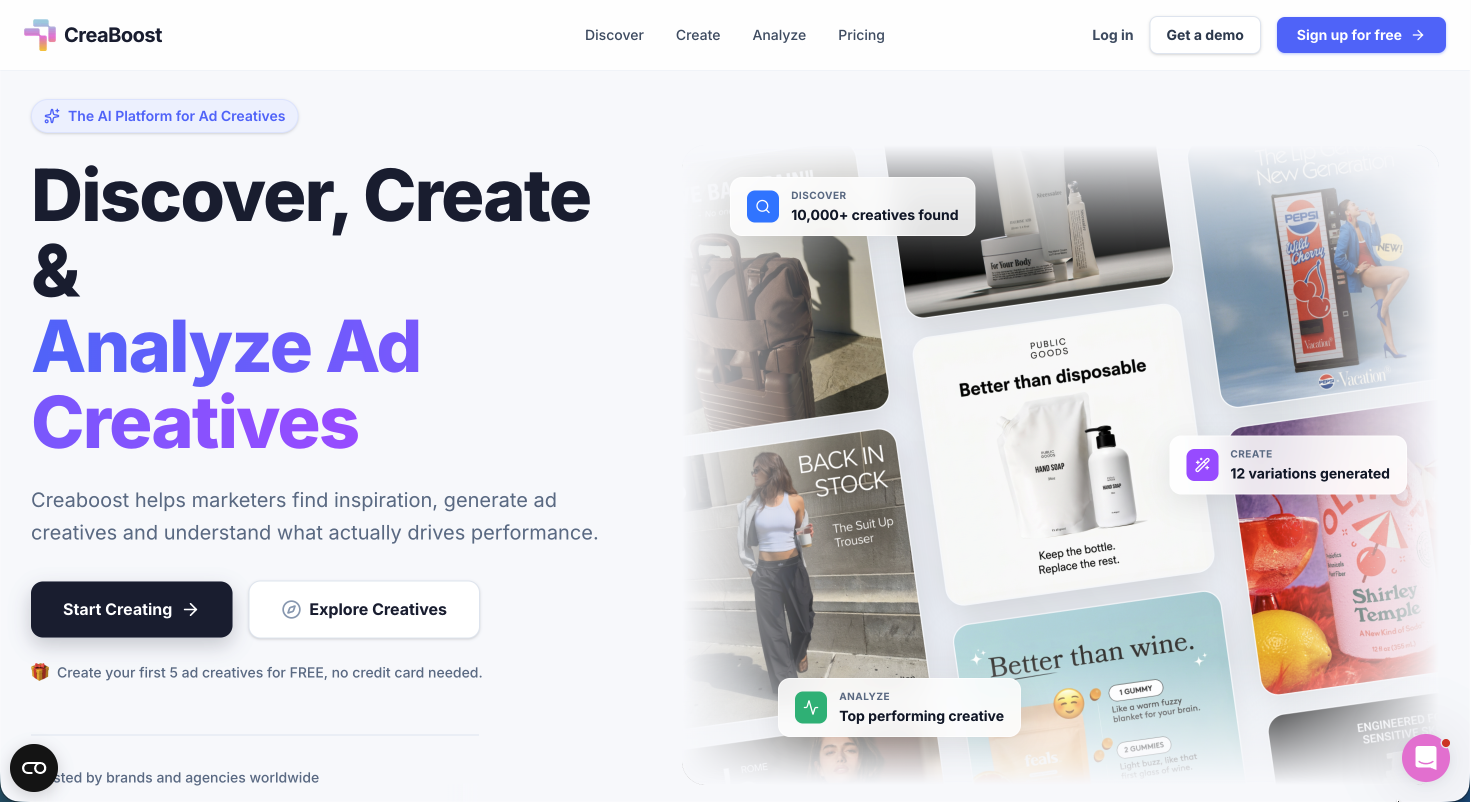
Creaboost's creative performance analytics auto-tags every creative by hook, format, angle, and concept the moment it goes live, so your test results are always organized and comparable across campaigns. When a concept wins, the AI creative generation tool lets you spin up element variations in minutes rather than days, keeping your testing pipeline moving without bottlenecking your design team. For performance marketers running Meta and TikTok at scale, explore how Meta and TikTok campaign tips integrate with Creaboost's workflow to tighten your creative loop.
FAQ
What is the difference between concept testing and A/B testing?
Concept testing compares fundamentally different messaging strategies against each other, while A/B testing isolates a single variable within a proven concept. Run concept tests first to find the winning story, then use A/B tests to optimize its execution.
How long should a TikTok split test run?
TikTok split tests require a minimum of seven days and at least 50 conversions per ad variation before you can declare a winner at 90% confidence. Calling results earlier produces unreliable data due to algorithm volatility during the learning phase.
What spend is required for Meta's Conversion Lift study?
Meta's Conversion Lift study requires approximately $50,000 in spend and 300 or more conversions over a two to four week period to reach statistical significance. Tests below those thresholds produce confidence intervals too wide to act on.
What is media mix modeling and when should I use it?
Media mix modeling uses regression analysis of historical spend and revenue data to estimate each channel's contribution to total revenue. Use it quarterly alongside platform-level incrementality tests to validate your overall channel budget allocation.
Should I use pre-launch surveys or in-market tests?
Use both. Pre-launch surveys validate messaging and emotional resonance before you spend budget, while in-market A/B tests confirm actual consumer response. Combining the two methods reduces the risk of scaling an ad that performs well in research but fails in the real market.