

Pouring more budget into ads and hoping results follow is one of the most expensive mistakes in digital advertising. Performance marketing flips that logic entirely. Instead of paying for exposure and crossing your fingers, you pay for outcomes: clicks, leads, purchases, installs. Every dollar is accountable. Every campaign is measurable. This guide breaks down exactly what performance marketing is, how it works across channels like Meta, TikTok, and Google, where measurement gets complicated, and what separates teams that consistently scale from those stuck in a cycle of wasted spend and guesswork.
Table of Contents
Key Takeaways
| Point | Details |
|---|---|
| Performance means measurable results | Every action in performance marketing ties spend to direct business outcomes such as clicks, leads, or sales. |
| Success needs more than tactics | Disciplined weekly optimization, creative refresh pipelines, and careful measurement outperform set-and-forget strategies. |
| AI and automation aren’t autopilot | Human oversight and high-quality creative assets are crucial to making automated tools deliver results and avoid pitfalls. |
| Adapt fast to platform changes | Outcomes depend on channel-specific tactics and quickly responding to privacy rules and behavioral shifts. |
Defining performance marketing: Beyond just paid media
Performance marketing is advertising driven by measurable outcomes. You set a specific action you want users to take, build campaigns designed to drive that action, and pay based on results rather than reach. That action might be a purchase, a form submission, an app install, or a subscription sign-up. The defining feature is accountability: if the campaign doesn’t produce the outcome, you know it immediately and can act on it.
This is fundamentally different from traditional brand marketing, which prioritizes visibility and long-term perception over short-term conversion. Brand campaigns measure impressions, share of voice, and brand lift surveys. Performance campaigns measure cost per acquisition, return on ad spend, and conversion rate. Neither approach is wrong, but they serve different goals on different timelines.
Here’s a quick comparison to make the distinction concrete:
| Dimension | Performance marketing | Brand/growth marketing |
|---|---|---|
| Primary goal | Measurable action (purchase, lead, install) | Awareness, perception, long-term loyalty |
| Timeline | Short-term, campaign-level | Long-term, brand-level |
| Success metric | CPA, ROAS, CVR, CPL | Impressions, brand recall, NPS |
| Budget model | Pay per result or optimized bidding | Fixed media buys, CPM |
| Feedback loop | Days to weeks | Months to years |
| Channels | Paid search, social ads, affiliate, programmatic | TV, OOH, sponsorships, content |
Some practitioners define performance marketing narrowly as paid media only: search ads, social ads, affiliate, and programmatic display. Others see it as a broader management system that also includes retention marketing, lifecycle experiments, and conversion rate optimization. Both definitions have merit. What matters is that every activity within the system is tied to a measurable outcome and subject to continuous optimization.
The channels most commonly associated with performance marketing today include:
-
Paid search: Google and Microsoft Ads, where intent signals are strong and purchase-ready audiences are reachable
-
Paid social: Meta (Facebook and Instagram), TikTok, Pinterest, and Snapchat, where targeting and creative drive cold audience acquisition
-
Affiliate marketing: Partner-driven traffic where you pay only on confirmed conversions
-
Programmatic display: Automated ad buying across publisher networks, optimized toward conversion signals
“Core methodologies include setting clear objectives, selecting channels like paid search, social ads (Meta, TikTok), affiliate, programmatic; tracking conversions with pixels/server-side; optimizing via A/B testing, bid adjustments, creative refreshes, and AI-driven automation.” Source
What ties all of these together is the feedback loop. You launch, you measure, you optimize, you repeat. That cycle is the engine of performance marketing, and the speed at which you run it determines how fast you grow.
Core methodologies and channels for modern campaigns
With the basics defined, let’s dig into exactly how performance marketing works in practice and what channels teams rely on today.
Launching a high-impact performance campaign isn’t just about picking a platform and setting a budget. It follows a structured process that most winning teams repeat consistently:
-
Define your objective clearly. Are you optimizing for purchases, leads, or app installs? Your objective shapes every downstream decision, from bidding strategy to creative format.
-
Select the right channel for your audience. Younger demographics respond to TikTok’s native video format. Older, higher-intent buyers convert well on Meta and Google Search.
-
Set up conversion tracking before you spend a dollar. This means implementing pixels, configuring server-side events, and verifying that your data is flowing correctly into your ad platform.
-
Build creative variations from day one. Algorithms need options to test. Launching with a single creative is like running a race with one shoe.
-
Let the algorithm learn before you intervene. Most platforms need a statistically meaningful number of conversions before their optimization kicks in properly.
-
Analyze performance weekly and iterate. Adjust bids, pause underperformers, refresh creatives, and reallocate budget toward what’s working.
Conversion tracking has become significantly more complex in recent years. Privacy regulations like GDPR and the deprecation of third-party cookies have weakened browser-based pixel tracking. The industry has responded with server-side tracking, which sends conversion data directly from your server to the ad platform rather than relying on a browser cookie. This preserves more signal and improves the accuracy of your optimization data.

AI-driven campaign types have changed how performance teams operate. Google’s Performance Max and TikTok’s Smart+ use machine learning to automate bids, placements, and creative combinations across their respective networks. These tools can dramatically increase reach and efficiency when fed high-quality inputs: clean conversion data, diverse creative assets, and strong audience signals. Without those inputs, automation amplifies mediocrity rather than performance.
| Channel | Strength | Best audience fit | Key optimization lever |
|---|---|---|---|
| Google Search | High purchase intent | In-market buyers | Keywords, match types, bid strategy |
| Meta (Facebook/Instagram) | Retargeting, lookalikes | 25-54 age range | Creative testing, audience segmentation |
| TikTok | Native video, discovery | 18-34 age range | Hook quality, completion rate, UGC |
| Programmatic | Scale, reach | Broad awareness to retargeting | Audience segments, creative rotation |
| Affiliate | Cost-efficient acquisition | Niche, high-intent | Partner quality, offer structure |
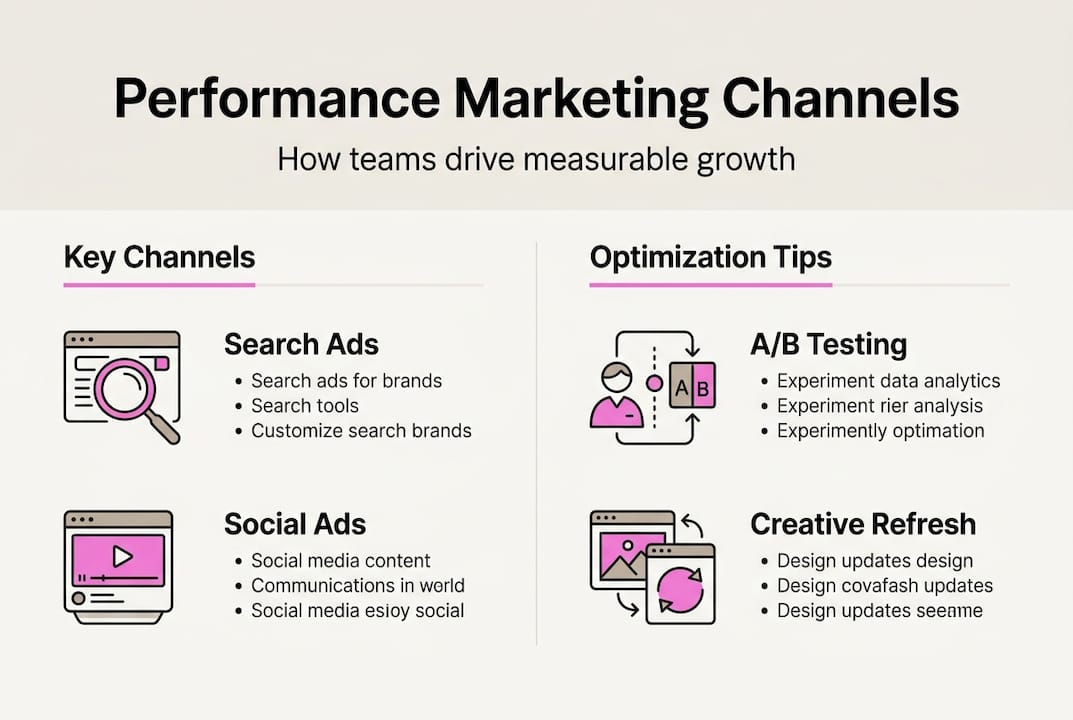
AI creative generation tools are now a competitive advantage for teams that need to keep up with the volume demands of modern algorithms. Meta Andromeda and TikTok Smart Creative reward creative diversity, meaning teams that can produce and test more variations faster consistently outperform those stuck waiting on design cycles.
Pro Tip: Don’t just deploy automation and walk away. AI tools like Performance Max operate as black boxes, which means you need to monitor for signal loss, creative fatigue, and anomalous spend patterns. Pair automation with regular creative performance analysis to stay in control of outcomes.
Measurement, attribution, and the limits of platform data
Effective campaigns aren’t just about launch. They’re about honest measurement and learning. Let’s talk about how best-in-class teams measure what matters.
Here’s an uncomfortable truth: the numbers your ad platforms show you are not the full picture. Meta’s reported ROAS and Google’s conversion counts are calculated using their own attribution models, which are designed to make their platforms look as effective as possible. This doesn’t mean the data is useless. It means you need to triangulate it against other sources before making major budget decisions.
The most common measurement pitfalls include:
-
Attribution overlap: The same conversion gets claimed by multiple platforms simultaneously, inflating reported results across the board
-
View-through attribution: Counting a conversion because someone saw your ad, even if they never clicked, which dramatically overstates platform impact
-
Last-click bias: Giving 100% credit to the final touchpoint ignores the full customer journey
-
Signal loss from privacy changes: iOS updates and cookie restrictions mean platforms are working with incomplete data and filling gaps with modeled estimates
“No single source of truth exists in marketing measurement; platform data often over or understates true impact. Prioritize incrementality over attribution and creative testing over campaign structure.”
Best-in-class teams blend three measurement approaches to get closer to the truth:
-
Platform conversion data for day-to-day optimization signals
-
Marketing Mix Modeling (MMM) for understanding the long-term contribution of each channel at a macro level
-
Incrementality testing for proving that your ads actually caused the conversions, not just correlated with them
Incrementality tests work by holding out a portion of your audience from seeing ads and comparing conversion rates between the exposed and unexposed groups. The difference represents the true lift your advertising is generating. This is the gold standard of measurement, but it requires volume and patience to run correctly.
Pro Tip: When scaling spend significantly, run a geo-based incrementality test before committing to the increase. Use a third-party measurement tool or your own performance analytics setup to validate results independently from platform-reported data. This one habit can save you from scaling campaigns that look great on paper but aren’t actually driving incremental revenue.
Edge cases and expert tactics for Meta, TikTok, and beyond
Now that we’ve covered the core frameworks, let’s zoom in on edge cases and tactical tips that separate top performers from everyone else.
Privacy constraints are no longer an edge case. They’re the default operating environment. iOS 14.5 and subsequent Apple privacy updates reduced the signal available to Meta’s pixel by a significant margin, and similar restrictions are rolling out across Android and web browsers. The practical response is a two-part approach: implement server-side tracking through the Conversions API (CAPI) for Meta or server-side tagging via Google Tag Manager, and accept that some portion of your measurement will always be modeled rather than observed.
Modeled conversions are estimates generated by the platform’s machine learning when direct tracking data is unavailable. They’re better than nothing, but they introduce uncertainty. The best way to manage this uncertainty is to supplement platform data with your own first-party data: email lists, CRM records, and purchase data from your backend.
For TikTok specifically, the creative requirements are non-negotiable. The platform’s algorithm rewards content that feels native to the feed, not repurposed from other channels. Key tactics include:
-
Hook within the first 1-3 seconds. TikTok users scroll fast. If your opening frame doesn’t stop the thumb, the rest of the ad doesn’t matter.
-
Aim for completion rates above 15-20%. Completion rate benchmarks signal to the algorithm that your content is engaging, which improves distribution.
-
Use authentic UGC-style formats. Polished studio ads underperform against raw, real-feeling content on TikTok.
-
Test multiple hooks on the same offer. The hook is the highest-leverage variable on TikTok. Changing the first three seconds can double your completion rate without touching anything else.
-
Refresh creatives every two to three weeks. Creative fatigue hits faster on TikTok than any other platform because users consume content at a higher frequency.
For Meta campaigns, the learning phase is a critical concept that many advertisers mishandle. Meta’s algorithm needs approximately 50 conversion events per ad set per week to exit the learning phase and optimize effectively. Editing campaigns, changing budgets significantly, or switching creative before this threshold is hit resets the learning phase and wastes the data you’ve already accumulated. Patience during this window pays off in lower CPAs once the algorithm stabilizes.
For automated campaigns like Performance Max, the biggest lever is ad creative best practices. These campaigns pull from your asset library and mix combinations automatically, so the quality and diversity of what you provide directly determines the ceiling of what the algorithm can achieve.
Pro Tip: Build a creative refresh pipeline as a standing process, not a reactive one. Map out a 90-day creative calendar with planned refresh dates, new concept hypotheses, and format variations. Teams that treat creative production as a continuous system consistently outperform those who scramble to replace burned-out assets after the fact.
What most performance marketing guides don’t tell you
Most guides focus on tactics: which platforms to use, what bid strategies to set, how to structure campaigns. What they skip is the operating system underneath those tactics. The teams that consistently win at performance marketing aren’t necessarily using different tools. They’re running a more disciplined process.
The most important habit is weekly optimization cadence. Winning teams reallocate budget, pause underperformers, and launch new creative tests every single week. Not monthly. Not quarterly. Weekly. The compounding effect of 52 optimization cycles per year versus 12 is enormous.
Here are the most common misconceptions beginners bring into performance marketing, and a more accurate way to think about each:
-
“More budget fixes poor performance.” More budget amplifies whatever is already happening. If your creative is weak or your targeting is off, scaling spend makes the problem worse faster.
-
“Automation handles everything.” AI tools handle bidding and distribution. They don’t generate creative strategy, handle regulatory rejections, or interpret signal loss. Human judgment is still the critical variable.
-
“Attribution tells you what’s working.” Attribution tells you a story. Incrementality testing tells you the truth. Use both, but trust the latter more when making major decisions.
-
“Set it and forget it works at scale.” The opposite is true. The higher your spend, the more actively you need to monitor for creative fatigue, audience saturation, and algorithm anomalies.
The marketers who treat performance marketing as a system, not a set of tactics, are the ones who build durable competitive advantages. Creative quality, process discipline, and honest measurement are harder to copy than any campaign structure or bidding strategy.
Take your performance marketing to the next level
Ready to put these insights into action? Here’s how to get started.
The gap between knowing performance marketing principles and executing them at scale comes down to one thing: creative infrastructure. CreaBoost gives performance marketers and eCommerce brands the tools to close that gap fast.
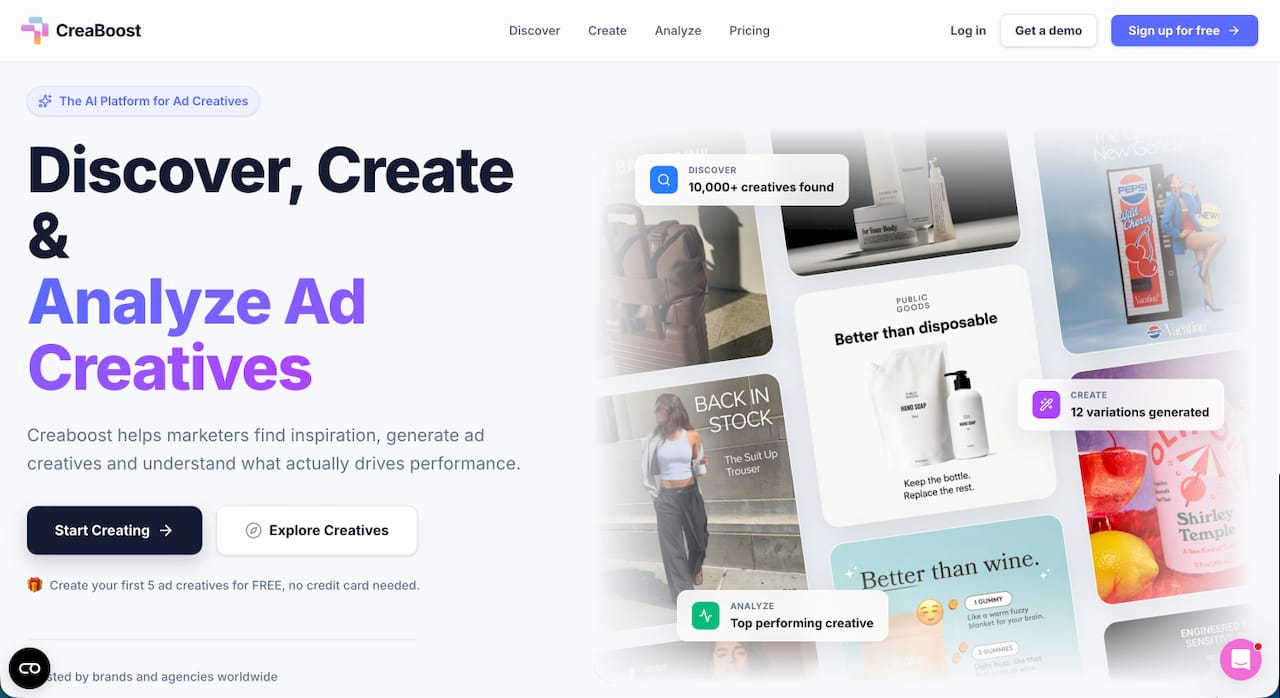
With CreaBoost’s creative analytics tools, you can connect your ad accounts, surface top-performing creatives, detect fatigue before it tanks your ROAS, and auto-tag visuals by type. The AI-powered ad creation module turns a product URL into dozens of platform-ready concepts with batch resizing across every major format. One platform. One source of truth. No more scattered screenshots and design briefs. Check out view pricing plans to find the right fit for your team.
Frequently asked questions
How is performance marketing different from brand marketing?
Performance marketing focuses on direct, measurable actions like clicks or purchases, while brand marketing targets long-term awareness and perception. The core distinction is that performance campaigns optimize for short-term conversion events, whereas brand campaigns optimize for reach and recall over time.
What are the best platforms for performance marketing in 2026?
Meta remains strongest for retargeting and reaching audiences aged 25 to 54, TikTok excels for native video and younger demographics when video hooks are strong, and Google Search captures high-intent buyers actively searching for solutions.
How do privacy regulations impact performance marketing measurement?
Privacy rules have weakened browser-based pixel tracking significantly, pushing teams toward server-side tracking and modeled conversions to maintain measurement accuracy across Meta, Google, and TikTok campaigns.
Is AI automation replacing human marketers in performance campaigns?
AI improves scale and bidding efficiency, but human oversight remains essential for creative strategy, handling regulatory ad rejections, interpreting signal loss, and making judgment calls that algorithms cannot handle on their own.